ESSENTIAL QUESTION:
What role can literature play in shaping American policy?
CONTEXT:
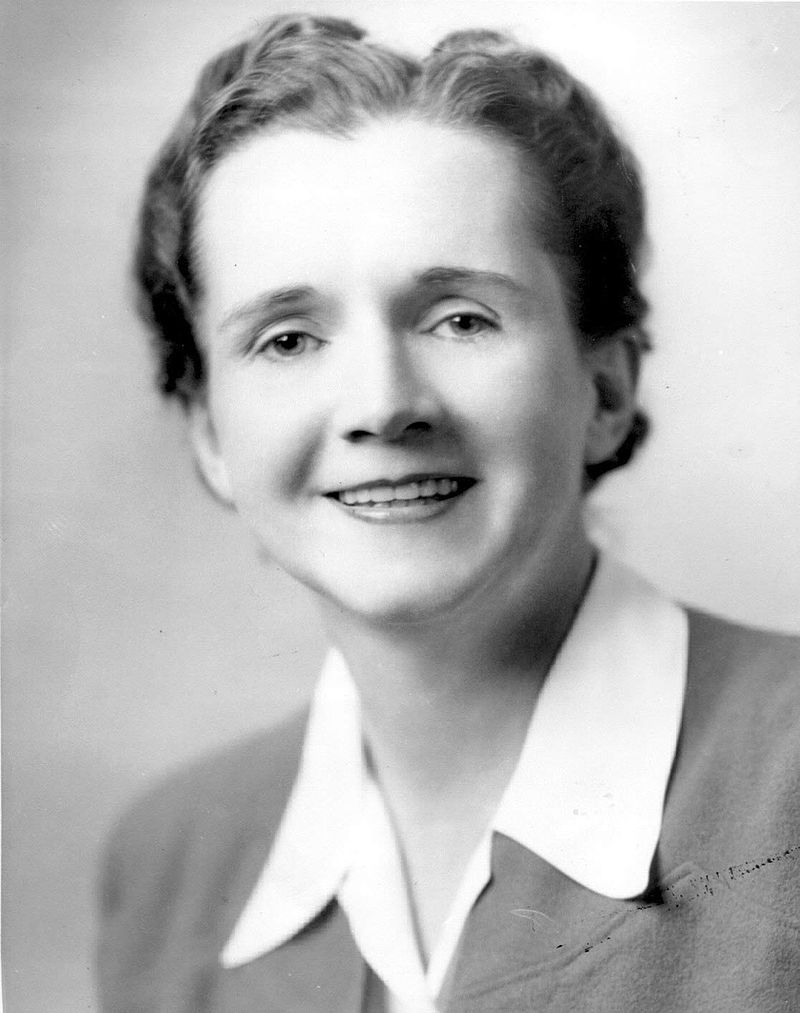
Rachel Carson (1907-1964) was an American conservationist, marine biologist, and writer of several best selling books detailing marine life. In 1962 she published Silent Spring, a book which brought the environmental movement to the attention of the American People by combining scientific research and narrative writing to appeal to a broad audience. She reasoned that widespread use of synthetic pesticides (such as DDT) were harmful in the short and long terms, entering the food chain and threatening humans. Although chemical companies fiercely opposed the work, it brought a change in national pesticide policy and led to a nationwide ban of DDT and other pesticides. The work inspired a grassroots environmental movement, leading to the creation of the US Environmental Protection Agency. Carson died of breast cancer in 1964 at her home in Silver Spring, Maryland.
TEXT:
…There was once a town in the heart of America where all life seemed to be in harmony with its surroundings. The town lay in the midst of a checkerboard of prosperous farms, with fields of grain and hillsides of orchards, where white clouds of bloom drifted above the green land. In autumn, oak and maple and birch set up a blaze of color that flamed and flickered across a backdrop of pines. Then foxes barked in the hills and deer crossed the fields, half hidden in the mists of the mornings. Along the roads, laurel, viburnum, and alder, great ferns and wild flowers delighted the traveler’s eye through much of the year. Even in winter, the roadsides were places of beauty, where countless birds came to feed on the berries and on the seed heads of the dried weeds rising above the snow….
Then, one spring, a strange blight crept over the area, and everything began to change. Some evil spell had settled on the community; mysterious maladies swept the flocks of chickens, and the cattle and sheep sickened and died. Everywhere was the shadow of death. The farmers told of much illness among their families. In the town, the doctors were becoming more and more puzzled by new kinds of sickness that had appeared among their patients. There had been several sudden and unexplained deaths, not only among the adults but also among the children, who would be stricken while they were at play, and would die within a few hours. And there was a strange stillness. The birds, for example—where had they gone? Many people, baffled and disturbed, spoke of them. The feeding stations in the back yards were deserted….
This town does not actually exist; I know of no community that has experienced all the misfortunes I describe. Yet every one of them has actually happened somewhere in the world, and many communities have already suffered a substantial number of them. A grim specter has crept upon us almost unnoticed, and soon my imaginary town may have thousands of real counterparts. What is silencing the voices of spring in countless towns in America?….
It is widely known that radiation has done much to change the very nature of the world, the very nature of its life; strontium 90, released into the air through nuclear explosions, comes to earth in rain or drifts down as fallout, lodges in soil, enters into the grass or corn or wheat grown there, and, in time, takes up its abode in the bones of a human being, there to remain until his death. It is less well known that many man-made chemicals act in much the same way as radiation; they lie long in the soil, and enter into living organisms, passing from one to another. Or they may travel mysteriously by underground streams, emerging to combine, through the alchemy of air and sunlight, into new forms, which kill vegetation, sicken cattle, and work unknown harm on those who drink from once pure wells….. Now, in the modern world, there is no time. The speed with which new hazards are created reflects the impetuous and heedless pace of man, rather than the deliberate pace of nature….
INQUIRY:
- Carson’s first two paragraphs sharply contrast an imaginary town. Why did she start with such an idyllic place? How does this influence the tone of this excerpt?
- Although Carson did not specifically mention DDT in this excerpt, her work led to the banning of the substance. DDT is the short form of dichlorodiphenyltrichloroethane, a colorless, odorless chemical compound. It was used widely during World War II with civilian and military populations to control malaria, typhus and other insect-born diseases. In 1945 it was made available to American farmers to use as an insecticide. But today it is classified as a “probably human carcinogen” by US and international authorities and is banned in the US and most other countries. How did Carson imply the dangers of DDT? What images did she use?
- Compare these first two paragraphs. Why did Carson’s narrative voice (telling a story) convey her message more strongly that a list of scientific facts might have? What imagery did she use?
- The US banned DDT in 1972. This, along with the passage of the Endangered Species Act (1973) were major factors in the recovery of the bald eagle and the peregrine falcon from near extinction. Bald eagles are still protected but are no longer listed as endangered of extinction.; the peregrine falcon is also no longer listed as endangered. Investigate the Endangered Species Act. Which species have been “recovered” so that they were removed from the Endangered Species List? What is the importance of a varied biosphere?
- What is the significance of Carson’s title of this book? In what way is it a metaphor? In what way is it a warning?
- Investigate other works that have changed American policies, such as “Common Sense” (Thomas Paine), Uncle Tom’s Cabin (Harriet Beecher Stowe), The Jungle (Upton Sinclair), or others. Why and in what ways did these works influence Americans and American history?
ADDITIONAL RESOURCES:
https://www.newyorker.com/magazine/1962/06/16/silent-spring-part-1
https://www.history.com/articles/rachel-carson-silent-spring-impact-environmental-movement
 Read Closely