ESSENTIAL QUESTION:
Analyze one of the first cases to establish Native American rights in the US.
CONTEXT:
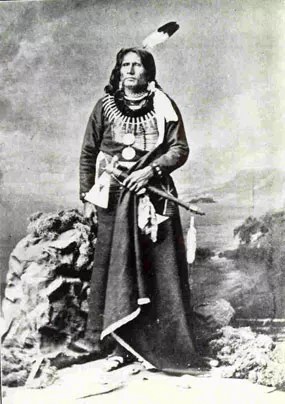
Standing Bear (c.1829-1908) was born on Ponca land in what is now Nebraska near the Niobrara River. By the 1860s he was a tribal leader of the Ponca Tribe, and they faced a desperate situation. In 1858 the Ponca had given up their lands except a small section where they tried to change from buffalo hunters to farmers. By 1868 this property was included in a treaty giving lands to the Sioux; the Sioux began to raid the Ponca lands. The US government then removed the Ponca to Indian Territory (now Oklahoma) in 1877.
The Ponca resisted this move, and many Ponca died in the process. Standing Bear and several followers left the Indian Territory to return to their homeland and were arrested. General George Crook arrested them under orders, even though he sympathized with Standing Bear. They were jailed at Fort Omaha, Nebraska.
In 1879 newspaper editor Thomas Henry Tibbles interviewed Standing Bear and published his story. It went viral quickly. Standing Bear petitioned for his right to return to his home; lawyers volunteered their services and moved to help prevent Standing Bear and his people from being returned against their will to Indian Territory. Federal Judge Elmer Dundy ruled in Standing Bear’s favor.
Standing Bear returned to Nebraska. He later traveled to the eastern states and spoke about Indian rights. He won the support of many prominent Americans, and died at his home of cancer in 1908.
This text is from Judge Dundy’s decision.
TEXT: (NOTE: the term, “Indian” is used as in the original document.)
…The reasoning advanced in support of my views, leads me to conclude:
- That an Indian is a “person” within the meaning of the laws of the United States, and has, therefore, the right to sue out a writ of habeas corpus in a federal court, or before a federal judge, in all cases where he may be confined or in custody under color of authority of the United States, or where he is restrained of liberty in violation of the constitution or laws of the United States.
- That General George Crook, the respondent, being commander of the military department of the Platte, has the custody of the relators, under color of authority of the United States, and in violation of the laws thereof.
- That no rightful authority exists for removal by force any of the relators to the Indian Territory, as the respondent has been directed to do.
- That the Indians possess the inherent right of expatriation, as well as the more fortunate white race, and have the inalienable right to “life, liberty, and the pursuit of happiness,” so long as they obey the laws and do not trespass on forbidden ground. And,
- Being restrained of liberty under color of authority of the United States, and in violation of the laws thereof, the relators must be discharged from custody, and it is so ordered...
INQUIRY:
- What did the Judge mean when he said, “an Indian is a person under the law”?
- In Standing Bear v. Crook, for the first time a Native American was recognized as a person with legal standing in a US federal court. The US government could not hold Native Americans without their consent without legal cause. What part of the US Constitution was addressed by this ruling?
- Before this case Native Americans were considered “wards of the government.” What did that mean? How did this case change that status?
- What is expatriation?
- What is habeas corpus? How was Standing Bear being denied this when he was imprisoned? What part of the US Constitution addresses this right?
- Where did the Judge reference the Declaration of Independence? What was the significance of the use of the term, “inalienable”?
- Investigate the Indian Citizenship Act of 1924. How did the Standing Bear case relate to the 1924 case?
ADDITIONAL RESOURCES:
https://www.nps.gov/mnrr/learn/historyculture/standingbear.htm
 Read Closely