Tag: Cold War

1987: Reagan at the Gate

ESSENTIAL QUESTION:

How did the Berlin Wall represent the Cold War?

CONTEXT:

Ronald Reagan (1911-2004), president of the United States from 1981 until 1989, delivered one of his best known speeches at the Brandenburg Gate, a major historical landmark in Berlin, Germany, on June 12, 1987.

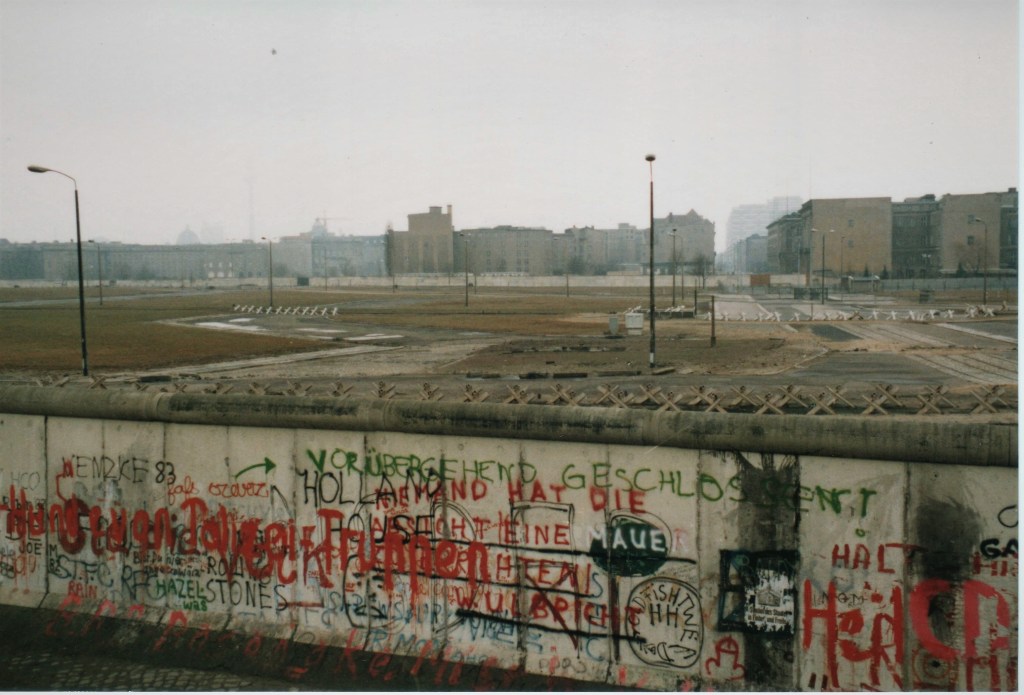
After World War II, Germany was divided into four sectors, each controlled by one of the Allied Forces. Berlin, Germany’s capitol, was also divided. The Soviet Union controlled East Germany and East Berlin, and the Western Allies (US, Great Britain, and France) controlled West Germany and West Berlin. Many East Germans fled to West Berlin to find better economic and political opportunities, and this became a major embarrassment for the East Germans. In 1961 they began building a wall using concrete blocks and wire to prevent this exodus. The 155 kilometer wall surrounded West Berlin, separating families and friends. But escapes to the West continued, and East Berlin strengthened the Wall; escapees could face death if caught. The Wall became a major symbol of the Cold War and the division between Western culture and the Soviets.

Although by the 1980s the Soviet economy was weakening and nationalist movements were arising within the Soviet Union, it would be 1991 before the Soviet Union dissolved. In 1987 President Reagan traveled to Berlin to give this speech, emphasizing the US support for West Berlin and West Germany and pressuring the Soviets to end the division of Berlin and Germany.
TEXT:

…Behind me stands a wall that encircles the free sectors of this city, part of a vast system of barriers that divides the entire continent of Europe. From the Baltic South, those barriers cut across Germany in a gash of barbed wire, concrete, dog runs, and guard towers. Farther south, there may be no visible, no obvious wall. But there remain armed guards and checkpoints all the same–still a restriction on the right to travel, still an instrument to impose upon ordinary men and women the will of a totalitarian state. Yet, it is here in Berlin where the wall emerges most clearly; here, cutting across your city, where the news photo and the television screen have imprinted this brutal division of a continent upon the mind of the world.

Standing before the Brandenburg Gate, every man is a German separated from his fellow men.
Every man is a Berliner, forced to look upon a scar…

…But in the West today, we see a free world that has achieved a level of prosperity and well-being unprecedented in all human history. In the Communist world, we see failure, technological backwardness, declining standards of health, even want of the most basic kind–too little food.
Even today, the Soviet Union still cannot feed itself. After these four decades, then, there stands before the entire world one great and inescapable conclusion: Freedom leads to prosperity. Freedom replaces the ancient hatreds among the nations with comity and peace. Freedom is
the victor.


And now—now the Soviets themselves may, in a limited way, be coming to understand the importance of freedom. We hear much from Moscow about a new policy of reform and openness. Some political prisoners have been released. Certain foreign news broadcasts are no longer being jammed. Some economic enterprises have been permitted to operate with greater freedom from state control.


Are these the beginnings of profound changes in the Soviet state? Or are they token gestures intended to raise false hopes in the West, or to strengthen the Soviet system without changing it? We welcome change and openness; for we believe that freedom and security go together, that the advance of human liberty—the advance of human liberty can only strengthen the cause of world peace.


There is one sign the Soviets can make that would be unmistakable, that would advance dramatically the cause of freedom and peace.
General Secretary Gorbachev, if you seek peace, if you seek prosperity for the Soviet Union and Eastern Europe, if you seek liberalization: Come here to this gate.
Mr. Gorbachev, open this gate.
Mr. Gorbachev—Mr. Gorbachev, tear down this wall!…

INQUIRY:

  1. The Brandenburg Gate in Berlin is located in what was the restricted zone when Berlin was divided. Why do you think Reagan chose the Gate as the site of this speech?
  2. How did Reagan describe the Wall? What tone did those terms convey?
  3. When Reagan used the term “will of a totalitarian state”, to which country was he referring? What is a totalitarian state?
  4. What was the effect of Reagan declaring “…every man is a German, separated from his fellow men. Every man is a Berliner, forced to look upon a scar…”? How did this define Reagan’s audience for the speech?
  5. How did Reagan compare the Communist world and the Free World?
  6. What did Reagan list as the results of freedom?
  7. Did Reagan believer that the Soviets were in the process of making changes? How do you know?
  8. What did Reagan state would be the main sign of changes and the desire for freedom in the Soviet Union?
  9. In what ways did the Berlin Wall represent the Cold War?
  10. The most well known line from this speech is the last one in this excerpt. Why do you think that line would be best remembered?

ADDITIONAL RESOURCES:

https://www.stiftung-berliner-mauer.de/en/topics/berlin-wall

https://www.archives.gov/publications/prologue/2007/summer/berlin.html

1962: JFK and Cuba

ESSENTIAL QUESTION:

In what ways can diplomacy be more effective that physical force?

CONTEXT:

In 1962 the US and the USSR (Soviet Union) were embroiled in the Cold War, a period of intense global tension lasting from 1947 until 1991. Born in the aftermath of World War II amid different views of the future of the world, the US and the Soviet Union (and their respective allies) were intense enemies. Although actual military conflict did not break out as part of the Cold War, competition was keen in several areas. The US wished to contain the spread of Soviet Communism to other countries, and each side developed nuclear weapons with a MAD philosophy. MAD, or mutually assured destruction, meant that each side wanted to develop enough weapons to discourage the other side from firing on them first: if the Soviets fired on the US, the US could retaliate with enough fire power to destroy the Soviet Union. Each side competed to build the first rockets and capsules into space, not only to explore but also to use them to supplement military strategy. The Soviet section of the German capitol of Berlin (from the end of WWII) was walled off from the rest of Berlin (the famous Berlin Wall). Years later the Cold War finally deescalated with the fall of Soviet regimes in the late 1980s, the fall of the Berlin Wall in 1989, and the collapse of the Soviet Union in 1991.

But in 1962 the Cold War had escalated to a flash point, and war between the US and the Soviet Union seemed imminent. On October 14, 1962, an American spy plane photographed nuclear missile launch sites being built in Cuba. Cuba is an island only 90 miles south of Florida, and nuclear missiles launched from there could easily reach the US, Canada, Mexico, and areas throughout the Caribbean. While US President John Kennedy’s military advisors strongly recommended a military response, Kennedy, known as JFK, (1917-1963) chose another course of action. On October 22 he announced the threat to America and his plans to install a blockade around Cuba to prevent any additional construction. However, a blockade is legally an act of war, so Kennedy labeled his action a “quarantine.” While the Soviet Premier Nikita Khrushchev initially refused to remove the weapons and an American pilot was shot down by Cuban soldiers, on October 28 a diplomatic resolution was reached whereby the Soviets removed the missiles from Cuba and the US promised not to invade Cuba and removed missiles they had stationed in Turkey. In addition, a direct line of communication was established between the US and USSR to prevent future misunderstandings.

This text is taken from JFK’s speech to the American people announcing the Crisis. broadcasted on radio and television on October 22, 1962.

TEXT:

This government, as promised, has maintained the closest surveillance of the Soviet military buildup
on the island of Cuba. Within the past week, unmistakable evidence has established the fact that a
series of offensive missile sites is now in preparation on that imprisoned island. The purpose of these
bases can be none other than to provide a nuclear strike capability against the Western Hemisphere.
..

Acting, therefore, in the defense of our own security and of the entire Western Hemisphere, and under the authority entrusted to me by the Constitution as endorsed by the resolution of the Congress, I have directed that the following initial steps be taken immediately:


To halt this offensive buildup, a strict quarantine on all offensive military equipment under shipment to Cuba is being initiated. All ships of any kind bound for Cuba from whatever nation and port will, if found to contain cargoes of offensive weapons, be turned back. This quarantine will be extended, if needed, to other types of cargo and carriers. We are not at this time, however, denying the necessities of life as the Soviets attempted to do in their Berlin blockade of 1948…

It shall be the policy of this nation to regard any nuclear missile launched from Cuba against any nation in the Western Hemisphere as an attack on the United States, requiring a full retaliatory response upon the Soviet Union.

Under the Charter of the United Nations, we are asking tonight that an emergency meeting of the Security Council be convoked without delay to take action against this latest Soviet threat to world peace. Our resolution will call for the prompt dismantling and withdrawal of all offensive weapons in Cuba, under the supervision of U.N. observers, before the quarantine can be lifted.

I call upon Chairman Khrushchev to halt and eliminate this clandestine, reckless, and provocative threat to world peace and to stable relations between our two nations. I call upon him further to abandon this course of world domination, and to join in an historic effort to end the perilous arms race and to transform the history of man. He has an opportunity now to move the world back from the abyss of destruction — by returning to his government’s own words that it had no need to station missiles outside its own territory, and withdrawing these weapons from Cuba — by refraining from any action which will widen or deepen the present crisis — and then by participating in a search for peaceful and permanent solutions. …

My fellow citizens: let no one doubt that this is a difficult and dangerous effort on which we have set out. No one can foresee precisely what course it will take or what costs or casualties will be incurred.
Many months in which both our patience and our will will be tested — months in which many threats
and denunciations will keep us aware of our dangers. But the greatest danger of all would be to do
nothing. …

Our goal is not the victory of might, but the vindication of right — not peace at the expense of freedom, but both peace and freedom, here in this hemisphere, and we hope, around the world. God
willing, that goal will be achieved
.

INQUIRY:

  1. Kennedy used several adjectives in the first paragraph. What is the effect of “closest” surveillance and “unmistakable” evidence? How does this set the tone of the speech?
  2. In Kennedy’s argument how did he affirm the purpose of the Soviet weapons? What phrase did he use?
  3. How did JFK define his quarantine? What items would be prevented from continuing on to Cuba?
  4. Why did JFK reference the Berlin Blockade of 1948? (For more information on that blockade, see https://history.state.gov/milestones/1945-1952/berlin-airlift )
  5. According to JFK, what will be the response of the US should any of the Soviet missiles be launched?
  6. Why did JFK call for an emergency meeting of the UN Security Council? What type of appeal is this (ethos, pathos, logos)?
  7. What did JFK ask Khrushchev to do? Characterize his options as presented by Kennedy.
  8. Why did JFK warn the American people that this would be a “difficult and dangerous” effort? Remember, WWII had ended only 17 years before this speech.
  9. What did JFK clearly state as America’s goal in this crisis? Based on this goal, why do you believe he chose a non-military response first?
  10. Identify the tone of this speech. Does it change? If so, where and how do you know?
  11. Research EXCOMM, JFK’s 12-member advisory committee. What was their role in the Crisis?
  12. Do you believe JFK’s goal had been achieved? Why or why not?

ADDITIONAL RESOURCES:

https://history.state.gov/milestones/1961-1968/cuban-missile-crisis

https://microsites.jfklibrary.org/cmc/

https://www.jfklibrary.org/learn/about-jfk/historic-speeches/address-during-the-cuban-missile-crisis

1961: JFK Inaugural

ESSENTIAL QUESTION

How did John Kennedy use language to defend freedom and encourage Americans to serve their country?

CONTEXT

John Fitzgerald Kennedy (1917-1963) was the 35th President of the United States. Born to an Irish family in Massachusetts, he served in the US Navy during World War II and later served in the US House and Senate. In 1960 he was the youngest man elected to the US presidency and was the first Roman Catholic President of the US. America was in the throes of the Cold War and questions were raised as to whether, considering his youth and background, he would be able to lead the US. This text is from his Inaugural Address on January 20, 1961.

TEXT

We observe today not a victory of party but a celebration of freedom–symbolizing an end as well as a beginning–signifying renewal as well as change. For I have sworn before you and Almighty God the same solemn oath our forbears prescribed nearly a century and three-quarters ago.

The world is very different now. For man holds in his mortal hands the power to abolish all forms of human poverty and all forms of human life. And yet the same revolutionary beliefs for which our forebears fought are still at issue around the globe–the belief that the rights of man come not from the generosity of the state but from the hand of God.

We dare not forget today that we are the heirs of that first revolution. Let the word go forth from this time and place, to friend and foe alike, that the torch has been passed to a new generation of Americans–born in this century, tempered by war, disciplined by a hard and bitter peace, proud of our ancient heritage–and unwilling to witness or permit the slow undoing of those human rights to which this nation has always been committed, and to which we are committed today at home and around the world.

Let every nation know, whether it wishes us well or ill, that we shall pay any price, bear any burden, meet any hardship, support any friend, oppose any foe to assure the survival and the success of liberty…

Finally, to those nations who would make themselves our adversary, we offer not a pledge but a request: that both sides begin anew the quest for peace, before the dark powers of destruction unleashed by science engulf all humanity in planned or accidental self-destruction.

We dare not tempt them with weakness. For only when our arms are sufficient beyond doubt can we be certain beyond doubt that they will never be employed.

But neither can two great and powerful groups of nations take comfort from our present course–both sides overburdened by the cost of modern weapons, both rightly alarmed by the steady spread of the deadly atom, yet both racing to alter that uncertain balance of terror that stays the hand of mankind’s final war.

So let us begin anew–remembering on both sides that civility is not a sign of weakness, and sincerity is always subject to proof. Let us never negotiate out of fear. But let us never fear to negotiate.

Let both sides explore what problems unite us instead of belaboring those problems which divide us…

In the long history of the world, only a few generations have been granted the role of defending freedom in its hour of maximum danger. I do not shrink from this responsibility–I welcome it. I do not believe that any of us would exchange places with any other people or any other generation. The energy, the faith, the devotion which we bring to this endeavor will light our country and all who serve it–and the glow from that fire can truly light the world.

And so, my fellow Americans: ask not what your country can do for you–ask what you can do for your country.

My fellow citizens of the world: ask not what America will do for you, but what together we can do for the freedom of man…

INQUIRY

  1. Kennedy’s election in 1960 was controversial for several reasons: he was much younger than previous presidents and he was the first Roman Catholic to be elected president. How did JFK connect himself to previous presidents?
  2. How did JFK attempt to reduce conflict between political parties? Describe the juxtapositions he uses. ( A juxtaposition places two things close together to contrast them).
  3. How did JFK allude (indirectly suggest) to the atomic bomb?
  4. How did JFK explain that even though America is influenced by the Founding Fathers, times are now different? What imagery did he use?
  5. What is the “torch” that has been passed to “a new generation”?
  6. Describe JFK’s “new generation of Americans.”
  7. What is “the deadly atom”?
  8. How did Kennedy describe America’s responsibility to protect liberty?
  9. Kennedy used juxtaposition (two things placed close together with contrasting effect) several times. Give at least three examples and explain their purposes.
  10. What did Kennedy ask his audience to do?
  11. What is the tone of this speech? Give examples.

ADDITIONAL RESOURCES

jfklibrary.org

https://www.whitehouse.gov/about-the-white-house/presidents/john-f-kennedy/

https://www.archives.gov/milestone-documents/president-john-f-kennedys-inaugural-address