ESSENTIAL QUESTION:
Analyze conditions that contributed to the rise of the Women’s Rights Movement in America.
CONTEXT:
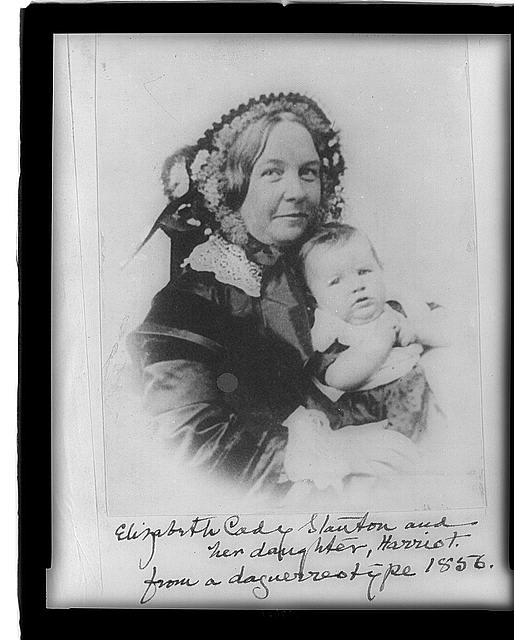
Elizabeth Cady Stanton (1815-1902) was an author, editor, and major influencer in the American women’s rights movement of the 19th century. Born in New York, she was educated at a local boys school and graduated from Troy Female Seminary. Against her family’s wishes she married abolitionist Henry Stanton, and she omitted the vow “to obey” from her marriage ceremony. They moved to Seneca Falls, New York, and began their family, which included seven children.
The responsibilities and frustrations of the home and a woman’s “proper sphere” led Elizabeth along with several friends to call for a convention in 1848 to advocate for the rights of women. Wives and mothers all, they were also temperance and abolitionist reformers and understood discrimination by men and society in general. This was the first American Women’s Rights Convention; 300 people, men and women, attended, and 100 signed the Declaration of Rights and Sentiments. After the Convention Stanton continued as a writer and activist for 19th century reforms. She died of heart failure in 1902.
This text is from the “Declaration of Rights and Sentiments” from the Seneca Falls Convention of July 19-20, 1848.
TEXT:
…We hold these truths to be self-evident; that all men and women are created equal; that they are endowed by their Creator with certain inalienable rights; that among these are life, liberty, and the pursuit of happiness;…
The history of mankind is a history of repeated injuries and usurpations on the part of man toward woman, having in direct object the establishment of an absolute tyranny over her. To prove this, let facts be submitted to a candid world.
- He has never permitted her to exercise her inalienable right to the elective franchise.
- He has compelled her to submit to laws, in the formation of which she had no voice.
- He has withheld from her rights which are given to the most ignorant and degraded men – both natives and foreigners.
- Having deprived her of this first right of a citizen, the elective franchise, thereby leaving her without representation in the halls of legislation, he has oppressed her on all sides.
- He has made her, if married, in the eye of the law, civilly dead.
- He has taken from her all right in property, even to the wages she earns.
- He has made her, morally, an irresponsible being, as she can commit many crimes, with impunity, provided they be done in the presence of her husband. In the covenant of marriage, she is compelled to promise obedience to her husband, he becoming, to all intents and purposes, her master – the law giving him power to deprive her of her liberty, and to administer chastisement.
- He has so framed the laws of divorce, as to what shall be the proper causes of divorce; in case of separation, to whom the guardianship of the children shall be given, as to be wholly regardless of the happiness of women – the law, in all cases, going upon the false supposition of the supremacy of man, and giving all power into his hands.
- After depriving her of all rights as a married woman, if single and the owner of property, he has taxed her to support a government which recognizes her only when her property can be made profitable to it.
- He has monopolized nearly all the profitable employments, and from those she is permitted to follow, she receives but a scanty remuneration.
- He closes against her all the avenues to wealth and distinction, which he considers most honorable to himself. As a teacher of theology, medicine, or law, she is not known.
- He has denied her the facilities for obtaining a thorough education – all colleges being closed against her.
- He allows her in Church as well as State, but a subordinate position, claiming Apostolic authority for her exclusion from the ministry, and with some exceptions, from any public participation in the affairs of the Church.
- He has created a false public sentiment, by giving to the world a different code of morals for men and women, by which moral delinquencies which exclude women from society, are not only tolerated but deemed of little account in man.
- He has usurped the prerogative of Jehovah himself, claiming it as his right to assign for her a sphere of action, when that belongs to her conscience and her God.
- He has endeavored, in every way that he could to destroy her confidence in her own powers, to lessen her self-respect, and to make her willing to lead a dependent and abject life.
Now, in view of this entire disfranchisement of one-half the people of this country, their social and religious degradation, – in view of the unjust laws above mentioned, and because women do feel themselves aggrieved, oppressed, and fraudulently deprived of their most sacred rights, we insist that they have immediate admission to all the rights and privileges which belong to them as citizens of these United States...
INQUIRY:
- This Declaration is modeled on the American Declaration of Independence. Why might Stanton and the other authors have used that as their template?
- In the 19th century true womanhood included piety, purity, submissiveness, and domesticity. A woman’s place and her area of influence was considered to be in the home, where she could influence future generations (her children). The Declaration listed a series of grievances of women against men and the society they controlled. Classify the grievances listed into those four areas.
- Were some grievances more serious than others? Justify your response.
- Choose one of the grievances and research it. When was it resolved, or has it been resolved? For instance, when did women get the vote and under what circumstances? When were women admitted to college and professional degrees? When were women allowed to hold property in their own names? When could a women have a credit card in her own name? Are you surprised by your findings? Why/why not?
- The original copy of the Declaration of Rights and Sentiments has never been found, but Frederick Douglass published the first known copy in his newspaper The North Star in July, 1848 (the same month as the Convention). Does the fact that the original has not been located change the significance of the document? Why or why not?
- Many women who fought for women’s rights in the early 19th century also fought for the abolition of slavery. How might fighting against slavery prepare a women to fight for women’s rights? What were some common issues?
- Compare the Seneca Falls Document with “Second Wave Feminism”, or the Women’s Rights Movement of the 1960s. What are similarities? Differences?
ADDITIONAL RESOURCES:
https://www.loc.gov/pictures/resource/cph.3a49096/
https://www.nps.gov/wori/learn/historyculture/declaration-of-sentiments.htm
https://womenshistory.si.edu/blog/175th-anniversary-seneca-falls-convention

 Read Closely