Tag: Native American History

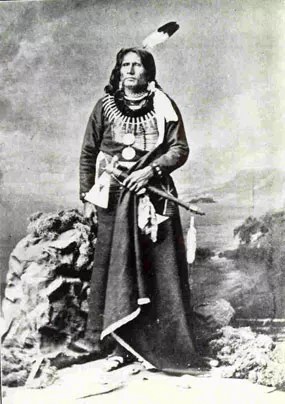
1879: Standing Bear v. Crook

ESSENTIAL QUESTION:

Analyze one of the first cases to establish Native American rights in the US.

CONTEXT:

Standing Bear (c.1829-1908) was born on Ponca land in what is now Nebraska near the Niobrara River. By the 1860s he was a tribal leader of the Ponca Tribe, and they faced a desperate situation. In 1858 the Ponca had given up their lands except a small section where they tried to change from buffalo hunters to farmers. By 1868 this property was included in a treaty giving lands to the Sioux; the Sioux began to raid the Ponca lands. The US government then removed the Ponca to Indian Territory (now Oklahoma) in 1877.

The Ponca resisted this move, and many Ponca died in the process. Standing Bear and several followers left the Indian Territory to return to their homeland and were arrested. General George Crook arrested them under orders, even though he sympathized with Standing Bear. They were jailed at Fort Omaha, Nebraska.

In 1879 newspaper editor Thomas Henry Tibbles interviewed Standing Bear and published his story. It went viral quickly. Standing Bear petitioned for his right to return to his home; lawyers volunteered their services and moved to help prevent Standing Bear and his people from being returned against their will to Indian Territory. Federal Judge Elmer Dundy ruled in Standing Bear’s favor.

Standing Bear returned to Nebraska. He later traveled to the eastern states and spoke about Indian rights. He won the support of many prominent Americans, and died at his home of cancer in 1908.

This text is from Judge Dundy’s decision.

TEXT: (NOTE: the term, “Indian” is used as in the original document.)

The reasoning advanced in support of my views, leads me to conclude:

  1. That an Indian is a “person” within the meaning of the laws of the United States, and has, therefore, the right to sue out a writ of habeas corpus in a federal court, or before a federal judge, in all cases where he may be confined or in custody under color of authority of the United States, or where he is restrained of liberty in violation of the constitution or laws of the United States.
  2. That General George Crook, the respondent, being commander of the military department of the Platte, has the custody of the relators, under color of authority of the United States, and in violation of the laws thereof.
  3. That no rightful authority exists for removal by force any of the relators to the Indian Territory, as the respondent has been directed to do.
  4. That the Indians possess the inherent right of expatriation, as well as the more fortunate white race, and have the inalienable right to “life, liberty, and the pursuit of happiness,” so long as they obey the laws and do not trespass on forbidden ground. And,
  5. Being restrained of liberty under color of authority of the United States, and in violation of the laws thereof, the relators must be discharged from custody, and it is so ordered...

INQUIRY:

  1. What did the Judge mean when he said, “an Indian is a person under the law”?
  2. In Standing Bear v. Crook, for the first time a Native American was recognized as a person with legal standing in a US federal court. The US government could not hold Native Americans without their consent without legal cause. What part of the US Constitution was addressed by this ruling?
  3. Before this case Native Americans were considered “wards of the government.” What did that mean? How did this case change that status?
  4. What is expatriation?
  5. What is habeas corpus? How was Standing Bear being denied this when he was imprisoned? What part of the US Constitution addresses this right?
  6. Where did the Judge reference the Declaration of Independence? What was the significance of the use of the term, “inalienable”?
  7. Investigate the Indian Citizenship Act of 1924. How did the Standing Bear case relate to the 1924 case?

ADDITIONAL RESOURCES:

https://www.nps.gov/mnrr/learn/historyculture/standingbear.htm

https://plainshistory.org/items/show/49

1881: Jackson’s “Century of Dishonor”

ESSENTIAL QUESTION:

Investigate America’s “Century of Dishonor.”

CONTEXT:

Helen Hunt Jackson (1830-1885), born in Massachusetts, was a poet, author, and Native American rights activist. She later moved to Colorado on the advice of her physicians to improve her poor health. In 1879 she was inspired by Chief Standing Bear (c. 1829-1908, a Ponca chief and Native American activist who argued successfully in 1879 for judicial rights in federal court), and she later wrote A Century of Dishonor, an expose of the crimes against Native Americans. It led to the founding of the Indian Rights Association (1930-1994). She died of stomach cancer in 1885.

This excerpt is from A Century of Dishonor.

TEXT: (NOTE: “Indian” is used as it was in the original text)

…There is not among these three hundred bands of Indians [in the United States] one which has not suffered cruelly at the hands either of the Government or of white settlers. The poorer, the more insignificant, the more helpless the band, the more certain the cruelty and outrage to which they have been subjected. This is especially true of the bands on the Pacific slopes.

These Indians found themselves of a sudden surrounded by and caught up in the
great influx of gold-seeking settlers, as helpless creatures on a shore are caught
up in a tidal wave. There was not time for the Government to make treaties;
not even time for communities to make laws. The tale of the wrongs, the
oppressions, the murders of the Pacific-slope Indians in the last thirty years
would be a volume by itself, and is too monstrous to be believed.
It makes little difference, however, where one opens the record of the
history of the Indians; every page and every year has its dark stain. The story of
one tribe is the story of all, varied only by differences of time and place; but
neither time nor place makes any difference in the main facts. Colorado is as
greedy and unjust in 1880 as was Georgia in 1830, and Ohio in 1795; and the
United States Government breaks promises now as deftly as then, and with added ingenuity long practice….

The history of the Government connections with the Indians is a
shameful record of broken treaties and unfulfilled promises. The history of the
border, white man’s connection with the Indians is a sickening record of
murder, outrage, robbery, and wrongs committed by the former, as the rule,
and occasional savage outbreaks and unspeakably barbarous deeds of
retaliation by the latter, as the exception….

INQUIRY: (NOTE: the term “Indian” is used in the questions as it was in Jackson’s text)

  1. What two sources did Jackson list as the source of Indian mistreatment?
  2. What role did the Gold Rush play in the mistreatment of the Indians?
  3. According to Jackson, were any tribes exempt from mistreatment? How do you know?
  4. How did Jackson characterize “the history of the Government connections” with the Indians?
  5. How did she characterize “the border, white man’s connection” with the Indians?
  6. Investigate Red Cloud, leader of the Oglala Sioux from 1865 until 1900. Evaluate his relationship with the US Government. Or choose another Native American leader to investigate, such as Sitting Bull, Geronimo, Tecumseh, Black Hawk, or Crazy Horse. Compare their relationships with the US Government during their times.
  7. The Battle of Wounded Knee in South Dakota occurred in 1890. Investigate this battle and assess how it characterized the attitude of the US Army at the time.
  8. The term “Indian” is now usually considered derogatory and offensive. “First Nations”, “Native Americans”, or other terms such as individual tribal names are considered more appropriate. Why does it matter? What value does a name have?

ADDITIONAL RESOURCES:

https://www.nps.gov/articles/000/a-century-of-dishonor-by-helen-hunt-jackson.htm

https://archive.org/details/centuryofdishono00jackrich/page/n7/mode/2up

https://www.gutenberg.org/files/50560/50560-h/50560-h.htm

https://aktalakota.stjo.org/american-indian-leaders/red-cloud/