Tag: Ronald Reagan

1987: Reagan at the Gate

ESSENTIAL QUESTION:

How did the Berlin Wall represent the Cold War?

CONTEXT:

Ronald Reagan (1911-2004), president of the United States from 1981 until 1989, delivered one of his best known speeches at the Brandenburg Gate, a major historical landmark in Berlin, Germany, on June 12, 1987.

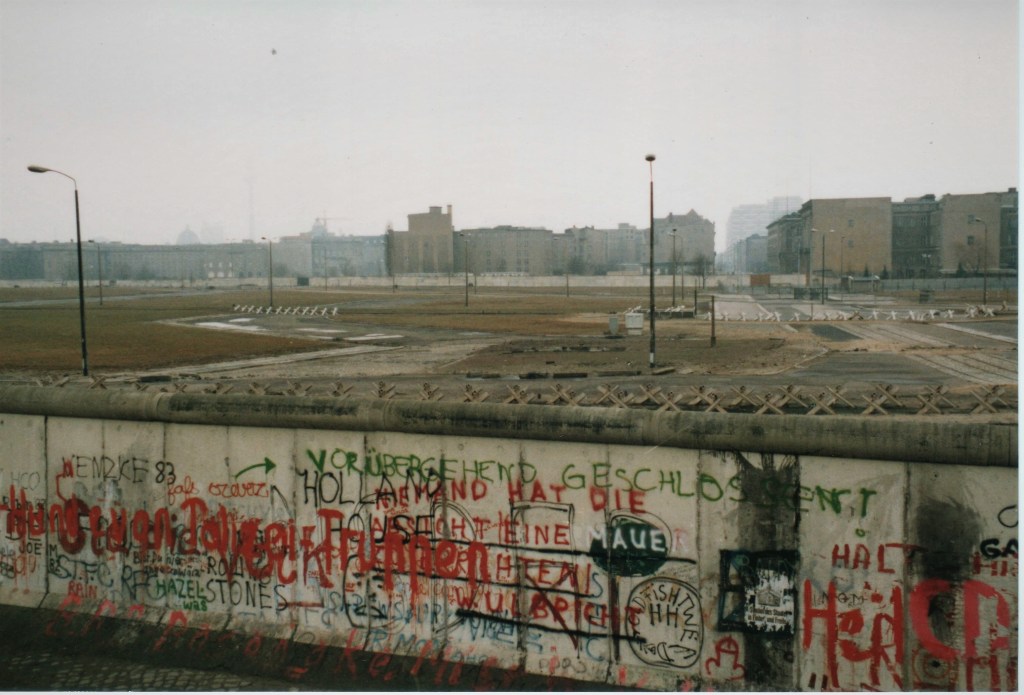
After World War II, Germany was divided into four sectors, each controlled by one of the Allied Forces. Berlin, Germany’s capitol, was also divided. The Soviet Union controlled East Germany and East Berlin, and the Western Allies (US, Great Britain, and France) controlled West Germany and West Berlin. Many East Germans fled to West Berlin to find better economic and political opportunities, and this became a major embarrassment for the East Germans. In 1961 they began building a wall using concrete blocks and wire to prevent this exodus. The 155 kilometer wall surrounded West Berlin, separating families and friends. But escapes to the West continued, and East Berlin strengthened the Wall; escapees could face death if caught. The Wall became a major symbol of the Cold War and the division between Western culture and the Soviets.

Although by the 1980s the Soviet economy was weakening and nationalist movements were arising within the Soviet Union, it would be 1991 before the Soviet Union dissolved. In 1987 President Reagan traveled to Berlin to give this speech, emphasizing the US support for West Berlin and West Germany and pressuring the Soviets to end the division of Berlin and Germany.
TEXT:

…Behind me stands a wall that encircles the free sectors of this city, part of a vast system of barriers that divides the entire continent of Europe. From the Baltic South, those barriers cut across Germany in a gash of barbed wire, concrete, dog runs, and guard towers. Farther south, there may be no visible, no obvious wall. But there remain armed guards and checkpoints all the same–still a restriction on the right to travel, still an instrument to impose upon ordinary men and women the will of a totalitarian state. Yet, it is here in Berlin where the wall emerges most clearly; here, cutting across your city, where the news photo and the television screen have imprinted this brutal division of a continent upon the mind of the world.

Standing before the Brandenburg Gate, every man is a German separated from his fellow men.
Every man is a Berliner, forced to look upon a scar…

…But in the West today, we see a free world that has achieved a level of prosperity and well-being unprecedented in all human history. In the Communist world, we see failure, technological backwardness, declining standards of health, even want of the most basic kind–too little food.
Even today, the Soviet Union still cannot feed itself. After these four decades, then, there stands before the entire world one great and inescapable conclusion: Freedom leads to prosperity. Freedom replaces the ancient hatreds among the nations with comity and peace. Freedom is
the victor.


And now—now the Soviets themselves may, in a limited way, be coming to understand the importance of freedom. We hear much from Moscow about a new policy of reform and openness. Some political prisoners have been released. Certain foreign news broadcasts are no longer being jammed. Some economic enterprises have been permitted to operate with greater freedom from state control.


Are these the beginnings of profound changes in the Soviet state? Or are they token gestures intended to raise false hopes in the West, or to strengthen the Soviet system without changing it? We welcome change and openness; for we believe that freedom and security go together, that the advance of human liberty—the advance of human liberty can only strengthen the cause of world peace.


There is one sign the Soviets can make that would be unmistakable, that would advance dramatically the cause of freedom and peace.
General Secretary Gorbachev, if you seek peace, if you seek prosperity for the Soviet Union and Eastern Europe, if you seek liberalization: Come here to this gate.
Mr. Gorbachev, open this gate.
Mr. Gorbachev—Mr. Gorbachev, tear down this wall!…

INQUIRY:

  1. The Brandenburg Gate in Berlin is located in what was the restricted zone when Berlin was divided. Why do you think Reagan chose the Gate as the site of this speech?
  2. How did Reagan describe the Wall? What tone did those terms convey?
  3. When Reagan used the term “will of a totalitarian state”, to which country was he referring? What is a totalitarian state?
  4. What was the effect of Reagan declaring “…every man is a German, separated from his fellow men. Every man is a Berliner, forced to look upon a scar…”? How did this define Reagan’s audience for the speech?
  5. How did Reagan compare the Communist world and the Free World?
  6. What did Reagan list as the results of freedom?
  7. Did Reagan believer that the Soviets were in the process of making changes? How do you know?
  8. What did Reagan state would be the main sign of changes and the desire for freedom in the Soviet Union?
  9. In what ways did the Berlin Wall represent the Cold War?
  10. The most well known line from this speech is the last one in this excerpt. Why do you think that line would be best remembered?

ADDITIONAL RESOURCES:

https://www.stiftung-berliner-mauer.de/en/topics/berlin-wall

https://www.archives.gov/publications/prologue/2007/summer/berlin.html

1986: Reagan & the Challenger

ESSENTIAL QUESTION

How did President Reagan use language to encourage a mourning American public to focus on the future?

CONTEXT

The US Space Shuttle program (1981-2011) employed a partially reusable spacecraft for flights to conduct research while in orbit as well as to deploy scientific, military, and sometimes commercial payloads. The program was run by NASA, the National Aeronautics and Space Administration, and each shuttle included a crew as well as equipment. Five shuttles were built, and the Challenger was the second one constructed. The January 1986 mission was the 10th of the Challenger orbiter and the 25th of the Space Shuttle fleet. This mission was scheduled to deploy a communication satellite, to study Haley’s Comet, and to initiate the new “Teacher in Space” program. The shuttle launch was widely televised and seen in classrooms across the US. This photograph from the NASA Photograph Collection shows the shuttle prior to launch.

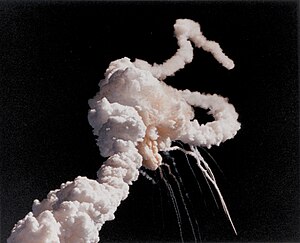
But the Challenger exploded and broke apart 73 seconds into its flight and fell 46,000 feet into the Atlantic Ocean. Seven astronauts, including a civilian classroom teacher, died. The Shuttle Program was grounded for 30 months while an official investigation progressed, resulting in significant changes. The Shuttle Program was retired in 2011.

Although President Ronald Reagan had been scheduled to deliver his State of the Union Address on January 28, 1986, he postponed it and instead addressed the nation about the Challenger disaster. This text is taken from his speech.

The Challenger exploded 73 seconds into flight.

TEXT

Ladies and gentlemen,… Today is a day for mourning and remembering… This is truly a national loss.

Nineteen years ago, almost to the day, we lost three astronauts in a terrible accident on the ground. But we’ve never lost an astronaut in flight; we’ve never had a tragedy like this. And perhaps we’ve forgotten the courage it took for the crew of the shuttle. But they, the Challenger Seven, were aware of the dangers, but overcame them and did their jobs brilliantly. We mourn seven heroes: Michael Smith, Dick Scobee, Judith Resnik, Ronald McNair, Ellison Onizuka, Gregory Jarvis, and Christa McAuliffe. We mourn their loss as a nation together.

For the families of the seven, we cannot bear, as you do, the full impact of this tragedy. But we feel the loss, and we’re thinking about you so very much. Your loved ones were daring and brave, and they had that special grace, that special spirit that says, “Give me a challenge, and I’ll meet it with joy.” They had a hunger to explore the universe and discover its truths. They wished to serve, and they did. They served all of us. We’ve grown used to wonders in this century. It’s hard to dazzle us. But for 25 years the United States space program has been doing just that. We’ve grown used to the idea of space, and perhaps we forget that we’ve only just begun. We’re still pioneers. They, the members of the Challenger crew, were pioneers.

And I want to say something to the schoolchildren of America who were watching the live coverage of the shuttle’s takeoff. I know it is hard to understand, but sometimes painful things like this happen. It’s all part of the process of exploration and discovery. It’s all part of taking a chance and expanding man’s horizons. The future doesn’t belong to the fainthearted; it belongs to the brave. The Challenger crew was pulling us into the future, and we’ll continue to follow them.

I’ve always had great faith in and respect for our space program, and what happened today does nothing to diminish it. We don’t hide our space program. We don’t keep secrets and cover things up. We do it all up front and in public. That’s the way freedom is, and we wouldn’t change it for a minute. We’ll continue our quest in space. There will be more shuttle flights and more shuttle crews and, yes, more volunteers, more civilians, more teachers in space. Nothing ends here; our hopes and our journeys continue…

The crew of the space shuttle Challenger honored us by the manner in which they lived their lives. We will never forget them, nor the last time we saw them, this morning, as they prepared for their journey and waved goodbye and “slipped the surly bonds of earth” to “touch the face of God.”

INQUIRY

  1. What was Reagan’s tone in the beginning of the speech? How did Reagan set the tone of his speech in the first paragraph? Why was it important to set the tone early?
  2. Reagan alluded to a previous space disaster on the ground (the Apollo I fire). Why? What is the effect of the mention of this January 1967 disaster?
  3. In what way did Reagan distinguish the Challenger tragedy as different from previous disasters in the space program?
  4. How did Reagan personalize the tragedy, enabling the American public to identify with the people they may not have known personally?
  5. What is the effect of Reagan’s use of the word “courage”? of “challenge”?
  6. Why did Reagan use the image of pioneers?
  7. Reagan spoke directly to school children. What message was he trying to convey?
  8. How did Reagan characterize the future of the space program?
  9. By the end of the speech Reagan’s tone has shifted. How? How did he accomplish this shift?
  10. In his last sentence Reagan quoted from the poem “High Flight” by John Gillespie Magee, Jr. Magee was a 19-year-old American who volunteered with the Royal Canadian Air Force in 1940, before the US had entered WWII. He was sent to the United Kingdom where he flew a Spitfire over hostile territory in Europe but was killed in a training exercise December 11, 1941. How do these quotes convey the imagery of flight? Why are they appropriate here, even though Magee never experienced space flight?

ADDITIONAL RESOURCES

https://www.reaganlibrary.gov/archives/speech/address-nation-explosion-space-shuttle-challenger

https://www.nasa.gov/challenger-sts-51l-accident