ESSENTIAL QUESTION:
How did Thomas Paine use language to convince colonists that independence was the proper course for America?
CONTEXT:
In January of 1776, only months after the Battles of Lexington and Concord, times were tense in the American colonies. The Declaration of Independence would not be signed for another six months. Many believed that reconciliation with Great Britain was unlikely; yet, independence from Great Britain was unthinkable.
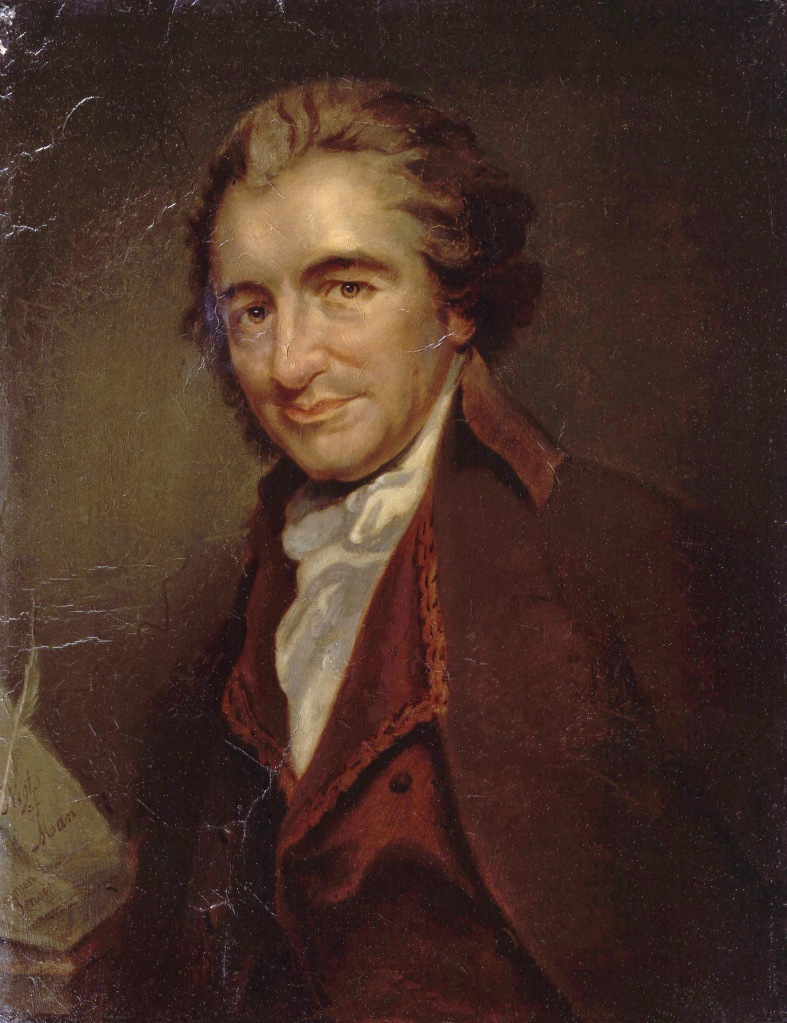
Thomas Paine (1737-1809), a magazine editor in Pennsylvania, anonymously published a pamphlet entitled “Common Sense” which quickly became a best seller. 47 pages long, it sold thousands of copies in three months and would often be read aloud in taverns.
Paine used moral and political arguments, written in plain language, to declare that independence was the only logical choice for the Colonies. While not everyone agreed, his work was immediately popular and widely read. It helped clarify and move public opinion towards independence and encouraged recruitment in the continental army.
TEXT:
…Here then is the origin and rise of government; namely, a mode rendered necessary by the inability of moral virtue to govern the world; here too is the design and end of government, viz. Freedom and security…
I draw my idea of the form of government from a principle in nature which no art can overturn, viz. that the more simple any thing is, the less liable it is to be disordered, and the easier repaired when disordered; and with this maxim in view I offer a few remarks on the so much boasted constitution of England That it was noble for the dark and slavish times in which it was erected, is granted. When the world was overrun with tyranny the least remove therefrom was a glorious rescue. But that it is imperfect, subject to convulsions, and incapable of producing what it seems to promise, is easily demonstrated…
In England a King hath little more to do than to make war and give away places; which, in plain terms, is to empoverish the nation and set it together by the ears. A pretty business indeed for a man to be allowed eight hundred thousand sterling a year for, and worshipped into the bargain! Of more worth is one honest man to society, and in the sight of God, than all the crowned ruffians that ever lived…
I challenge the warmest advocate for reconciliation to show a single advantage that this continent can reap by being connected with Great Britain. I repeat the challenge; not a single advantage is derived. Our corn will fetch its price in any market in Europe, and our imported goods must be paid for buy them where we will… Even the distance at which the Almighty hath placed England and America is a strong and natural proof that the authority of the one over the other, was never the design of Heaven.
I am not induced by motives of pride, party, or resentment to espouse the doctrine of separation and independence; I am clearly, positively, and conscientiously persuaded that it is the true interest of this Continent to be so; that every thing short of that is mere patchwork, that it can afford no lasting felicity,—that it is leaving the sword to our children, and shrinking back at a time when a little more, a little further, would have rendered this Continent the glory of the earth.
As Britain hath not manifested the least inclination towards a compromise, we may be assured that no terms can be obtained worthy the acceptance of the Continent, or any ways equal to the expence of blood and treasure we have been already put to.
If there is any true cause of fear respecting independance, it is because no plan is yet laid down. Men do not see their way out. Wherefore, as an opening into that business I offer the following hints; at the same time modestly affirming, that I have no other opinion of them myself, than that they may be the means of giving rise to something better. Could the straggling thoughts of individuals be collected, they would frequently form materials for wise and able men to improve into useful matter. [Paine then outlines his ideas for the organization of government in America].
A government of our own is our natural right: and when a man seriously reflects on the precariousness of human affairs, he will become convinced, that it is infinitely wiser and safer, to form a constitution of our own in a cool deliberate manner, while we have it in our power, than to trust such an interesting event to time and chance…
We ought to reflect, that there are three different ways by which an independancy may hereafter be effected; and that one of those three, will, one day or other, be the fate of America, viz. By the legal voice of the people in Congress; by a military power; or by a mob: It may not always happen that our soldiers are citizens, and the multitude a body of reasonable men; virtue, as I have already remarked, is not hereditary, neither is it perpetual. Should an independancy be brought about by the first of those means, we have every opportunity and every encouragement before us, to form the noblest, purest constitution on the face of the earth. We have it in our power to begin the world over again. A situation, similar to the present, hath not happened since the days of Noah until now. The birthday of a new world is at hand, and a race of men, perhaps as numerous as all Europe contains, are to receive their portion of freedom from the events of a few months. The reflection is awful, and in this point of view, how trifling, how ridiculous, do the little paltry cavilings [petty objections] of a few weak or interested men appear, when weighed against the business of a world…
INQUIRY:
- What did Paine list as the reason governments exist?
- What did he see as the purpose of government?
- Why did Paine advocate a simple government?
- Why did Paine see Britain’s government as no longer right for America?
- What criticisms did Paine offer of the King of England? Do you agree?
- What economic reasons did Paine offer for independence?
- Why did Paine advocate independence now and not later?
- How did Paine attempt to convince those who disagreed with independence?
- What three ways did Paine offer to achieve independence? Why did he recommend the first of these three ways?
- To what did Paine refer when he said, “the birth of a new world”? Do you agree? Why/why not?
- Paine used several appeals in his argument. Within the text, identify an appeal to authority (history); an appeal to emotion; an appeal to logic.
ADDITIONAL RESOURCES:
 Read Closely