Tag: american-revolution

1776: Jefferson’s Declaring Truths

ESSENTIONAL QUESTION:

Analyze the opening of the US Declaration of Independence.

CONTEXT:

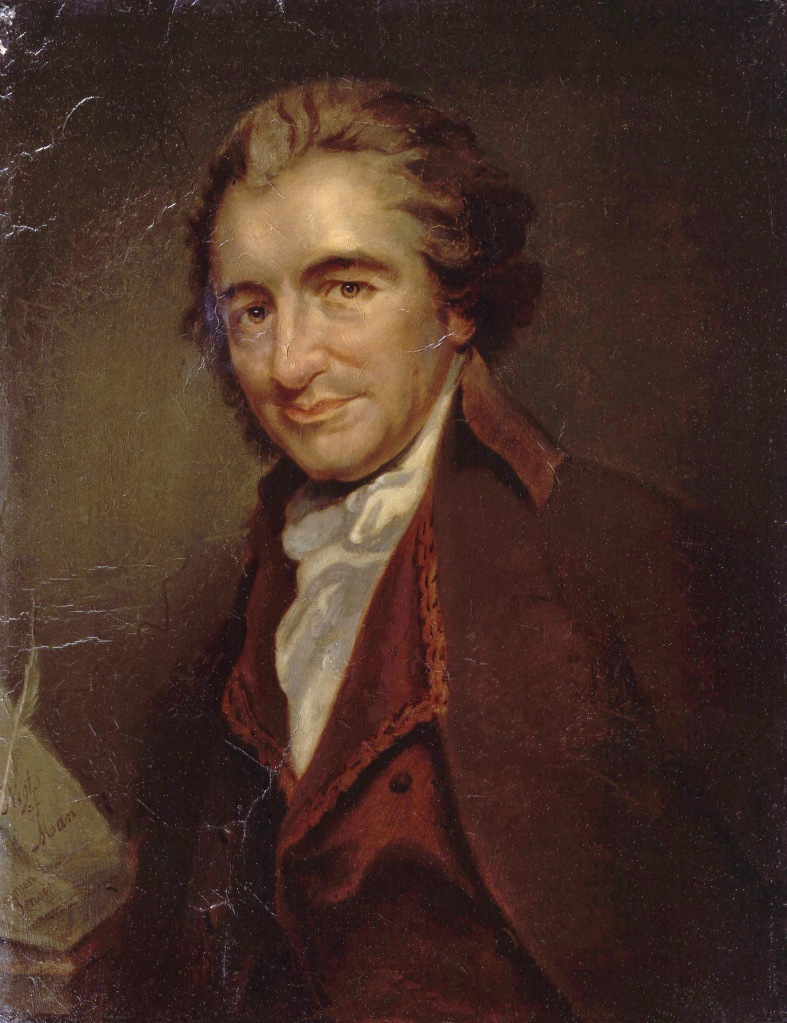
After the French and Indian War (1754-1763) in America, relationships between Great Britain and her American Colonies began to sour. Britain saw the relationship in economic terms–the Colonies’ purpose was to support Britain, providing raw materials and a market for goods. The Colonies saw the relationship in increasingly political terms–Britain owed colonists the same rights and privileges of Englishmen in Britain. In April, 1775, British troops and American militia exchanged fire over an ammunitions cache at a local farm near Lexington and Concord, Massachusetts. Blood had been spilt. Through political actions and documents such as Thomas Paine’s “Common Sense”, more and more people became convinced that America could not remain as British colonies. On June 7, 1776, Richard Henry Lee of Virginia presented a resolution in the Second Continental Congress that the United States should be free and independent.

But not everyone was totally convinced. Some delegates to the Congress wanted to pursue diplomatic negotiations. After all, Britain was one of the most powerful nations in the world at that time; many Americans had economic ties with Britain; and the Colonies had no army or navy to speak of. If independence happened, it was going to require the help of foreign nations, especially France. So Congress decided to draft a statement to explain their actions.

For that purpose Congress established a Committee of Five, including Thomas Jefferson (of Virginia), John Adams (of Massachusetts), Roger Sherman (of Connecticut), Benjamin Franklin (of Pennsylvania), and Robert Livingston (of New York). The Committee asked Jefferson to do most of the writing (he was a talented writer), and Jefferson asked Franklin and Adams to look over his drafts. When the document went back to the Congress, other changes were incorporated. The Declaration was eventually adopted on July 4 and signed over the next several weeks. It was printed (it is unknown how many copies were printed) and distributed. This text is from the beginning of the Declaration of Independence. There are currently 26 copies of the original printing known to exist.

Jefferson would go on to be a governor of Virginia and the third President of the United States. Of the other 56 men who signed the Declaration, some served in Continental Militia, five were captured and tortured by the British, nine died from war wounds or hardships, and twelve saw their homes and farms burned by the British.

TEXT:

In Congress, July 4, 1776

The unanimous Declaration of the thirteen united States of America, When in the Course of human events, it becomes necessary for one people to dissolve the political bands which have connected them with another, and to assume among the powers of the earth, the separate and equal station to which the Laws of Nature and of Nature’s God entitle them, a decent respect to the opinions of mankind requires that they should declare the causes which impel them to the separation.

We hold these truths to be self-evident, that all men are created equal, that they are endowed by their Creator with certain unalienable Rights, that among these are Life, Liberty and the pursuit of Happiness.–That to secure these rights, Governments are instituted among Men, deriving their just powers from the consent of the governed, ….

INQUIRY:

  1. What was the purpose of this document, as stated in the first paragraph?
  2. What made this document necessary? Quote from the document.
  3. What two states did this document cause to happen? Quote from the document.
  4. What was the effect of using the phrase, “to which the Laws of Nature and of Nature’s God”?
  5. Why was it necessary to “declare the causes which impel them to the separation”?
  6. What does it mean to be “self-evident”?
  7. One phrase of this document that has been controversial over the years is “all men are created equal”. When the Declaration was written, society still held women, enslaved people, non-property owners, and others in subservient roles, without political voice. Thus in this case “men” meant all humanity. How has the meaning of “men” changed over the centuries?
  8. What two references to God are found in this document? Why do these strengthen the argument?
  9. What are “unalienable rights”? What three unalienable rights are listed?
  10. At this time the “pursuit of happiness” meant the pursuit of a good character, virtue, and becoming a good citizen. Do we still pursue this kind of happiness? Give examples.
  11. Before editing, the phrase “pursuit of happiness” read “pursuit of property”, meaning owning things, mainly property. How did the changing of this one word change the meaning of the phrase? (Life, liberty and property were natural rights as put forth by philosopher John Locke).
  12. What is the purpose of government?
  13. From where does government get its power?
  14. The Declaration of Independence is not a law. But why is it so important in America?
  15. The purpose of these paragraphs is to declare, not to persuade. What is the document declaring?
  16. The Declaration closes with the statement, “And for the support of this Declaration, with a firm reliance on the protection of divine Providence, we mutually pledge to each other our Lives, our Fortunes and our sacred Honor..” What did this statement suggest?
  17. Investigate John Locke and the other influences on Jefferson’s writing.

ADDITIONAL RESOURCES:

https://www.archives.gov/founding-docs/declaration-transcript

https://jeffersonpapers.princeton.edu/declaration-of-independence/

https://www.si.edu/spotlight/american-revolutionary-war/signers-declaration-independence
https://www.archives.gov/founding-docs/signers-factsheet

1796: Washington and Parties

ESSENTIAL QUESTION:

Analyze the dangers of parties that George Washington foresaw for the young American Republic as he left public life.

CONTEXT:

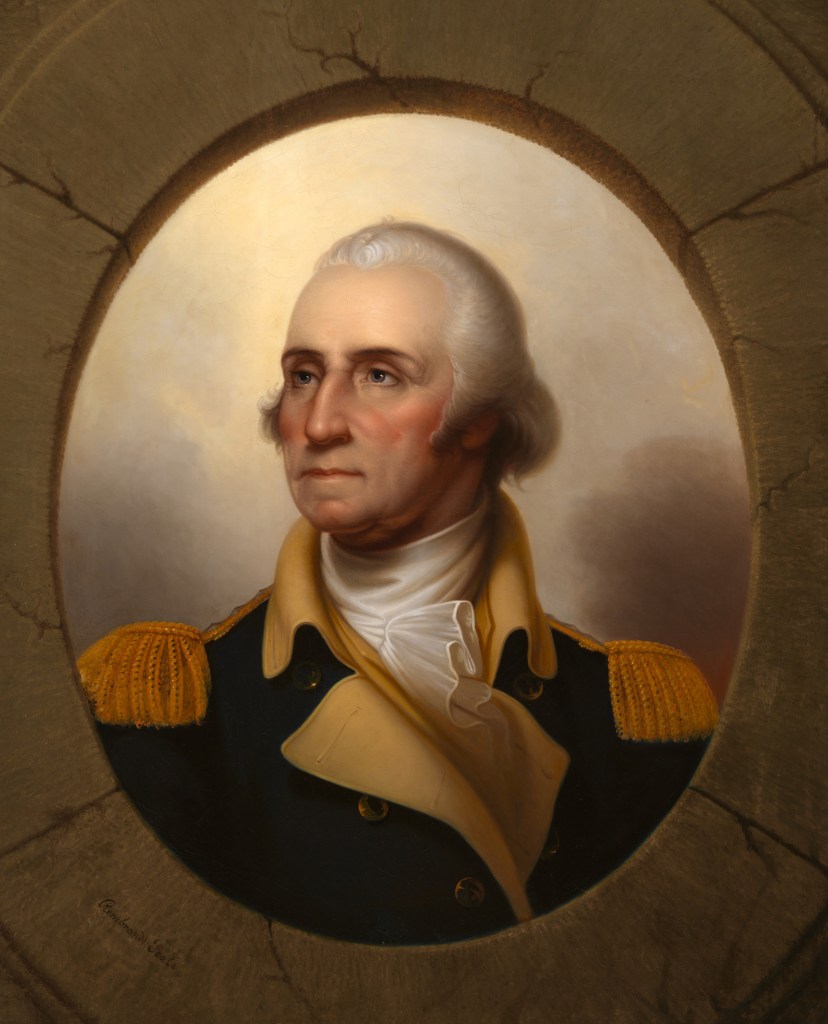
George Washington (1732-1799) was born in Virginia to a prosperous planter family. He learned the culture of a colonial gentleman, and early on had two special interests: the military and westward expansion. At age 16 he helped survey the Shenandoah Valley; in 1754 he was commissioned a lieutenant colonel in the British Army and he served during the French and Indian War. He later managed his lands around Mount Vernon, Virginia, (his home), served in the Virginia House of Burgesses, and married Martha Custis, a wealthy widow. In 1775 the Second Continental Congress appointed him Commander in Chief of the Continental Army.

After the American Revolution Washington wished to retire to Mount Vernon, but realizing that the new nation needed stronger form of government, he encouraged a Constitutional Convention in Philadelphia in 1787. After the new Constitution was adopted, Washington was unanimously elected by the electoral college to be the first president of the United States. He set many precedents. By the end of his second term political parties had developed and there was much contention even within his cabinet; Washington was pressured to continue as president but he refused, setting another precedent of a maximum of two presidential terms which would last until Franklin Roosevelt began his third term in 1941. Another precedent he established was delivering a farewell address, from which this text is taken. He wrote it with the help of Alexander Hamilton and James Madison. Washington did not deliver his address in person to the Congress but instead published it in a Philadelphia newspaper, the American Daily Advertiser, on September 19, 1796. After leaving office Washington returned to Mount Vernon to continue farming. He died there in 1799 from quinsy, a serious throat infection.

TEXT:

…I have already intimated to you the danger of parties in the State, with particular reference to the founding of them on geographical discriminations. Let me now take a more comprehensive view, and warn you in the most solemn manner against the baneful effects of the spirit of party generally.

This spirit, unfortunately, is inseparable from our nature, having its root in the strongest passions of the human mind. It exists under different shapes in all governments, more or less stifled, controlled, or repressed; but, in those of the popular form, it is seen in its greatest rankness, and is truly their worst enemy….

Without looking forward to an extremity of this kind (which nevertheless ought not to be entirely out of sight), the common and continual mischiefs of the spirit of party are sufficient to make it the interest and duty of a wise people to discourage and restrain it.

It serves always to distract the public councils and enfeeble the public administration. It agitates the community with ill-founded jealousies and false alarms, kindles the animosity of one part against another, foments occasionally riot and insurrection. It opens the door to foreign influence and corruption, which finds a facilitated access to the government itself through the channels of party passions. Thus the policy and the will of one country are subjected to the policy and will of another.

There is an opinion that parties in free countries are useful checks upon the administration of the government and serve to keep alive the spirit of liberty. This within certain limits is probably true; and in governments of a monarchical cast, patriotism may look with indulgence, if not with favor, upon the spirit of party. But in those of the popular character, in governments purely elective, it is a spirit not to be encouraged. From their natural tendency, it is certain there will always be enough of that spirit for every salutary purpose. And there being constant danger of excess, the effort ought to be by force of public opinion, to mitigate and assuage it. A fire not to be quenched, it demands a uniform vigilance to prevent its bursting into a flame, lest, instead of warming, it should consume.

INQUIRY:

  1. Did Washington encourage or discourage the development of political parties? Quote from the text to support your response.
  2. List five dangers from the development of parties.
  3. How might parties affect US foreign policy?
  4. Why did Washington discourage parties in governments “purely elective”?
  5. What force should “mitigate and assuage” the dangers of parties?
  6. In Washington’s time many Americans chiefly identified with their state. Rather than saying “I am an American” they might say “I am a Virginian” and then say “I am an American.” Washington warned against this earlier in his speech. What dangers might exist with this frame of mind?
  7. During Washington’s administration the first political parties developed–the Federalists, chiefly from New England, and the Democratic-Republicans, chiefly from the South. People were encouraged to vote based on party loyalty rather than choosing the best qualified candidate. Investigate the toxic relationship between Alexander Hamilton (leader of the Federalists) and Thomas Jefferson (leader of the Democratic-Republicans) that developed while the two men served in Washington’s Cabinet.
  8. In 1796 when this address was delivered the US Constitution was only eight years old. How might that fact have influenced Washington’s words?
  9. To commemorate Washington’s birthday his Farewell Address is still read aloud in the US Senate. How well do you believe we are listening to his advice? Give evidence to support your answer.

ADDITIONAL RESOURCES:

https://millercenter.org/president/washington/life-in-brief

https://www.senate.gov/artandhistory/history/resources/pdf/Washingtons_Farewell_Address.pdf?utm_source=substack&utm_medium=email

Chernow, Ron. Washington: A Life. Penguin Press, 2010.

1776: Washington at Year’s End

ESSENTIAL QUESTION:

How did George Washington use language to convince his Continentals to remain in arms even after the difficult year of 1776?

CONTEXT:

As the year 1776 drew to a close, the American war effort was in crisis. The British occupied New York. Congress had abandoned Philadelphia in the face of the British advance and moved to Baltimore. General George Washington (1732-1799) worried, as his army was scheduled to dissolve; many one-year enlistments would elapse at year’s end. On December 23, Thomas Paine’s published The Crisis, and Washington had the series of essays read to his troops camped up and down the Delaware River in an attempt to improve morale.

On Christmas Eve his army crossed the Delaware River and defeated the British at the Battle of Trenton the next morning in less than one hour . The Americans then crossed back into Pennsylvania; on December 28 they crossed back to Trenton, planning to launch another attack on the British. But a more immediate problem existed; in three days, the Army’s enlistments would expire.

On December 30, Washington gathered his men and addressed his troops as a comrade in arms, asking them to stay six more weeks and offering a ten-dollar bounty (on December 27 Congress had authorized Washington to offer bounties for enlistment). When volunteers were asked for, no one stepped out. One soldier spoke up and reminded the General of all they had sacrificed; exhausted and lacking proper equipment, they were looking forward to going home. Seated on his horse, Washington rode along the line of men and spoke the words below.

TEXT:

My brave fellows, you have done all I asked you to do, and more than can be reasonably expected; but your country is at stake, your wives, your houses and all that you hold dear. You have worn yourselves out with fatigues and hardships, but we know not how to spare you. If you will consent to stay one month longer, you will render that service to the cause of liberty, and to your country, which you probably can never do under any other circumstances.

INQUIRY:

  1. How did Washington acknowledge the soldiers’ sacrifices? Why was that important?
  2. After Washington’s words, soldiers grouped and discussed. One man said “I’ll go if you will.” What feeling did this comment convey? Would you have agreed to stay?
  3. Another soldier whispered, “We can’t go home under such circumstances.” What feeling did this comment convey? Would you have agreed with this soldier?
  4. The men responded in small groups at first until finally 200 of the regiment had agreed to stay. Washington then spoke to each additional regiment personally, and eventually he had 3000 soldiers remain. What was the effect of Washington addressing each regiment in person?
  5. The men who stayed in the Army were not required to reenlist on paper–Washington said he would trust each man upon his word. What did this say about Washington’s attitude toward his Continental Troops?
  6. What appeals to emotion did Washington use in this speech? Why do you believe they worked?
  7. What was the tone of Washington’s speech? Cite examples.
  8. Do you believe this speech displays leadership on Washington’s part? Why or why not?

ADDITIONAL RESOURCES:

Chernow, Ron. Washington: A Life. New York: Penguin Books, 2010.

“George Washington to Robert Morris, 31 December 1776,” Founders Online, National Archives, https://founders.archives.gov/documents/Washington/03-07-02-0389. [Original source: The Papers of George Washington, Revolutionary War Series, vol. 7, 21 October 1776–5 January 1777, ed. Philander D. Chase. Charlottesville: University Press of Virginia, 1997, p. 497.]

1776: Paine’s Common Sense

ESSENTIAL QUESTION:

How did Thomas Paine use language to convince colonists that independence was the proper course for America?

CONTEXT:

In January of 1776, only months after the Battles of Lexington and Concord, times were tense in the American colonies. The Declaration of Independence would not be signed for another six months. Many believed that reconciliation with Great Britain was unlikely; yet, independence from Great Britain was unthinkable.

Thomas Paine (1737-1809), a magazine editor in Pennsylvania, anonymously published a pamphlet entitled “Common Sense” which quickly became a best seller. 47 pages long, it sold thousands of copies in three months and would often be read aloud in taverns.

Paine used moral and political arguments, written in plain language, to declare that independence was the only logical choice for the Colonies. While not everyone agreed, his work was immediately popular and widely read. It helped clarify and move public opinion towards independence and encouraged recruitment in the continental army.

TEXT:

…Here then is the origin and rise of government; namely, a mode rendered necessary by the inability of moral virtue to govern the world; here too is the design and end of government, viz. Freedom and security…

I draw my idea of the form of government from a principle in nature which no art can overturn, viz. that the more simple any thing is, the less liable it is to be disordered, and the easier repaired when disordered; and with this maxim in view I offer a few remarks on the so much boasted constitution of England That it was noble for the dark and slavish times in which it was erected, is granted. When the world was overrun with tyranny the least remove therefrom was a glorious rescue. But that it is imperfect, subject to convulsions, and incapable of producing what it seems to promise, is easily demonstrated…

In England a King hath little more to do than to make war and give away places; which, in plain terms, is to empoverish the nation and set it together by the ears. A pretty business indeed for a man to be allowed eight hundred thousand sterling a year for, and worshipped into the bargain! Of more worth is one honest man to society, and in the sight of God, than all the crowned ruffians that ever lived…

I challenge the warmest advocate for reconciliation to show a single advantage that this continent can reap by being connected with Great Britain. I repeat the challenge; not a single advantage is derived. Our corn will fetch its price in any market in Europe, and our imported goods must be paid for buy them where we will… Even the distance at which the Almighty hath placed England and America is a strong and natural proof that the authority of the one over the other, was never the design of Heaven.

I am not induced by motives of pride, party, or resentment to espouse the doctrine of separation and independence; I am clearly, positively, and conscientiously persuaded that it is the true interest of this Continent to be so; that every thing short of that is mere patchwork, that it can afford no lasting felicity,—that it is leaving the sword to our children, and shrinking back at a time when a little more, a little further, would have rendered this Continent the glory of the earth.

As Britain hath not manifested the least inclination towards a compromise, we may be assured that no terms can be obtained worthy the acceptance of the Continent, or any ways equal to the expence of blood and treasure we have been already put to.

If there is any true cause of fear respecting independance, it is because no plan is yet laid down. Men do not see their way out. Wherefore, as an opening into that business I offer the following hints; at the same time modestly affirming, that I have no other opinion of them myself, than that they may be the means of giving rise to something better. Could the straggling thoughts of individuals be collected, they would frequently form materials for wise and able men to improve into useful matter. [Paine then outlines his ideas for the organization of government in America].

A government of our own is our natural right: and when a man seriously reflects on the precariousness of human affairs, he will become convinced, that it is infinitely wiser and safer, to form a constitution of our own in a cool deliberate manner, while we have it in our power, than to trust such an interesting event to time and chance…

We ought to reflect, that there are three different ways by which an independancy may hereafter be effected; and that one of those three, will, one day or other, be the fate of America, viz. By the legal voice of the people in Congress; by a military power; or by a mob: It may not always happen that our soldiers are citizens, and the multitude a body of reasonable men; virtue, as I have already remarked, is not hereditary, neither is it perpetual. Should an independancy be brought about by the first of those means, we have every opportunity and every encouragement before us, to form the noblest, purest constitution on the face of the earth. We have it in our power to begin the world over again. A situation, similar to the present, hath not happened since the days of Noah until now. The birthday of a new world is at hand, and a race of men, perhaps as numerous as all Europe contains, are to receive their portion of freedom from the events of a few months. The reflection is awful, and in this point of view, how trifling, how ridiculous, do the little paltry cavilings [petty objections] of a few weak or interested men appear, when weighed against the business of a world…

INQUIRY:

  1. What did Paine list as the reason governments exist?
  2. What did he see as the purpose of government?
  3. Why did Paine advocate a simple government?
  4. Why did Paine see Britain’s government as no longer right for America?
  5. What criticisms did Paine offer of the King of England? Do you agree?
  6. What economic reasons did Paine offer for independence?
  7. Why did Paine advocate independence now and not later?
  8. How did Paine attempt to convince those who disagreed with independence?
  9. What three ways did Paine offer to achieve independence? Why did he recommend the first of these three ways?
  10. To what did Paine refer when he said, “the birth of a new world”? Do you agree? Why/why not?
  11. Paine used several appeals in his argument. Within the text, identify an appeal to authority (history); an appeal to emotion; an appeal to logic.

ADDITIONAL RESOURCES:

https://constitutioncenter.org/the-constitution/historic-document-library/detail/thomas-paine-common-sense-1776

https://www.loc.gov/item/18016803/?loclr=blogser

https://www.gutenberg.org/files/147/147-h/147-h.htm

1783: Washington resigns

ESSENTIAL QUESTION:

Assess the short and long term significance of General George Washington’s resignation of his military commission.

CONTEXT:

George Washington (1732-1799) served as the Commander in Chief of the American Forces in the American Revolution and in 1789 became the first president of the United States. While fighting in the American Revolution ended mainly with the Battle of Yorktown (1781), the war itself only ended with the Treaty of Paris (1783). In that two year period, the American Army stayed organized, with Washington as its leader, as the threat of new fighting remained. As Commander in Chief Washington constantly petitioned Congress for pay and better conditions for the soldiers who had fought in the Revolution, but there was little money; money had to be requested by Congress of the individual states. Several mutinies occurred over unpaid wages, supplies, and expiring enlistments, including the Pennsylvania Line Mutiny (1781) and the Newburgh Conspiracy (1783). Washington was able to quell these uprisings and retain control of the Army.

Washington had been appointed Commander in Chief of the American Forces in May of 1775, and many thought he would remain in power throughout his life. But the Treaty of Paris (1783) had been signed three months earlier and Washington saw his job as a military commander completed. During the War he had been granted broad powers and many thought he would continue to use them. But he did not. Having bid farewell to his soldiers the month before, in December 1783 he bid farewell to his officers and two days before Christmas in 1783 he addressed the Continental Congress in Annapolis, Maryland, to resign his commission. He then traveled to his home at Mount Vernon, hoping to live out his days as a farmer. His quiet life did not last long; he was elected President of the United States six years later, serving from 1789 until 1797. Washington died at Mount Vernon in 1799.

TEXT:

The great events on which my resignation depended having at length taken place; I have now the honor of offering my sincere Congratulations to Congress and of presenting myself before them to surrender into their hands the trust committed to me, and to claim the indulgence of retiring from the Service of my Country...

I resign with satisfaction the Appointment I accepted with diffidence. A diffidence in my abilities to accomplish so arduous a task, which however was superseded by a confidence in the rectitude of our Cause, the support of the Supreme Power of the Union, and the patronage of Heaven…

While I repeat my obligations to the Army in general, I should do injustice to my own feelings not to acknowledge in this place the peculiar Services and distinguished merits of the Gentlemen who have been attached to my person during the War. It was impossible the choice of confidential Officers to compose my family should have been more fortunate. Permit me Sir, to recommend in particular those, who have continued in Service to the present moment, as worth of the favorable notice and patronage of Congress.

I consider it an indispensable duty to close this last solemn act of my Official life, by commending the Interests of our dearest Country to the protection of Almighty God, and those who have the superintendence of them, to his holy keeping.

Having now finished the work assigned me, I retire from the great theatre of Action; and bidding an Affectionate farewell to this August body under whose order I have so long acted, I here offer my Commission, and take my leave of all the employments of public life.

INQUIRY:

  1. Washington believed this would be his last act of public life, and he handed his commission and a copy of his remarks to Thomas Mifflin, the President of the Congress. He bowed to Congress and then left for Mount Vernon to be home for Christmas. What was the short term effect of Washington’s resignation?
  2. Many wanted Washington to remain in power as head of the Army and nation. Why would they want that?
  3. Washington said he accepted his commission with diffidence. What does that mean? What powers allowed him to overcome that diffidence? What does that say about Washington as a leader?
  4. How did Washington view his officers? What language did he use?
  5. What did Washington ask the Congress to provide for his officers?
  6. Investigate the Newburgh Conspiracy (1783). How might that have influenced Washington’s comments?
  7. Washington made several religious references. What does this say about his attitude regarding the success of the American Revolution?
  8. After Washington’s resignation the Continental Army essentially disbanded, leaving the colonies with no unified military force; eventually Congress took over the responsibilities of the Army. What dangers might the new United States have faced with no organized military force?
  9. When news of Washington voluntarily giving up political power to return to his farm spread across the nation and the world, people were astonished. How did this act represent what the American Revolution had been fought for?
  10. Today the US Constitution marks the President of the United States as the Commander in Chief of the Military. What fundamental principle of American democracy doe the placing of military power into the hands of a civilian (president) represent? How did Washington’s resignation establish this principle?

ADDITIONAL RESOURCES:

https://www.mountvernon.org/library/digitalhistory/digital-encyclopedia/article/resignation-of-military-commission

https://www.aoc.gov/explore-capitol-campus/art/general-george-washington-resigning-his-commission

https://founders.archives.gov/documents/Jefferson/01-06-02-0319-0004

Washington: A Life by Ron Chernow (Penguin Books, 2011)

1570: Haudenosaunee Constitution

ESSENTIAL QUESTION:

How did early Native American culture reflect their values?

CONTEXT:

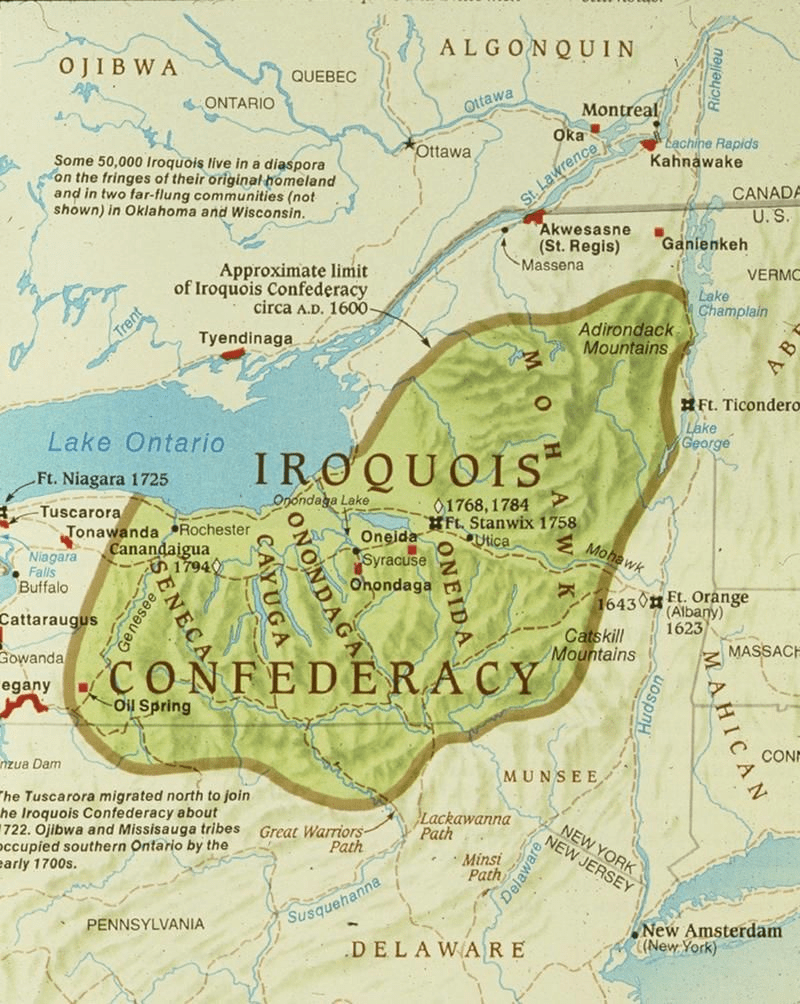
The Haudenosaunee were a group of Native Americans in what would become the New England colonies in America, and they were present well before colonial settlement. They are sometimes called the “Iroquois Confederacy,” but this was a name given to them by French fur trappers; the English called them the “League of Five Nations.” The Haudenosaunee were actually a language and cultural group, and from this grew the Haudenosaunee Confederacy, a political union. The Seneca, Cayuga, Onondaga, Oneida, and Mohawk tribes were original members, and the Tuscarora joined the Confederacy in approximately 1722.

The Haudenosaunee Confederacy developed a Constitution which was oral, recorded on wampum belts, and may have dated to as early as 1190. Passed down through the generations, it was later written and translated into English in the 19th century. Known as “The Great Law of Peace,” the Constitution emphasized peace and unity among the nations, consensus decision making, established a legal system, and created delegates to form a Grand Council. This text is drawn from a translation.

The Haudenosaunee Confederacy still exists today.

TEXT:

This is wisdom and justice of the part of the Great Spirit to create and raise chiefs, give and establish unchangable laws, rules and customs between the Five Nation Indians, viz the Mohawks, Oneidas, Onondagas, Cayugas and Senecas and the other nations of Indians in North America. The object of these laws is to establish peace between the numerous nations of Indians, hostility will be done away with, for the preservation and protection of life, property and liberty…

And when the Five Nation Indians confederation chiefs assemble to hold a council, the council shall be duly opened and closed by the Onondaga chiefs, the Firekeepers. They will offer thanks to the Great Spirit that dwells in the heave above the source and ruler of our lives, and it is him that sends daily blessings upon us, our daily wants and daily health, and they will then declare the council open for the transaction of business, and give decisions of all that is done in the council…

INQUIRY:

  1. In the first sentence, what does the Great Spirit do?
  2. What is the purpose of these laws, rules and customs?
  3. How do the Nations open their Council? Why is that significant?
  4. For what do the Nations offer thanks? How does that characterize their relationship with the Great Spirit?
  5. How does the Haudenosaunee Constitution blend laws and values?
  6. Haudenosaunee means “people of the longhouse.” They not only lived in longhouses but also saw their culture as a connected people within a metaphorical longhouse, serving as an image of the connection of the tribes of the Confederacy. How does living close to each other encourage the principles of the Haudenosaunee?
  7. Historians debate the influence of the Haudenosaunee Constitution on the US Constitution. Certainly Benjamin Franklin was familiar with the principles of the Haudenosaunee Constitution; he invited representatives of the Iroquois Nations to the Provincial Council of Pennsylvania in 1744 and the Albany Congress in 1754 to help promote peace, equity and justice in the gathering of colonies. The US Senate, in 1987, formally recognized that the framers of the US Constitution admired the principles and practices of the Confederacy (yet the Constitution itself was based more upon Enlightenment principles of the time). What similarities do you see with this excerpt and the US Constitution?
  8. Investigate the Albany Congress and the Albany Plan of Union. What similarities do you see with the Haudenosaunee Constitution?
  9. During the American colonial period the Haudenosaunee developed political alliances with the French and the English, based on their own tribal benefits. Yet during the American Revolution the Confederacy fractured, with some tribes siding with the English and some with the Americans. How did this violate one of their core principles?
  10. Many historians recognize the Haudenosaunee Confederacy as the world oldest democracy. Do you agree? Why or why not?

ADDITIONAL RESOURCES:

haudenosauneeconfederacy.com

https://web.pdx.edu/~caskeym/iroquois_web/html/greatlaw.html

1791: Franklin’s Virtues

ESSENTIAL QUESTION

What qualities did Benjamin Franklin consider to be important in developing himself as a young man?

CONTEXT

Benjamin Franklin (1706-1790) was one of the best known founding fathers. He was a writer, scientist, diplomat, publisher, inventor, and a leading intellectual of the late 18th century. He helped draft the American Declaration of Independence and was the first president of what would become the University of Pennsylvania. His life and legacy in the founding of the United States is reflected in the fact that his image is still on the $100 bill. From a poor family, Franklin built his publishing business from nothing but was always interested in ways to improve himself and the world around him.

As a young man wanting to make his way in the world, Franklin took a hard look at his own behaviors and thought of ways to improve himself. In 1726, at about the age of 20, Franklin wrote his 13 Virtues, listed below as taken from Franklin’s Autobiography. He decided that he would not try to change everything at once–that was overwhelming–but he would work on one virtue for a week and then move on to the next one.

As you read his list of virtues, consider the different areas of his life that Franklin was attempting to discipline. Where appropriate, clarification of terms are included in brackets.

TEXT

Franklin’s 13 Virtues

  1. Temperance: Eat not to dullness [being too full]. Drink not to elevation [being drunk].
  2. Silence: Speak not but what may benefit others or yourself. Avoid trifling conversation [gossip].
  3. Order: Let all your things have their places. Let each part of your business have its time.
  4. Resolution: Resolve to perform [Determine to accomplish] what you ought [should]. Perform without fail what you resolve.
  5. Frugality: Make no expense but to do good to others or yourself: i.e. waste nothing.
  6. Industry: Lose no time. Be always employed in [busy with] something useful. Cut off all unnecessary actions.
  7. Sincerity: Use no hurtful deceit. Think innocently and justly; and, if you speak, speak accordingly.
  8. Justice: Wrong none, by doing injuries or omitting the benefits that are your duty.
  9. Moderation: Avoid extremes. Forbear [politely do not] resenting injuries so much as you think they deserve.
  10. Cleanliness: Tolerate no uncleanliness in body, clothes or habitation [living area].
  11. Tranquility: Be not disturbed at trifles [unimportant things], or at accidents common or unavoidable.
  12. Chastity: Rarely use venery [sexual indulgence] but for health or offspring; never to dullness, weakness or the injury of your own or another’s peace or reputation.
  13. Humility: Imitate Jesus and Socrates.

INQUIRY

  1. Looking at the list of virtues, classify the virtues in three or four groups of virtues. Justify your answer.
  2. Franklin intended to list the virtues in a specific order so that each virtue could support the development of the next one on the list; for instance, temperance could help support the virtue of silence. Do you agree with his order? Do you see ones that might be reordered? Justify your answer.
  3. Was it wise for Franklin to attempt to master a new virtue each week? Why or why not?
  4. Which three virtues do you consider most important for Franklin as a young man in 1726? Why?
  5. Franklin added the 13th virtue later because a friend told him he had a problem with self-pride. What does it say about Franklin that he was willing to amend his list?
  6. In what ways do each virtue relate to self-discipline?
  7. Which three virtues would you consider most important for yourself? Why?
  8. Write your own list of 13 virtues. Chart your progress over 13 weeks. What conclusions can you draw from the experience?

ADDITIONAL RESOURCES

https://www.fi.edu/en/science-and-education/benjamin-franklin

https://www.pbs.org/kenburns/benjamin-franklin/

https://www.gutenberg.org/files/20203/20203-h/20203-h.htm 

https://guides.loc.gov/finding-benjamin-franklin

1776: A Feminine Rebellion

ESSENTIAL QUESTION

What political advice does Abigail Adams give her husband John in 1776?

CONTEXT

Abigail Smith Adams (1744-1818) was born in Weymouth, Massachusetts, to a liberal Congregationalist minister and his wife. Although the family held up to four slaves, Abigail later developed anti-slavery views. Even though she had no formal education, she learned to read, write, and cipher and enjoyed access to her father’s large library. In 1764 she married John Adams, a young lawyer from Braintree, Massachusetts. As the political atmosphere of Boston became more unsettled in the 1770s, Abigail remained at the farm in Braintree while husband John tended to his law practice and political duties in Boston. John became the second President of the United States and Abigail’s son John Quincy became the sixth President of the United States. She died in her home in 1818 of typhoid fever.

Due to John’s active political career Abigail and John spent months apart, but wrote over 300 letters to each other. This text is taken from a letter Abigail wrote to John on March 31, 1776, just prior to the announcement of the Declaration of Independence.

TEXT* (original spellings are maintained)

Do not put such unlimited power into the hands of the Husbands. Remember all Men would be tyrants if they could. If perticuliar care and attention is not paid to the Laidies we are determined to foment a Rebelion, and will not hold ourselves bound by any Laws in which we have no voice, or Representation.

That your Sex are Naturally Tyrannical is a Truth so thoroughly established as to admit of no dispute, but such of you as wish to be happy willingly give up the harsh title of Master for the more tender and endearing one of Friend. Why then, not put it out of the power of the vicious and the Lawless to use us with cruelty and indignity with impunity. Men of Sense in all Ages abhor those customs which treat us only as the vassals of your Sex. Regard us then as Beings placed by providence under your protection and in immitation of the Supreem Being make use of that power only for our happiness.

INQUIRY (Cite from the text where you found your responses)

  1. Abigail Adams uses strong language to describe men. When she says “Remember all Men would be tyrants if they could”, what does she mean? What keeps all men from being tyrants?
  2. While John Adams did not take the advice in this letter seriously, what does the fact that his wife describes her thoughts so plainly imply about their relationship?
  3. What does she mean by “use us with cruelty and indignity with impunity”?
  4. What does Abigail says that women will do if “perticuliar care and attention is not paid to the Laidies”?
  5. According to Abigail, how can men prevent a revolution by women?
  6. How does Abigail contrast “Men of Sense” and tyrants? What is the effect of this contrast?
  7. Would Abigail’s speech be relevant in our lives today? Why or why not?

ADDITIONAL RESOURCES

*Text from “Abigail Adams to John Adams, 31 March 1776,” Founders Online, National Archives, https://founders.archives.gov/documents/Adams/04-01-02-0241. [Original source: The Adams Papers, Adams Family Correspondence, vol. 1, December 1761 – May 1776, ed. Lyman H. Butterfield. Cambridge, MA: Harvard University Press, 1963, pp. 369–371.]

https://www.womenshistory.org/education-resources/biographies/abigail-adams

https://www.masshist.org/digitaladams/archive/letter

1776: Paine’s Crisis

1776: Paine’s Crisis

ESSENTIAL QUESTION

Which rhetorical devices does Thomas Paine use to rouse American morale in the face of military defeat?

CONTEXT

On December 19, 1776, Thomas Paine (1739-1809) published The American Crisis, a pamphlet sold on the street of Boston opposite the Court House. This was the first of a 13-part pamphlet series he published between 1776 and 1783.

1776 had been a difficult year for the American Army. After the announcement of the Declaration of Independence in July, August brought military defeats and the British captured New York City. Over 60% of Washington’s troops had left the Army, been killed or captured, and enlistments for many of those who remained were due to expire in just 13 days, on December 31. Morale was low and it appeared the Army might evaporate.

Thomas Paine was well-known for his literary support of the American Revolution. He had written another pamphlet, Common Sense, in January, 1776; it sold over 100,000 copies in the first three months, and it helped explain the necessity of the American Revolution. Now, as the American troops retreated from New York City, Paine, who was with the Army, again began to write. He penned The American Crisis to stir American patriotism and improve morale, and General Washington ordered this new pamphlet to be read to all his men. Drawing courage from Paine’s words, the Continental Troops crossed the Delaware River and defeated Hessian troops at Trenton on Christmas night. This victory helped breathe new life into the American cause.

This excerpt is from the introduction to The American Crisis.

TEXT

THESE are the times that try men’s souls: The summer soldier and the sunshine patriot will, in this crisis, shrink from the service of his country but he that stands it NOW, deserves the love and thanks of man and woman. Tyranny, like hell, is not easily conquered; yet we have this consolation with us, that the harder the conflict, the more glorious the triumph. What we obtain too cheap, we esteem too lightly;-‘Tis dearness only that gives everything its value. Heaven knows how to set a proper price upon its goods; and it would be strange indeed, if so celestial an article as Freedom should not be highly rated...

INQUIRY

  1. How does Paine construct his opening sentence as an appeal to ethos?
  2. Identify three examples of consonance (repetition of consonant sounds) in the first sentence. What is the effect of using this device, both when reading the pamphlet and when hearing it read in public?
  3. Identify the antithesis in the second sentence. What is the effect of this comparison?
  4. According to Paine, what gives things value? Do you agree? Why or why not?
  5. What does Paine consider to be a highly rated article? How do you know?
  6. Paine speaks of both heaven and hell in this section. What type of appeal is this? What is the effect?
  7. What imagery does Paine use in this excerpt? Cite at least three examples and give the effect of each.
  8. Which do you think is the most important sentence in this excerpt? Why?
  9. Do you agree with Paine’s reasoning? Why or why not?
  10. With this pamphlet and the American victory that followed, momentum in the American Revolution shifted toward the Americans. What is the importance of momentum in any type of contest, for instance a sports game? Give examples.

ADDITIONAL RESOURCES

https://www.loc.gov/resource/rbpe.03902300/?st=text

https://constitutioncenter.org/blog/how-thomas-paines-other-pamphlet-saved-the-revolution