Author: caseyc54

1933: FDR and “Fear Itself”

ESSENTIAL QUESTION

In his First Inaugural Address, how did President Franklin Roosevelt use language to rally Americans to focus on a positive future rather than the bleak present reality?

CONTEXT

It was 1933 and America was in crisis, the most dangerous time, some said, since the American Revolution. In October, 1929, the US Stock Market crashed, bringing on the worse economic depression in American history. 25% of the workforce, one in four men, were unemployed at a time when there was no unemployment insurance of any kind. American productivity was only 1/3 of what it had been in early 1929. Many farmers lost their land and homes due to a drastic drop in prices. Factories shut down. Mines were abandoned. Banks closed. People were starving. Families split up to go elsewhere to look for work, but often there was no work to find. People looked to the federal government for help, but President Hoover’s policies did not address the problems of the nation.

Franklin Delano Roosevelt (1882-1945) won the presidential election in 1932 and immediately set about not only changing the American mindset but also changing the American future. This excerpt is from his first Inaugural Address given on March 4, 1933, at the US Capitol.

TEXT

…This is preeminently the time to speak the truth, the whole truth, frankly and boldly. Nor need we shrink from honestly facing conditions in our country today. This great nation will endure as it has endured, will revive and will prosper. So first of all let me assert me firm belief that the only thing we have to fear is fear itself,–nameless, unreasoning, unjustified terror which paralyzes needed efforts to convert retreat into advance. In every dark hour of our national life a leadership of frankness and vigor has met with that understanding and support of the people themselves which is essential to victory. I am convinced that you will again give that support to leadership in these critical days…

…Happiness lies not in the mere possession of money; it lies in the joy of achievement, in the thrill of creative effort. The joy and moral stimulation of work no longer must be forgotten in the mad chase of evanescent profits. These dark days will be worth all they cost is if they teach us that our true destiny is not to be ministered unto but to minister to ourselves and to our fellowmen…Our greatest primary task is to put people to work…

,..If I read the temper of our people correctly we now realize as we have never realized before our interdependence on each other: that we cannot merely take but we must give as well: that if we are to go forward we must move as a trained and loyal army willing to sacrifice for the good of a common discipline, because without such discipline no progress is made, no leadership becomes effective…

INQUIRY

  1. Why does FDR focus on speaking “the truth”? What does this imply about the behavior of the previous President’s administration?
  2. What does “endure” mean? What is the effect of using this verb in this circumstance?
  3. FDR uses the verbs, “endure”, “revive”, and “proper” in that order. How does this define his plans for his administration?
  4. One of the most well-known quotations from this speech is “…the only thing we have to fear is fear itself…” What does that mean?
  5. According to FDR, what is the effect of this fear? What might be the importance of FDR using the verb “paralyze”, considering that he had been disabled with polio since 1921 when he was 39 years old?
  6. Describe the partnership between the government and the public that FDR is calling upon.
  7. What will the role of work be in the days to come? Why is it important that people work rather than simply be given money or materials?
  8. Identify at least three examples of contrasts in this excerpt. Explain the effects of each example.
  9. FDR uses the image of a “trained and loyal army willing to sacrifice for the good of a common discipline.” What is the effect of this image?
  10. Describe an example in your life that required hard work but from which you gained “the joy of achievement…[or] the thrill of creative effort”.

ADDITIONAL RESOURCES

https://avalon.law.yale.edu/20th_century/froos1.asp

1910: TR “In the Arena”

ESSENTIAL QUESTION

Which is more important–honest, hard-won effort, or easy success?

CONTEXT

Theodore Roosevelt (1858-1919) was the 26th US President, serving from 1901-1909. He became President upon the assassination of President William McKinley and later won a term on his own. Previously he served as the governor of New York and was a leader in the Republican Party.

Born in New York, TR, as he was often known, was a sickly child and worked hard to build himself up physically. He attended Harvard College, served in the Spanish-American War, and became an active naturalist, conservationist, author, statesman, and explorer. He won the Nobel Peace Prize in 1906.

After returning from an 11-month African safari in 1910, he and his wife embarked on an extended tour of Europe. As a world-wide celebrity, he received many invitations while on the trip, including one to speak at the Sorbonne in Paris. This text is excerpted from his speech made there on April 23, 1910, entitled “Citizenship in a Republic.” It is often referred to as “The Man in the Arena” speech.

TEXT

…Let the man of learning, the man of lettered leisure, beware of that queer [strange] and cheap temptation to pose to himself and to others as a cynic, as the man who has outgrown emotions and beliefs, the man to whom good and evil are as one. The poorest way to face life is to face it with a sneer. There are many men who feel a kind of twisted pride in cynicism; there are many who confine themselves to criticism of the way others do what they themselves dare not even attempt. There is no more unhealthy being, no man less worthy of respect, than he who either really holds, or feigns to hold, an attitude of sneering disbelief toward all that is great and lofty, whether in achievement or in that noble effort which, even if it fails, comes second to achievement. A cynical habit of thought and speech, a readiness to criticize work which the critic himself never tries to perform, an intellectual aloofness which will not accept contact with life’s realities—all these are marks, not as the possessor would fain to think, of superiority, but of weakness. They mark the men unfit to bear their part painfully in the stern strife of living, who seek, in the affectation of contempt for the achievement of others, to hide from others and from themselves their own weakness. The role is easy; there is none easier, save only the role of the man who sneers alike at both criticism and performance.

It is not the critic who counts; not the man who points out how the strong man stumbles or where the doer of deeds could have done them better. The credit belongs to the man who is actually in the arena, whose face is marred by dust and sweat and blood; who strives valiantly; who errs, who comes short again and again, because there is no effort without error and shortcoming; but who does actually strive to do the deeds; who knows the great enthusiasms, the great devotions; who spends himself in a worthy cause; who at the best knows in the end the triumph of high achievement, and who at the worst, if he fails, at least fails while daring greatly, so that his place shall never be with those cold and timid souls who neither know victory nor defeat...

INQUIRY

  1. In 1912, while giving a speech in an unsuccessful run for a third term as president, Roosevelt was shot in the chest in an assassination attempt from 12 feet away. The bullet passed through his steel eyeglass case and a 50-page handwritten copy of his speech, before it lodged in his chest muscle. Roosevelt proceeded to deliver a 90-minute speech with blood seeping into his shirt. Doctors later determined that the best course was to leave the bullet in his chest as it had not punctured his lung, and TR carried the bullet the rest of his life. He returned to the campaign trail two weeks later. How does this event provide an example of Roosevelt’s “man in the arena”?
  2. In 1913, after losing the presidential election of 1912, Roosevelt left on an expedition to explore to its source the “River of Doubt” in the Brazilian Rainforest. While on the expedition Roosevelt suffered a leg wound which progressed into a life-threatening sickness. Roosevelt lost 50 pounds but survived the expedition. In what ways did this expedition provide an example of his “man in the arena” philosophy?
  3. How does TR define a “cynic”?
  4. According to TR, what are the signs of cynicism? Why should it be avoided?
  5. How can one avoid the cynical attitudes TR describes?
  6. How does TR describe the man in the arena? What images and verbs does he use? What are the effects of his word choice?
  7. How does TR compare success and attempts?
  8. Do you agree with TR’s ideas about success and honest effort? Why or why not? Give examples.

ADDITIONAL RESOURCES

https://www.presidency.ucsb.edu/documents/address-the-sorbonne-paris-france-citizenship-republic

https://www.theodorerooseveltcenter.org/Learn-About-TR/TR-Encyclopedia/Culture-and-Society/Man-in-the-Arena.aspx

The River of Doubt: Theodore Roosevelt’s Darkest Journey by Candice Millard (published 2006)

1940: Churchill, Blood and Beaches

ESSENTIAL QUESTION

How did Winston Churchill use language to help lead the British in the early days of WWII?

CONTEXT

Sir Winston Churchill (1874-1965) was a British politician, author, and international statesman during World War II and the early 1950s. Born into a wealthy family and a member of the aristocracy, he served in the military as a young man and joined His Majesty’s government in 1900. He became Prime Minister in 1940 and led Britain through World War II, working with American President Franklin D. Roosevelt as well as Joseph Stalin of Russia.

Seen by many historians as one of the most significant world figures of the 20th century, Churchill wrote several books on history and is considered a master orator. In 1939, Britain declared war on Germany (America would not enter the war until December, 1941). By 1940 England faced a dismal future and many called for a negotiated peace with Hitler, the leader of Nazi Germany. Churchill realized that Hitler was intent upon world domination and set out to convince Britain that they must fight Hitler, even though at the time Britain was suffering under constant aerial bombardment and military defeat. Two of his well known speeches from this early period are excerpted below. The first text is from Churchill’s first speech to the Parliament (the equivalent of the American Congress), made on May 13, 1940.

The second text is from Churchill’s address to the British House of Commons after the “Miracle of Dunkirk.” By the end of May, Hitler had overrun France and the British Army had been surrounded at the port of Dunkirk. The only option was to evacuate the Army across the English Channel. Expectations were low–perhaps 45,000 troops might escape German capture–but over 330,000 troops made it back to England. Churchill reported the “miracle” but wanted to remind Britain that the war was not over. He also wanted to remind US President Franklin Roosevelt that Britain needed American help.

TEXT 1

I would say to the House…I have nothing to offer but blood, toil, tears and sweat. We have before us an ordeal of the most grievous kind. We have before us many, many long months of struggle and of suffering. You ask, what is our policy? I can say: It is to wage war, by sea, land and air, with all our might and with all the strength that God can give us; to wage war against a monstrous tyranny, never surpassed in the dark, lamentable catalogue of human crime. That is our policy. You ask, what is our aim? I can answer in one word: It is victory, victory at all costs, victory in spite of all terror, victory, however long and hard the road may be; for without victory, there is no survival…

TEXT 2

I have, myself, full confidence that if all do their duty, if nothing is neglected, and if the best arrangements are made, as they are being made, we shall prove ourselves once again able to defend our Island home, to ride out the storm of war, and to outlive the menace to tyranny, if necessary for years, if necessary alone…Even though large tracts of Europe and many old and famous States have fallen or may fall into the grip of the Gestapo and all the odious apparatus of Nazi rule, we shall not flag or fail. We shall go on to the end, we shall fight in France, we shall fight on the seas and oceans, we shall fight with growing confidence and growing strength in the air, we shall defend our Island, whatever the cost may be, we shall fight on the beaches, we shall fight on the landing grounds, we shall fight in the fields, and in the streets, we shall fight in the hills; we shall never surrender….

INQUIRY

  1. What imagery does Churchill use in the first text to portray a difficult road ahead for the British?
  2. What is the tone of the first text? How do you know? Cite examples from the text.
  3. Identify an appeal to ethos that Churchill uses in Text 1.
  4. What does Churchill identify as Britain’s aim?
  5. What is the effect of Churchill repeatedly using the word “victory” in sentence 8 in text 1?
  6. How does Churchill convey that victory must be achieved?
  7. In Text 2, how does Churchill encourage the British people?
  8. What is the tone of Churchill’s phrase, “if necessary for years, if necessary alone”? To what country is this line addressed?
  9. Anaphora is the repetition of beginning words or phrases in a series of sentences. Churchill does this in sentence 3 of Text 2. What is the effect of this repetition? What tone does it convey?
  10. How does Churchill encourage each British man, woman, and child, regardless of whether they are serving in the military, to help “defend our Island home”?
  11. Compare the tones of Text 1 and Text 2. How does Churchill convey these different tones?

ADDITIONAL RESOURCES

winstonchurchill.org

1791: Franklin’s Virtues

ESSENTIAL QUESTION

What qualities did Benjamin Franklin consider to be important in developing himself as a young man?

CONTEXT

Benjamin Franklin (1706-1790) was one of the best known founding fathers. He was a writer, scientist, diplomat, publisher, inventor, and a leading intellectual of the late 18th century. He helped draft the American Declaration of Independence and was the first president of what would become the University of Pennsylvania. His life and legacy in the founding of the United States is reflected in the fact that his image is still on the $100 bill. From a poor family, Franklin built his publishing business from nothing but was always interested in ways to improve himself and the world around him.

As a young man wanting to make his way in the world, Franklin took a hard look at his own behaviors and thought of ways to improve himself. In 1726, at about the age of 20, Franklin wrote his 13 Virtues, listed below as taken from Franklin’s Autobiography. He decided that he would not try to change everything at once–that was overwhelming–but he would work on one virtue for a week and then move on to the next one.

As you read his list of virtues, consider the different areas of his life that Franklin was attempting to discipline. Where appropriate, clarification of terms are included in brackets.

TEXT

Franklin’s 13 Virtues

  1. Temperance: Eat not to dullness [being too full]. Drink not to elevation [being drunk].
  2. Silence: Speak not but what may benefit others or yourself. Avoid trifling conversation [gossip].
  3. Order: Let all your things have their places. Let each part of your business have its time.
  4. Resolution: Resolve to perform [Determine to accomplish] what you ought [should]. Perform without fail what you resolve.
  5. Frugality: Make no expense but to do good to others or yourself: i.e. waste nothing.
  6. Industry: Lose no time. Be always employed in [busy with] something useful. Cut off all unnecessary actions.
  7. Sincerity: Use no hurtful deceit. Think innocently and justly; and, if you speak, speak accordingly.
  8. Justice: Wrong none, by doing injuries or omitting the benefits that are your duty.
  9. Moderation: Avoid extremes. Forbear [politely do not] resenting injuries so much as you think they deserve.
  10. Cleanliness: Tolerate no uncleanliness in body, clothes or habitation [living area].
  11. Tranquility: Be not disturbed at trifles [unimportant things], or at accidents common or unavoidable.
  12. Chastity: Rarely use venery [sexual indulgence] but for health or offspring; never to dullness, weakness or the injury of your own or another’s peace or reputation.
  13. Humility: Imitate Jesus and Socrates.

INQUIRY

  1. Looking at the list of virtues, classify the virtues in three or four groups of virtues. Justify your answer.
  2. Franklin intended to list the virtues in a specific order so that each virtue could support the development of the next one on the list; for instance, temperance could help support the virtue of silence. Do you agree with his order? Do you see ones that might be reordered? Justify your answer.
  3. Was it wise for Franklin to attempt to master a new virtue each week? Why or why not?
  4. Which three virtues do you consider most important for Franklin as a young man in 1726? Why?
  5. Franklin added the 13th virtue later because a friend told him he had a problem with self-pride. What does it say about Franklin that he was willing to amend his list?
  6. In what ways do each virtue relate to self-discipline?
  7. Which three virtues would you consider most important for yourself? Why?
  8. Write your own list of 13 virtues. Chart your progress over 13 weeks. What conclusions can you draw from the experience?

ADDITIONAL RESOURCES

https://www.fi.edu/en/science-and-education/benjamin-franklin

https://www.pbs.org/kenburns/benjamin-franklin/

https://www.gutenberg.org/files/20203/20203-h/20203-h.htm 

https://guides.loc.gov/finding-benjamin-franklin

1776: A Feminine Rebellion

ESSENTIAL QUESTION

What political advice does Abigail Adams give her husband John in 1776?

CONTEXT

Abigail Smith Adams (1744-1818) was born in Weymouth, Massachusetts, to a liberal Congregationalist minister and his wife. Although the family held up to four slaves, Abigail later developed anti-slavery views. Even though she had no formal education, she learned to read, write, and cipher and enjoyed access to her father’s large library. In 1764 she married John Adams, a young lawyer from Braintree, Massachusetts. As the political atmosphere of Boston became more unsettled in the 1770s, Abigail remained at the farm in Braintree while husband John tended to his law practice and political duties in Boston. John became the second President of the United States and Abigail’s son John Quincy became the sixth President of the United States. She died in her home in 1818 of typhoid fever.

Due to John’s active political career Abigail and John spent months apart, but wrote over 300 letters to each other. This text is taken from a letter Abigail wrote to John on March 31, 1776, just prior to the announcement of the Declaration of Independence.

TEXT* (original spellings are maintained)

Do not put such unlimited power into the hands of the Husbands. Remember all Men would be tyrants if they could. If perticuliar care and attention is not paid to the Laidies we are determined to foment a Rebelion, and will not hold ourselves bound by any Laws in which we have no voice, or Representation.

That your Sex are Naturally Tyrannical is a Truth so thoroughly established as to admit of no dispute, but such of you as wish to be happy willingly give up the harsh title of Master for the more tender and endearing one of Friend. Why then, not put it out of the power of the vicious and the Lawless to use us with cruelty and indignity with impunity. Men of Sense in all Ages abhor those customs which treat us only as the vassals of your Sex. Regard us then as Beings placed by providence under your protection and in immitation of the Supreem Being make use of that power only for our happiness.

INQUIRY (Cite from the text where you found your responses)

  1. Abigail Adams uses strong language to describe men. When she says “Remember all Men would be tyrants if they could”, what does she mean? What keeps all men from being tyrants?
  2. While John Adams did not take the advice in this letter seriously, what does the fact that his wife describes her thoughts so plainly imply about their relationship?
  3. What does she mean by “use us with cruelty and indignity with impunity”?
  4. What does Abigail says that women will do if “perticuliar care and attention is not paid to the Laidies”?
  5. According to Abigail, how can men prevent a revolution by women?
  6. How does Abigail contrast “Men of Sense” and tyrants? What is the effect of this contrast?
  7. Would Abigail’s speech be relevant in our lives today? Why or why not?

ADDITIONAL RESOURCES

*Text from “Abigail Adams to John Adams, 31 March 1776,” Founders Online, National Archives, https://founders.archives.gov/documents/Adams/04-01-02-0241. [Original source: The Adams Papers, Adams Family Correspondence, vol. 1, December 1761 – May 1776, ed. Lyman H. Butterfield. Cambridge, MA: Harvard University Press, 1963, pp. 369–371.]

https://www.womenshistory.org/education-resources/biographies/abigail-adams

https://www.masshist.org/digitaladams/archive/letter

1588: Elizabeth I at Tilbury

ESSENTIAL QUESTION

In a time when women were considered the weaker sex and secondary citizens, how does Queen Elizabeth I of England convince her male troops to prepare for a foreign invasion?

CONTEXT

Queen of England during it’s Golden Age, Elizabeth I (1533-1603) was the second daughter of King Henry VIII. Never married, she was relatively tolerant in religious affairs and cautious in foreign affairs, successfully fending off multiple demands that she marry to produce an heir to the throne. She became known as the “Virgin Queen”, and her reign saw the rise of William Shakespeare, Christopher Marlowe, Francis Drake, and Sir Walter Raleigh, as well as the British defeat of the Spanish Armada, at the time considered the strongest navy afloat.

On July 12, 1588, a large Spanish fleet set sail for the English coast, intent upon invasion. English militia mustered to defend the southern coast, and the commander invited Elizabeth to inspect her troops. Wearing a white velvet gown under a breast plate with a steel helmet, she addressed her forces. Excerpts from her speech, made August 9, 1588, are below. Note how she uses language to convey her message.

TEXT

My Loving People

We have been persuaded by some that are careful of our safety to take heed how we commit ourselves to armed multitudes, for fear of treachery. But I assure you, I do not desire to live to distrust my faithful and loving people.

Let tyrants fear, I have always so behaved myself that, under God, I have placed my chiefest strength and safeguard in the loyal hearts and good-will of my subjects; and there fore I am come amongst you as you see, at this time, not for my recreation and disport, but being resolved, in the midst and heat of the battle, to live and die amongst you all; to lay down for my God, and for my kingdom, and my people, my honour and my blood, even in the dust.

I know I have the body of a weak and feeble woman; but I have the heart and stomach of a king, and of a king of England too, and think foul scorn that Parma or Spain, or any prince of Europe, should dare to invade the borders of my realm: to which rather than any dishonour shall grow by me, I myself will take up arms, I myself will be your general, judge, and rewarder to every one of your virtues in the field…

INQUIRY (Cite from the text where you found your response)

  1. Most of the militia have probably never seen the Queen in person. How does she establish an emotional connection with them? What phrases does she use?
  2. What does Elizabeth state is her purpose in addressing the troops? What connection is she making?
  3. Why does Elizabeth contrast her body with her heart and stomach? What is the effect?
  4. Why does Elizabeth infer back to her ancestors when she says “a King of England too”? What appeal is she making? (Remember, Elizabeth’s father was King Henry VIII and her grandfather King Henry VII)
  5. What imagery does Elizabeth use to convey her commitment to England?
  6. How does Elizabeth work to inspire commitment in the militia?
  7. Identify at least one appeal to logic in the speech.
  8. What is Elizabeth’s tone in this speech? Identify specific phrases that convey her tone.

ADDITIONAL RESOURCES

https://www.rmg.co.uk/stories/topics/queen-elizabeth-speech-troops-tilbury

1776: Paine’s Crisis

1776: Paine’s Crisis

ESSENTIAL QUESTION

Which rhetorical devices does Thomas Paine use to rouse American morale in the face of military defeat?

CONTEXT

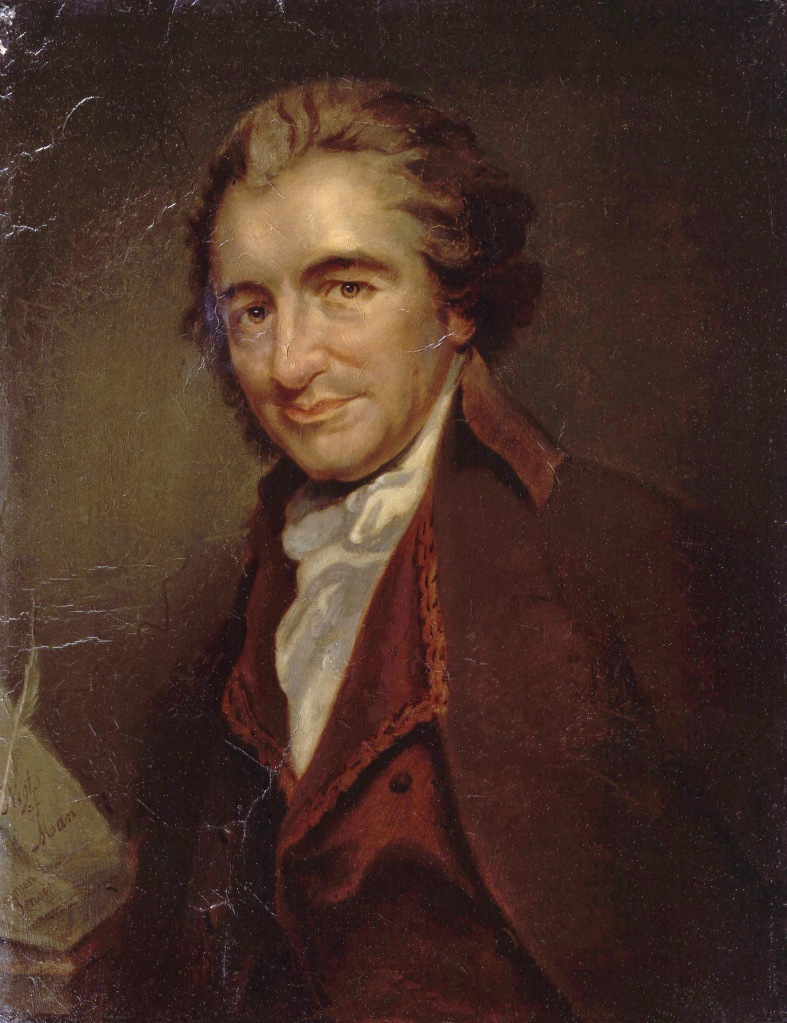
On December 19, 1776, Thomas Paine (1739-1809) published The American Crisis, a pamphlet sold on the street of Boston opposite the Court House. This was the first of a 13-part pamphlet series he published between 1776 and 1783.

1776 had been a difficult year for the American Army. After the announcement of the Declaration of Independence in July, August brought military defeats and the British captured New York City. Over 60% of Washington’s troops had left the Army, been killed or captured, and enlistments for many of those who remained were due to expire in just 13 days, on December 31. Morale was low and it appeared the Army might evaporate.

Thomas Paine was well-known for his literary support of the American Revolution. He had written another pamphlet, Common Sense, in January, 1776; it sold over 100,000 copies in the first three months, and it helped explain the necessity of the American Revolution. Now, as the American troops retreated from New York City, Paine, who was with the Army, again began to write. He penned The American Crisis to stir American patriotism and improve morale, and General Washington ordered this new pamphlet to be read to all his men. Drawing courage from Paine’s words, the Continental Troops crossed the Delaware River and defeated Hessian troops at Trenton on Christmas night. This victory helped breathe new life into the American cause.

This excerpt is from the introduction to The American Crisis.

TEXT

THESE are the times that try men’s souls: The summer soldier and the sunshine patriot will, in this crisis, shrink from the service of his country but he that stands it NOW, deserves the love and thanks of man and woman. Tyranny, like hell, is not easily conquered; yet we have this consolation with us, that the harder the conflict, the more glorious the triumph. What we obtain too cheap, we esteem too lightly;-‘Tis dearness only that gives everything its value. Heaven knows how to set a proper price upon its goods; and it would be strange indeed, if so celestial an article as Freedom should not be highly rated...

INQUIRY

  1. How does Paine construct his opening sentence as an appeal to ethos?
  2. Identify three examples of consonance (repetition of consonant sounds) in the first sentence. What is the effect of using this device, both when reading the pamphlet and when hearing it read in public?
  3. Identify the antithesis in the second sentence. What is the effect of this comparison?
  4. According to Paine, what gives things value? Do you agree? Why or why not?
  5. What does Paine consider to be a highly rated article? How do you know?
  6. Paine speaks of both heaven and hell in this section. What type of appeal is this? What is the effect?
  7. What imagery does Paine use in this excerpt? Cite at least three examples and give the effect of each.
  8. Which do you think is the most important sentence in this excerpt? Why?
  9. Do you agree with Paine’s reasoning? Why or why not?
  10. With this pamphlet and the American victory that followed, momentum in the American Revolution shifted toward the Americans. What is the importance of momentum in any type of contest, for instance a sports game? Give examples.

ADDITIONAL RESOURCES

https://www.loc.gov/resource/rbpe.03902300/?st=text

https://constitutioncenter.org/blog/how-thomas-paines-other-pamphlet-saved-the-revolution

1836: Victory or Death!

ESSENTIONAL QUESTION

What is patriotism?

CONTEXT

The Alamo began as a Spanish mission near San Antonio, now in the state of Texas, in 1718. A battle there would spark a rally cry, “Remember the Alamo,” for those who fought for Texas Independence. One of it’s commanders, William Barret Travis (1809-1836), was born in South Carolina and moved to Alabama when a boy. He went to school and later studied law in Claiborne, Alabama; however, he was soon in debt and fled to Mexico to earn money and avoid arrest. He purchased land from Stephen F. Austin and became active in the military forces opposing Mexican rule in the area which would become Texas. He was ordered to take a force to reinforce the Texan garrison at the Alamo Mission, which was greatly undermanned and undersupplied. Santa Anna, commander of the opposing Mexican forces, launched a 13-day siege of the mission. During the siege Travis wrote this letter addressed to “The People of Texas & all Americans in the world” and gave it to a courier to deliver. The letter did not bring aid to those at the Alamo; the mission was overrun and the remains of the defenders were burned. The letter did, however, rally support for Texan independence from Mexico.

TEXT

Commandancy of the Alamo
Fby. 24th, 1836

To the People of Texas & all Americans in the world–

Fellow Citizens & Compatriots: I am besieged, by a thousand or more of the Mexicans under Santa Ana–I have sustained a continual Bombardment & cannonade for 24 hours & have not lost a man–The enemy has demanded a surrender at discretion, otherwise the garrison are to be put to the sword, if the fort is taken–I have answered the demand with a cannon shot, & our flag still waves proudly from the walls–I shall never surrender or retreat. Then, I call on you in the name of Liberty, of patriotism & everything dear to the American character, to come to our aid, with all dispatch–The enemy is receiving reinforcements daily & will no doubt increase to three or four thousand in four or five days. If this call is neglected, I am determined to sustain myself as long as possible & die like a soldier who never forgets what is due to his own honor & that of his country–

VICTORY OR DEATH

William Barret Travis
Lt. Col. Comdt.

P.S. The Lord is on our side–When the enemy appeared in sight we had not three bushels of corn–We hae since found in deserted houses 80 or 90 bushels & got into the walls 20 or 30 head of Beeves–

Travis

INQUIRY

  1. What is a compatriot?
  2. How do you know that Travis refuses to surrender to Santa Anna?
  3. What will be the consequences of this refusal to surrender?
  4. According to Travis, why should people come to their aid?
  5. What kind of appeal is Travis making when he says, “The Lord is on our side”?
  6. What is patriotism?
  7. Are there things you would defend even if you were hopelessly outnumbered? Why?

ADDITIONAL RESOURCES

thealamo.org

Three Roads to the Alamo: The Lives and Fortunes of David Crockett, James Bowie, and William Barret Travis by William C. Davis

https://www.tshaonline.org/handbook/entries/alamo-battle-of-the

1781: Jefferson’s Notes on Slavery

This image has an empty alt attribute; its file name is thomas_jefferson_met_dt2069.jpg

ESSENTIAL QUESTION

How did Thomas Jefferson, a life-long slave holder, view the existence of slavery as a philosophical question?

CONTEXT

Thomas Jefferson (1743-1826), third president of the US, was a slave owner his entire adult life. Yet in some of his writings he noted that slavery was harmful to the slave, the master, and society in general. Historians have argued over the years about Jefferson’s thoughts and actions regarding slavery, and recent scholarship confirms that within Jefferson, slavery presented ideals that clashed with realities that he struggled with but could not resolve.

In 1780, while the American Revolution was still in progress, Francois Barbe-Marbois, secretary to the French legation in Philadelphia, sent a questionnaire to each of the governors of the former 13 American Colonies. He sought information about individual colonial history, geography, natural resources, and government, to be sent back to France. Jefferson, then governor of Virginia, complied his responses into a book, Notes on the State of Virginia, first published in 1781 and later revised and republished multiple times. The only full-length book Jefferson published during his lifetime, through 23 chapters he explored not only Virginia at that time but also his ideas on the future of Virginia and by extension, the future of America. This excerpt is from the 1784 version, describing what Jefferson thinks about slavery at the time, not what he is practicing.

As you read Jefferson’s text, remember when it was written. Pay special attention to how he uses language to convey his thoughts. Although the term “slave” is used in this lesson to preserve the historical text, most scholars today prefer the term, “enslaved person.”

VOCABULARY Understanding these terms will help you understand the text.

  • Commerce
  • Perpetual
  • Boisterous
  • Unremitting
  • Despotism
  • Degrading
  • Temperate
  • Perceptible
  • Abating
  • Mollifying
  • Auspices
  • Disposed
  • Extirpation

TEXT

…There must doubtless be an unhappy influence on the manners of our people produced by the existence of slavery among us. The whole commerce between master and slave is a perpetual exercise of the most boisterous passions, the most unremitting despotism on the one part, and degrading submissions on the other…

…For if a slave can have a country in this world, it must be any other in preference to that in which he is born to live and labor for another; in which he must lock up the faculties of his nature…

…But it is impossible to be temperate and to pursue this subject through the various considerations of policy, of morals, of history natural and civil. We must be contented to hope they will force their way into every one’s mind. I think a change already perceptible, since the origin of the present revolution. The spirit of the master is abating, that of the slave rising from the dust, his condition mollifying, the way I hope preparing, under the auspices of heaven, for a total emancipation, and that this is disposed, in the order of events, to be with the consent of the master, rather than by their extirpation.

INQUIRY

[AS PART OF YOUR RESPONSE, QUOTE FROM THE TEXT WHERE YOU FOUND THE ANSWER]

1. How does the existence of slavery affect the “manners” of Virginia? Why?

2. According to Jefferson, are slaves happy in their condition? How do you know?

3. What does Jefferson mean by “the faculties of his nature”? Why would “locking” up these faculties make slaves wish for another existence?

4. Does Jefferson believe that slavery can be easily discussed? Quote from the text.

5. How does Jefferson believe the existence of slavery will be resolved?

6. When does Jefferson believe the issue of slavery will be resolved?

7. Does Jefferson see the possibility of total emancipation? How might religion be involved? Why might he include this religious reference?

8. What does Jefferson mean by “in the order of events”?

9. Does Jefferson expect masters to cooperate with total emancipation? How do you know?

10. Is it possible to believe one thing but act in conflict with your belief? Why might this happen? Why do you think it happened to Jefferson? Why might it happen to you or someone you know?

ADDITIONAL RESOURCES

Gordon-Reed, Annette, and Peter S. Onuf. “Most Blessed of the Patriarchs”: Thomas Jefferson and the Empire of the Imagination. Liveright Publishing Corporation, 2017.

Jefferson, Thomas. Notes on the State of Virginia ; Written in the Year 1781, Somewhat Corrected and Enlarged in the Winter of 1782, for the Use of a Foreigner of Distinction, in Answer to Certain Queries Proposed by Him … 1782. 1784.

Monticello.org