Tag: native-americans

1881: Jackson’s “Century of Dishonor”

ESSENTIAL QUESTION:

Investigate America’s “Century of Dishonor.”

CONTEXT:

Helen Hunt Jackson (1830-1885), born in Massachusetts, was a poet, author, and Native American rights activist. She later moved to Colorado on the advice of her physicians to improve her poor health. In 1879 she was inspired by Chief Standing Bear (c. 1829-1908, a Ponca chief and Native American activist who argued successfully in 1879 for judicial rights in federal court), and she later wrote A Century of Dishonor, an expose of the crimes against Native Americans. It led to the founding of the Indian Rights Association (1930-1994). She died of stomach cancer in 1885.

This excerpt is from A Century of Dishonor.

TEXT: (NOTE: “Indian” is used as it was in the original text)

…There is not among these three hundred bands of Indians [in the United States] one which has not suffered cruelly at the hands either of the Government or of white settlers. The poorer, the more insignificant, the more helpless the band, the more certain the cruelty and outrage to which they have been subjected. This is especially true of the bands on the Pacific slopes.

These Indians found themselves of a sudden surrounded by and caught up in the
great influx of gold-seeking settlers, as helpless creatures on a shore are caught
up in a tidal wave. There was not time for the Government to make treaties;
not even time for communities to make laws. The tale of the wrongs, the
oppressions, the murders of the Pacific-slope Indians in the last thirty years
would be a volume by itself, and is too monstrous to be believed.
It makes little difference, however, where one opens the record of the
history of the Indians; every page and every year has its dark stain. The story of
one tribe is the story of all, varied only by differences of time and place; but
neither time nor place makes any difference in the main facts. Colorado is as
greedy and unjust in 1880 as was Georgia in 1830, and Ohio in 1795; and the
United States Government breaks promises now as deftly as then, and with added ingenuity long practice….

The history of the Government connections with the Indians is a
shameful record of broken treaties and unfulfilled promises. The history of the
border, white man’s connection with the Indians is a sickening record of
murder, outrage, robbery, and wrongs committed by the former, as the rule,
and occasional savage outbreaks and unspeakably barbarous deeds of
retaliation by the latter, as the exception….

INQUIRY: (NOTE: the term “Indian” is used in the questions as it was in Jackson’s text)

  1. What two sources did Jackson list as the source of Indian mistreatment?
  2. What role did the Gold Rush play in the mistreatment of the Indians?
  3. According to Jackson, were any tribes exempt from mistreatment? How do you know?
  4. How did Jackson characterize “the history of the Government connections” with the Indians?
  5. How did she characterize “the border, white man’s connection” with the Indians?
  6. Investigate Red Cloud, leader of the Oglala Sioux from 1865 until 1900. Evaluate his relationship with the US Government. Or choose another Native American leader to investigate, such as Sitting Bull, Geronimo, Tecumseh, Black Hawk, or Crazy Horse. Compare their relationships with the US Government during their times.
  7. The Battle of Wounded Knee in South Dakota occurred in 1890. Investigate this battle and assess how it characterized the attitude of the US Army at the time.
  8. The term “Indian” is now usually considered derogatory and offensive. “First Nations”, “Native Americans”, or other terms such as individual tribal names are considered more appropriate. Why does it matter? What value does a name have?

ADDITIONAL RESOURCES:

https://www.nps.gov/articles/000/a-century-of-dishonor-by-helen-hunt-jackson.htm

https://archive.org/details/centuryofdishono00jackrich/page/n7/mode/2up

https://www.gutenberg.org/files/50560/50560-h/50560-h.htm

https://aktalakota.stjo.org/american-indian-leaders/red-cloud/
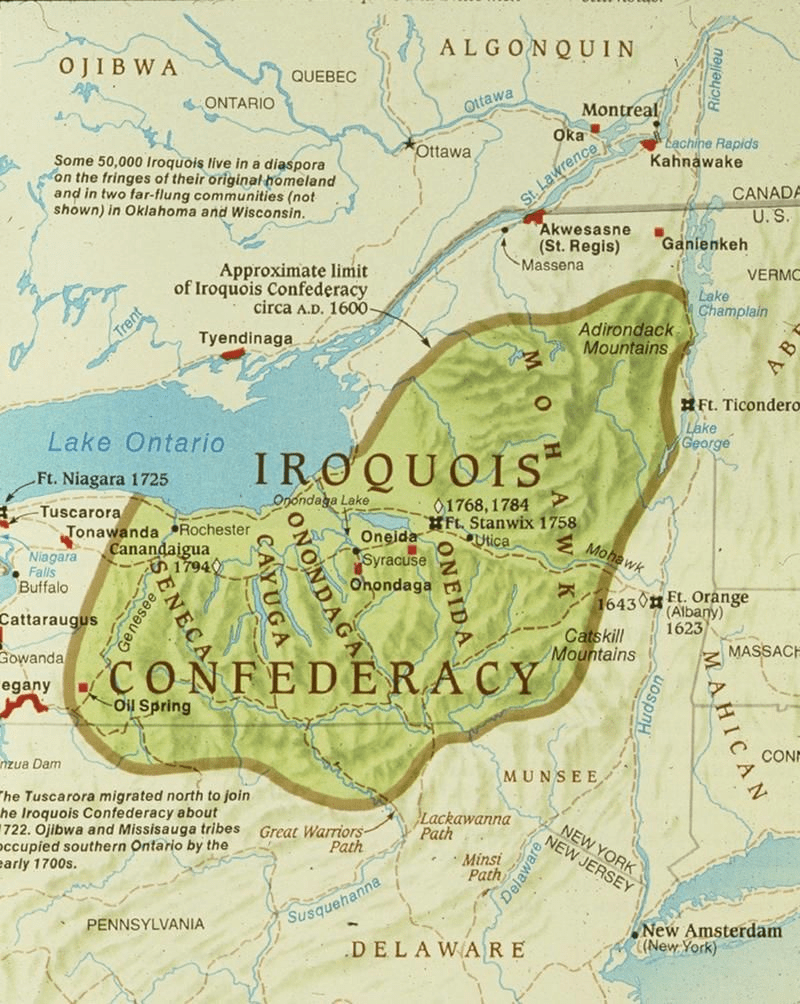
1570: Haudenosaunee Constitution

ESSENTIAL QUESTION:

How did early Native American culture reflect their values?

CONTEXT:

The Haudenosaunee were a group of Native Americans in what would become the New England colonies in America, and they were present well before colonial settlement. They are sometimes called the “Iroquois Confederacy,” but this was a name given to them by French fur trappers; the English called them the “League of Five Nations.” The Haudenosaunee were actually a language and cultural group, and from this grew the Haudenosaunee Confederacy, a political union. The Seneca, Cayuga, Onondaga, Oneida, and Mohawk tribes were original members, and the Tuscarora joined the Confederacy in approximately 1722.

The Haudenosaunee Confederacy developed a Constitution which was oral, recorded on wampum belts, and may have dated to as early as 1190. Passed down through the generations, it was later written and translated into English in the 19th century. Known as “The Great Law of Peace,” the Constitution emphasized peace and unity among the nations, consensus decision making, established a legal system, and created delegates to form a Grand Council. This text is drawn from a translation.

The Haudenosaunee Confederacy still exists today.

TEXT:

This is wisdom and justice of the part of the Great Spirit to create and raise chiefs, give and establish unchangable laws, rules and customs between the Five Nation Indians, viz the Mohawks, Oneidas, Onondagas, Cayugas and Senecas and the other nations of Indians in North America. The object of these laws is to establish peace between the numerous nations of Indians, hostility will be done away with, for the preservation and protection of life, property and liberty…

And when the Five Nation Indians confederation chiefs assemble to hold a council, the council shall be duly opened and closed by the Onondaga chiefs, the Firekeepers. They will offer thanks to the Great Spirit that dwells in the heave above the source and ruler of our lives, and it is him that sends daily blessings upon us, our daily wants and daily health, and they will then declare the council open for the transaction of business, and give decisions of all that is done in the council…

INQUIRY:

  1. In the first sentence, what does the Great Spirit do?
  2. What is the purpose of these laws, rules and customs?
  3. How do the Nations open their Council? Why is that significant?
  4. For what do the Nations offer thanks? How does that characterize their relationship with the Great Spirit?
  5. How does the Haudenosaunee Constitution blend laws and values?
  6. Haudenosaunee means “people of the longhouse.” They not only lived in longhouses but also saw their culture as a connected people within a metaphorical longhouse, serving as an image of the connection of the tribes of the Confederacy. How does living close to each other encourage the principles of the Haudenosaunee?
  7. Historians debate the influence of the Haudenosaunee Constitution on the US Constitution. Certainly Benjamin Franklin was familiar with the principles of the Haudenosaunee Constitution; he invited representatives of the Iroquois Nations to the Provincial Council of Pennsylvania in 1744 and the Albany Congress in 1754 to help promote peace, equity and justice in the gathering of colonies. The US Senate, in 1987, formally recognized that the framers of the US Constitution admired the principles and practices of the Confederacy (yet the Constitution itself was based more upon Enlightenment principles of the time). What similarities do you see with this excerpt and the US Constitution?
  8. Investigate the Albany Congress and the Albany Plan of Union. What similarities do you see with the Haudenosaunee Constitution?
  9. During the American colonial period the Haudenosaunee developed political alliances with the French and the English, based on their own tribal benefits. Yet during the American Revolution the Confederacy fractured, with some tribes siding with the English and some with the Americans. How did this violate one of their core principles?
  10. Many historians recognize the Haudenosaunee Confederacy as the world oldest democracy. Do you agree? Why or why not?

ADDITIONAL RESOURCES:

haudenosauneeconfederacy.com

https://web.pdx.edu/~caskeym/iroquois_web/html/greatlaw.html