ESSENTIAL QUESTION:
How did early Native American culture reflect their values?
CONTEXT:
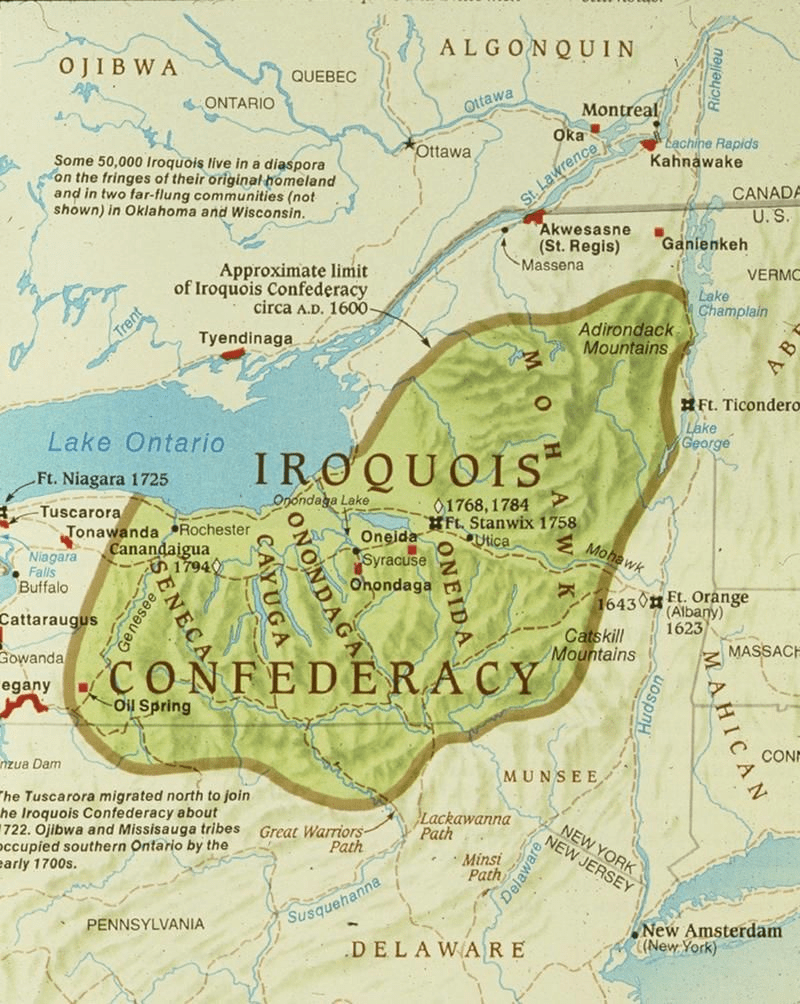
The Haudenosaunee were a group of Native Americans in what would become the New England colonies in America, and they were present well before colonial settlement. They are sometimes called the “Iroquois Confederacy,” but this was a name given to them by French fur trappers; the English called them the “League of Five Nations.” The Haudenosaunee were actually a language and cultural group, and from this grew the Haudenosaunee Confederacy, a political union. The Seneca, Cayuga, Onondaga, Oneida, and Mohawk tribes were original members, and the Tuscarora joined the Confederacy in approximately 1722.
The Haudenosaunee Confederacy developed a Constitution which was oral, recorded on wampum belts, and may have dated to as early as 1190. Passed down through the generations, it was later written and translated into English in the 19th century. Known as “The Great Law of Peace,” the Constitution emphasized peace and unity among the nations, consensus decision making, established a legal system, and created delegates to form a Grand Council. This text is drawn from a translation.
The Haudenosaunee Confederacy still exists today.
TEXT:
…This is wisdom and justice of the part of the Great Spirit to create and raise chiefs, give and establish unchangable laws, rules and customs between the Five Nation Indians, viz the Mohawks, Oneidas, Onondagas, Cayugas and Senecas and the other nations of Indians in North America. The object of these laws is to establish peace between the numerous nations of Indians, hostility will be done away with, for the preservation and protection of life, property and liberty…
And when the Five Nation Indians confederation chiefs assemble to hold a council, the council shall be duly opened and closed by the Onondaga chiefs, the Firekeepers. They will offer thanks to the Great Spirit that dwells in the heave above the source and ruler of our lives, and it is him that sends daily blessings upon us, our daily wants and daily health, and they will then declare the council open for the transaction of business, and give decisions of all that is done in the council…
INQUIRY:
- In the first sentence, what does the Great Spirit do?
- What is the purpose of these laws, rules and customs?
- How do the Nations open their Council? Why is that significant?
- For what do the Nations offer thanks? How does that characterize their relationship with the Great Spirit?
- How does the Haudenosaunee Constitution blend laws and values?
- Haudenosaunee means “people of the longhouse.” They not only lived in longhouses but also saw their culture as a connected people within a metaphorical longhouse, serving as an image of the connection of the tribes of the Confederacy. How does living close to each other encourage the principles of the Haudenosaunee?
- Historians debate the influence of the Haudenosaunee Constitution on the US Constitution. Certainly Benjamin Franklin was familiar with the principles of the Haudenosaunee Constitution; he invited representatives of the Iroquois Nations to the Provincial Council of Pennsylvania in 1744 and the Albany Congress in 1754 to help promote peace, equity and justice in the gathering of colonies. The US Senate, in 1987, formally recognized that the framers of the US Constitution admired the principles and practices of the Confederacy (yet the Constitution itself was based more upon Enlightenment principles of the time). What similarities do you see with this excerpt and the US Constitution?
- Investigate the Albany Congress and the Albany Plan of Union. What similarities do you see with the Haudenosaunee Constitution?
- During the American colonial period the Haudenosaunee developed political alliances with the French and the English, based on their own tribal benefits. Yet during the American Revolution the Confederacy fractured, with some tribes siding with the English and some with the Americans. How did this violate one of their core principles?
- Many historians recognize the Haudenosaunee Confederacy as the world oldest democracy. Do you agree? Why or why not?
ADDITIONAL RESOURCES:
haudenosauneeconfederacy.com
https://web.pdx.edu/~caskeym/iroquois_web/html/greatlaw.html
 Read Closely