Tag: politics

1974: Nixon Resigns

ESSENTIAL QUESTION:

How can the powers of the US President be limited?

CONTEXT:

Richard Milhous Nixon (1913-1994) was the 37th president of the US, serving from 1969 until 1974. Prior to his presidency he served in several political offices, including as vice president under President Dwight D. Eisenhower. Elected President in 1968, he resigned in 1974 in the wake of the Watergate Scandal, a break-in at the Democratic Party Headquarters in Washington, DC, and the Nixon administration’s cover-up of that criminal act. Nixon was the only US president to resign from office. This text is from his last public speech as president and was broadcast live on radio and TV on August 8, 1974. Nixon died in New York in 1994.

TEXT:

This is the 37th time I have spoken to you from this office, where so many decisions have been made that shaped the history of this Nation. Each time I have done so to discuss with you some matter that I believe affected the national interest.

In all the decisions I have made in my public life, I have always tried to do what was best for the Nation. Throughout the long and difficult period of Watergate, I have felt it was my duty to persevere, to make every possible effort to complete the term of office to which you elected me. In the past few days, however, it has become evident to me that I no longer have a strong enough political base in the Congress to justify continuing that effort. As long as there was such a base, I felt strongly that it was necessary to see the constitutional process through to its conclusion, that to do otherwise would be unfaithful to the spirit of that deliberately difficult process and a dangerously destabilizing precedent for the future. But with the disappearance of that base, I now believe that the constitutional purpose has been served, and there is no longer a need for the process to be prolonged.

I would have preferred to carry through to the finish whatever the personal agony it would have involved, and my family unanimously urged me to do so. But the interest of the Nation must always come before any personal considerations. From the discussions I have had with Congressional and other leaders, I have concluded that because of the Watergate matter I might not have the support of the Congress that I would consider necessary to back the very difficult decisions and carry out the duties of this office in the way the interests of the Nation would require.

I have never been a quitter. To leave office before my term is completed is abhorrent to every instinct in my body. But as President, I must put the interest of America first. America needs a full-time President and a full-time Congress, particularly at this time with problems we face at home and abroad. To continue to fight through the months ahead for my personal vindication would almost totally absorb the time and attention of both the President and the Congress in a period when our entire focus should be on the great issues of peace abroad and prosperity without inflation at home.

Therefore, I shall resign the Presidency effective at noon tomorrow. Vice President Ford will be sworn in as President at that hour in this office….

By taking this action, I hope that I will have hastened the start of that process of healing which is so desperately needed in America.

I regret deeply any injuries that may have been done in the course of the events that led to this decision. I would say only that if some of my Judgments were wrong, and some were wrong, they were made in what I believed at the time to be the best interest of the Nation.

So, let us all now join together in affirming that common commitment and in helping our new President succeed for the benefit of all Americans….

INQUIRY:

  1. Nixon’s successor as president, Gerald Ford, had not been elected; he was appointed to the office of vice president after Nixon’s elected vice president, Spiro Agnew, resigned in 1973 (from charges of tax evasion). Gerald Ford, as president after Nixon’s resignation, then nominated Nelson Rockefeller as vice president. Thus from 1974 until 1977 neither the president nor the vice president were elected by the people. What part of the US Constitution provides for succession to the presidency? Why would it have been necessary to nominate a vice president if there was not one currently in office? Who had to approve Rockefeller’s appointment as vice president?
  2. What did Nixon give as the reasons that he chose to resign?
  3. Investigate the Watergate Scandal and how and why it destroyed confidence in the Nixon presidency.
  4. What is impeachment? Where and in what ways does the US Constitution discuss impeachment?
  5. Congress had already begun the impeachment process against Nixon, but he resigned before the articles of impeachment could be passed. Would it have been better for the country if he had gone through with the impeachment process? Why or why not?
  6. How important is it for a president to have a “political base” in Congress? Why?
  7. In what ways did Nixon deflect blame from himself for the necessity to resign? In what ways did he accept blame?
  8. How did Nixon change the tone of this speech in the next to last sentence? In the last sentence?

ADDITIONAL RESOURCES:

https://www.pbs.org/newshour/spc/character/links/nixon_speech.html

https://www.nixonlibrary.gov/president-nixon

https://www.whitehousehistory.org/bios/richard-nixon

1570: Haudenosaunee Constitution

ESSENTIAL QUESTION:

How did early Native American culture reflect their values?

CONTEXT:

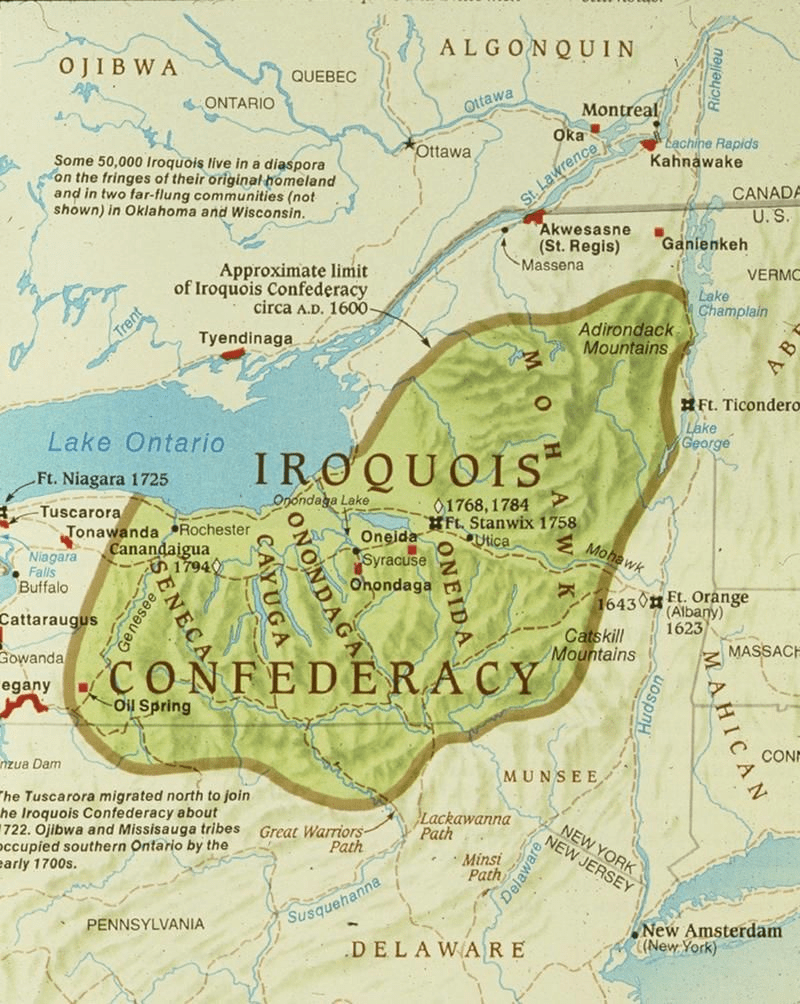
The Haudenosaunee were a group of Native Americans in what would become the New England colonies in America, and they were present well before colonial settlement. They are sometimes called the “Iroquois Confederacy,” but this was a name given to them by French fur trappers; the English called them the “League of Five Nations.” The Haudenosaunee were actually a language and cultural group, and from this grew the Haudenosaunee Confederacy, a political union. The Seneca, Cayuga, Onondaga, Oneida, and Mohawk tribes were original members, and the Tuscarora joined the Confederacy in approximately 1722.

The Haudenosaunee Confederacy developed a Constitution which was oral, recorded on wampum belts, and may have dated to as early as 1190. Passed down through the generations, it was later written and translated into English in the 19th century. Known as “The Great Law of Peace,” the Constitution emphasized peace and unity among the nations, consensus decision making, established a legal system, and created delegates to form a Grand Council. This text is drawn from a translation.

The Haudenosaunee Confederacy still exists today.

TEXT:

This is wisdom and justice of the part of the Great Spirit to create and raise chiefs, give and establish unchangable laws, rules and customs between the Five Nation Indians, viz the Mohawks, Oneidas, Onondagas, Cayugas and Senecas and the other nations of Indians in North America. The object of these laws is to establish peace between the numerous nations of Indians, hostility will be done away with, for the preservation and protection of life, property and liberty…

And when the Five Nation Indians confederation chiefs assemble to hold a council, the council shall be duly opened and closed by the Onondaga chiefs, the Firekeepers. They will offer thanks to the Great Spirit that dwells in the heave above the source and ruler of our lives, and it is him that sends daily blessings upon us, our daily wants and daily health, and they will then declare the council open for the transaction of business, and give decisions of all that is done in the council…

INQUIRY:

  1. In the first sentence, what does the Great Spirit do?
  2. What is the purpose of these laws, rules and customs?
  3. How do the Nations open their Council? Why is that significant?
  4. For what do the Nations offer thanks? How does that characterize their relationship with the Great Spirit?
  5. How does the Haudenosaunee Constitution blend laws and values?
  6. Haudenosaunee means “people of the longhouse.” They not only lived in longhouses but also saw their culture as a connected people within a metaphorical longhouse, serving as an image of the connection of the tribes of the Confederacy. How does living close to each other encourage the principles of the Haudenosaunee?
  7. Historians debate the influence of the Haudenosaunee Constitution on the US Constitution. Certainly Benjamin Franklin was familiar with the principles of the Haudenosaunee Constitution; he invited representatives of the Iroquois Nations to the Provincial Council of Pennsylvania in 1744 and the Albany Congress in 1754 to help promote peace, equity and justice in the gathering of colonies. The US Senate, in 1987, formally recognized that the framers of the US Constitution admired the principles and practices of the Confederacy (yet the Constitution itself was based more upon Enlightenment principles of the time). What similarities do you see with this excerpt and the US Constitution?
  8. Investigate the Albany Congress and the Albany Plan of Union. What similarities do you see with the Haudenosaunee Constitution?
  9. During the American colonial period the Haudenosaunee developed political alliances with the French and the English, based on their own tribal benefits. Yet during the American Revolution the Confederacy fractured, with some tribes siding with the English and some with the Americans. How did this violate one of their core principles?
  10. Many historians recognize the Haudenosaunee Confederacy as the world oldest democracy. Do you agree? Why or why not?

ADDITIONAL RESOURCES:

haudenosauneeconfederacy.com

https://web.pdx.edu/~caskeym/iroquois_web/html/greatlaw.html

1883: The New Colossus

ESSENTIAL QUESTION:

How can the meaning of a symbol change over time?

CONTEXT:

The Statue of Liberty is a huge neoclassical sculpture of a draped woman, possibly inspired by the Roman goddess of liberty, Libertas, standing on Liberty Island in New York Harbor. She holds a torch above in her right hand and in her left she holds a tablet inscribed July 4, 1776, the accepted date of the American Declaration of Independence.

The large statue was designed by Frederic Auguste Bartholdi of France, and it was intended to be celebrate America’s 100 years of Independence in 1876 and represent the friendship between the US and France. It was erected on Liberty Island in New York Harbor in 1886. A gift to the US from France, it served as a lighthouse in the Harbor from 1886 until 1902. It is made primarily of copper, which has oxidized to green over the years. It serves as a symbol of freedom and was the first thing many immigrants of the early 20th century saw as they entered New York Harbor. Between 1900 and 1915, almost 15 million immigrants arrived in America, more that in the previous 40 years combined.

In 1883 poet Emma Lazarus wrote a verse to help raise money to build the base for the Statue. In 1903 the poem was engraved on a bronze plaque which is located inside the base. This text is her poem and was entitled “The New Colossos.”

TEXT:

Not like the brazen giant of Greek fame,
With conquering limbs astride from land to land,
Here at our sea-washed, sunset gates shall stand
A mighty woman with a torch, whose flame
Is the imprisoned lightning, and her name
Mother of Exiles. From her beacon-hand
Glows worldwide welcome; her mild eyes command
The air-bridged harbor that twin cities frame.

“Keep, ancient lands, your storied pomp!” cries she
With silent lips. “Give me your tired, your poor,
Your huddled masses yearning to breathe free,
The wretched refuse of your teeming shore.
Send these, the homeless, tempest-tost to me,
I lift my lamp beside the golden door!”

INQUIRY:

  1. In her first two lines Lazarus alluded to the Colossos of Rhodes. The Colossos of Rhodes was a giant bronze status erected in the town of Rhodes, Greece, near the harbor and stood 110 feet tall. It was considered a wonder of the ancient world. Destroyed by an earthquake in 226 BCE, it symbolized ancient engineering and artistry and celebrated Greek military victories. Why did Lazarus begin her poem by contrasting the Statue of Liberty with the Colossos of Rhodes? What is the effect of this contrast?
  2. How did Lazarus describe New York Harbor?
  3. How did Lazarus describe the Statue of Liberty? What is her name? How does this name identify the purpose of the Statue?
  4. How did Lazarus characterize the torch? What was it’s purpose?
  5. What does the Statue mean when she says, “Keep, ancient lands, your storied pomp”? To whom is this addressed?
  6. To whom is the Statue lifting “my lamp beside the golden door”? Describe them. How do you know?
  7. What is the golden door?
  8. What is the tone of this poem? How do you know? Cite from the poem.
  9. Research American immigration laws and how they have changed since 1903. Especially note how immigration has remained a political issue over time.
  10. In what ways has the meaning of the Statue of Liberty changed since 1903?

ADDITIONAL RESOURCES:

https://www.nps.gov/stli/learn/historyculture/places_creating_statue.htm#:~:text=The%20head%20and%20shoulders%20were,Statue%20of%20Liberty%20in%20Paris.

https://en.wikipedia.org/wiki/Statue_of_Liberty

https://en.wikipedia.org/wiki/The_New_Colossus

1962: JFK and Cuba

ESSENTIAL QUESTION:

In what ways can diplomacy be more effective that physical force?

CONTEXT:

In 1962 the US and the USSR (Soviet Union) were embroiled in the Cold War, a period of intense global tension lasting from 1947 until 1991. Born in the aftermath of World War II amid different views of the future of the world, the US and the Soviet Union (and their respective allies) were intense enemies. Although actual military conflict did not break out as part of the Cold War, competition was keen in several areas. The US wished to contain the spread of Soviet Communism to other countries, and each side developed nuclear weapons with a MAD philosophy. MAD, or mutually assured destruction, meant that each side wanted to develop enough weapons to discourage the other side from firing on them first: if the Soviets fired on the US, the US could retaliate with enough fire power to destroy the Soviet Union. Each side competed to build the first rockets and capsules into space, not only to explore but also to use them to supplement military strategy. The Soviet section of the German capitol of Berlin (from the end of WWII) was walled off from the rest of Berlin (the famous Berlin Wall). Years later the Cold War finally deescalated with the fall of Soviet regimes in the late 1980s, the fall of the Berlin Wall in 1989, and the collapse of the Soviet Union in 1991.

But in 1962 the Cold War had escalated to a flash point, and war between the US and the Soviet Union seemed imminent. On October 14, 1962, an American spy plane photographed nuclear missile launch sites being built in Cuba. Cuba is an island only 90 miles south of Florida, and nuclear missiles launched from there could easily reach the US, Canada, Mexico, and areas throughout the Caribbean. While US President John Kennedy’s military advisors strongly recommended a military response, Kennedy, known as JFK, (1917-1963) chose another course of action. On October 22 he announced the threat to America and his plans to install a blockade around Cuba to prevent any additional construction. However, a blockade is legally an act of war, so Kennedy labeled his action a “quarantine.” While the Soviet Premier Nikita Khrushchev initially refused to remove the weapons and an American pilot was shot down by Cuban soldiers, on October 28 a diplomatic resolution was reached whereby the Soviets removed the missiles from Cuba and the US promised not to invade Cuba and removed missiles they had stationed in Turkey. In addition, a direct line of communication was established between the US and USSR to prevent future misunderstandings.

This text is taken from JFK’s speech to the American people announcing the Crisis. broadcasted on radio and television on October 22, 1962.

TEXT:

This government, as promised, has maintained the closest surveillance of the Soviet military buildup
on the island of Cuba. Within the past week, unmistakable evidence has established the fact that a
series of offensive missile sites is now in preparation on that imprisoned island. The purpose of these
bases can be none other than to provide a nuclear strike capability against the Western Hemisphere.
..

Acting, therefore, in the defense of our own security and of the entire Western Hemisphere, and under the authority entrusted to me by the Constitution as endorsed by the resolution of the Congress, I have directed that the following initial steps be taken immediately:


To halt this offensive buildup, a strict quarantine on all offensive military equipment under shipment to Cuba is being initiated. All ships of any kind bound for Cuba from whatever nation and port will, if found to contain cargoes of offensive weapons, be turned back. This quarantine will be extended, if needed, to other types of cargo and carriers. We are not at this time, however, denying the necessities of life as the Soviets attempted to do in their Berlin blockade of 1948…

It shall be the policy of this nation to regard any nuclear missile launched from Cuba against any nation in the Western Hemisphere as an attack on the United States, requiring a full retaliatory response upon the Soviet Union.

Under the Charter of the United Nations, we are asking tonight that an emergency meeting of the Security Council be convoked without delay to take action against this latest Soviet threat to world peace. Our resolution will call for the prompt dismantling and withdrawal of all offensive weapons in Cuba, under the supervision of U.N. observers, before the quarantine can be lifted.

I call upon Chairman Khrushchev to halt and eliminate this clandestine, reckless, and provocative threat to world peace and to stable relations between our two nations. I call upon him further to abandon this course of world domination, and to join in an historic effort to end the perilous arms race and to transform the history of man. He has an opportunity now to move the world back from the abyss of destruction — by returning to his government’s own words that it had no need to station missiles outside its own territory, and withdrawing these weapons from Cuba — by refraining from any action which will widen or deepen the present crisis — and then by participating in a search for peaceful and permanent solutions. …

My fellow citizens: let no one doubt that this is a difficult and dangerous effort on which we have set out. No one can foresee precisely what course it will take or what costs or casualties will be incurred.
Many months in which both our patience and our will will be tested — months in which many threats
and denunciations will keep us aware of our dangers. But the greatest danger of all would be to do
nothing. …

Our goal is not the victory of might, but the vindication of right — not peace at the expense of freedom, but both peace and freedom, here in this hemisphere, and we hope, around the world. God
willing, that goal will be achieved
.

INQUIRY:

  1. Kennedy used several adjectives in the first paragraph. What is the effect of “closest” surveillance and “unmistakable” evidence? How does this set the tone of the speech?
  2. In Kennedy’s argument how did he affirm the purpose of the Soviet weapons? What phrase did he use?
  3. How did JFK define his quarantine? What items would be prevented from continuing on to Cuba?
  4. Why did JFK reference the Berlin Blockade of 1948? (For more information on that blockade, see https://history.state.gov/milestones/1945-1952/berlin-airlift )
  5. According to JFK, what will be the response of the US should any of the Soviet missiles be launched?
  6. Why did JFK call for an emergency meeting of the UN Security Council? What type of appeal is this (ethos, pathos, logos)?
  7. What did JFK ask Khrushchev to do? Characterize his options as presented by Kennedy.
  8. Why did JFK warn the American people that this would be a “difficult and dangerous” effort? Remember, WWII had ended only 17 years before this speech.
  9. What did JFK clearly state as America’s goal in this crisis? Based on this goal, why do you believe he chose a non-military response first?
  10. Identify the tone of this speech. Does it change? If so, where and how do you know?
  11. Research EXCOMM, JFK’s 12-member advisory committee. What was their role in the Crisis?
  12. Do you believe JFK’s goal had been achieved? Why or why not?

ADDITIONAL RESOURCES:

https://history.state.gov/milestones/1961-1968/cuban-missile-crisis

https://microsites.jfklibrary.org/cmc/

https://www.jfklibrary.org/learn/about-jfk/historic-speeches/address-during-the-cuban-missile-crisis

2015: Obama at Selma

ESSENTIAL QUESTION:

How does the First March on Selma reflect the strength of the Civil Rights Movement?

CONTEXT:

On March 7, 1965, the first of a series of three protest marches demanding voting rights for African Americans took place in Selma, Alabama. The three marches were to go from Selma to Montgomery (the capital of Alabama), a 54 miles trek. The marches were organized by non-violent groups and were part of the larger civil rights movement to guarantee voting rights for African Americans, who had been denied voting rights through various means for decades.

On March 7, 1965, the marchers were ordered by local authorities not to cross the Edmund Pettus Bridge in Selma. The non-violent march continued and police rushed the crowd with batons and tear gas. The march was televised and led to a national call for voting rights legislation. On August 6, 1965, Congress passed the Voting Rights Act of 1965.

On the 50th anniversary of the March, in 2015, President Obama and his family joined many at the same bridge to commemorate the March of 1965. This text is taken from his speech on that occasion.

TEXT:

It is a rare honor in this life to follow one of your heroes.  And John Lewis is one of my heroes.

Now, I have to imagine that when a younger John Lewis woke up that morning 50 years ago and made his way to Brown Chapel, heroics were not on his mind.  A day like this was not on his mind.  Young folks with bedrolls and backpacks were milling about.  Veterans of the movement trained newcomers in the tactics of non-violence; the right way to protect yourself when attacked.  A doctor described what tear gas does to the body, while marchers scribbled down instructions for contacting their loved ones.  The air was thick with doubt, anticipation and fear…

As John noted, there are places and moments in America where this nation’s destiny has been decided.  Many are sites of war — Concord and Lexington, Appomattox, Gettysburg.  Others are sites that symbolize the daring of America’s character — Independence Hall and Seneca Falls, Kitty Hawk and Cape Canaveral.

Selma is such a place.  In one afternoon 50 years ago, so much of our turbulent history — the stain of slavery and anguish of civil war; the yoke of segregation and tyranny of Jim Crow; the death of four little girls in Birmingham; and the dream of a Baptist preacher — all that history met on this bridge. 

It was not a clash of armies, but a clash of wills; a contest to determine the true meaning of America…

INQUIRY:

  1. Obama uses the word “hero” in the first sentence. How does this image bring the speech to a personal level?
  2. In the next paragraph, Obama includes both “veterans of the movement” and “young folks.” How does this contribute to the description of the original march? Why is it important to know what types of people were part of the original march?
  3. What is the effect of a doctor describing what tear gas does to the body?
  4. Why were some marchers writing instructions for contracting their loved ones? What does this say about their expectations of the march?
  5. In the next paragraph Obama lists times when “the nation’s destiny has been decided” and “sites that symbolize the daring of America’s character”. How does this contribute to the importance of his subject and how does he connect these events to Selma?
  6. In the second sentence of the fourth paragraph Obama lists elements of American history. What are these elements? Why does he list them this way? How does this explain the significance of the events on the Pettus Bridge?
  7. In the last paragraph Obama deemphasizes the military response but instead emphasizes “a clash of wills.” How does this characterize and emphasize the importance of the Selma March?
  8. For what would you be willing to protest if you believed it could result in physical harm? What are other ways of protesting?

ADDITIONAL RESOURCES:

https://www.archives.gov/research/african-americans/vote/selma-marches

https://obamawhitehouse.archives.gov/the-press-office/2015/03/07/remarks-president-50th-anniversary-selma-montgomery-marches

https://www.history.com/articles/selma-montgomery-march

1630: Winthrop on “The Hill”

ESSENTIAL QUESTION

How did John Winthrop prepare colonists to emigrate to the Massachusetts Bay Colony?

CONTEXT

John Winthrop (1588-1649) was born into a wealthy merchant family in England and studied to become a lawyer. A deeply religious Puritan, he believed that the English Reformation was in danger from governmental policies, and with other Puritans he emigrated to the New World to escape persecution. In 1630 he arrived as the governor of the Massachusetts Bay Colony (the second English colony in the New World, as Plymouth Colony, settled in 1620, was the first). He served as governor of the Colony for most of the period 1630-1649 and upheld a rigid form of Puritan orthodoxy. He kept a journal most of his life, wrote many letters and documents, and is well-known for the lecture, “A Model of Christian Charity,” delivered before his group of emigrants left to face an unknown future in the New World. This text is taken from that lecture.

For 200 years the lecture was forgotten, but in 1839 the Massachusetts Historical Society published it. The work was again forgotten until the 1950s when Cold War historians reinterpreted it as a founding document of American exceptionalism (the idea that America holds a unique place in the world due to its values and systems). Most historians do not believe the original work indicated American exceptionalism, although the lecture has been used for that purpose several times in recent history. Presidents Kennedy, Reagan, and Obama used the “city on a hill” reference in speeches to indicate American exceptionalism and position in the world.

TEXT (original spellings have been modernized for clarity)

…Now the only way to avoid this shipwreck, and to provide for our posterity, is to follow the counsel of Micah, to do justly, to love mercy, to walk humbly with our God. For this end, we must be knit together, in this work, as one man. We most entertain each other in brotherly affection. We must be willing to abridge ourselves of our superfluities, for the supply of other’s necessities. We must uphold a familiar commerce together in all meekness, gentleness, patience, and liberality. We must delight in each other, make other’s conditions our own; rejoice together, mourn together, labor and suffer together, always having before our eyes our commission and community in the work, as members of the same body. So shall we keep the unity of the spirit in the bond of peace…For we must consider that we shall be as a city upon a hill. The eyes of all people are upon us...

INQUIRY

  1. Why would Winthrop tell the settlers to be “knit together…as one man”? What circumstances might the new settlers face that would require this type of working together?
  2. What would be the result of being “knit together”?
  3. In this speech Winthrop described a covenant between God and the Puritans. How did he describe the covenant?
  4. Winthrop described both group discipline and individual responsibilities. How did he believe these two concepts supported each other?
  5. The city on a hill image is from Jesus’s Sermon on the Mount, found in Matthew 5:14; “Ye are the light of the world. A city that is set on a hill cannot be hid.” By using the words of Jesus, Winthrop is using what type(s) of appeal– logos, ethos, pathos, and/or appeal to authority? Justify your response.
  6. How did Winthrop’s use of the image of a city on a hill reflect the Puritan flight from religious persecution?
  7. The Massachusetts Bay Colony centered around what would become the city of Boston. Did the Puritans live up to the image of a city on a hill? Justify your response.
  8. Some modern scholars dispute Winthrop’s authorship of this lecture, even if Winthrop delivered it orally, as two other ministers were also on his voyage. Would this change the message of the text? Why or why not? What is the role of modern speechwriters who compose a speech but do not deliver it?
  9. As governor Winthrop imposed his beliefs that there was no separation between church and state. In later years, two members of the Colony, Roger Williams and Anne Hutchinson, were forced to leave the Colony for their religious beliefs. Explain the irony.

ADDITIONAL RESOURCES

John Winthrop

1961: JFK Inaugural

ESSENTIAL QUESTION

How did John Kennedy use language to defend freedom and encourage Americans to serve their country?

CONTEXT

John Fitzgerald Kennedy (1917-1963) was the 35th President of the United States. Born to an Irish family in Massachusetts, he served in the US Navy during World War II and later served in the US House and Senate. In 1960 he was the youngest man elected to the US presidency and was the first Roman Catholic President of the US. America was in the throes of the Cold War and questions were raised as to whether, considering his youth and background, he would be able to lead the US. This text is from his Inaugural Address on January 20, 1961.

TEXT

We observe today not a victory of party but a celebration of freedom–symbolizing an end as well as a beginning–signifying renewal as well as change. For I have sworn before you and Almighty God the same solemn oath our forbears prescribed nearly a century and three-quarters ago.

The world is very different now. For man holds in his mortal hands the power to abolish all forms of human poverty and all forms of human life. And yet the same revolutionary beliefs for which our forebears fought are still at issue around the globe–the belief that the rights of man come not from the generosity of the state but from the hand of God.

We dare not forget today that we are the heirs of that first revolution. Let the word go forth from this time and place, to friend and foe alike, that the torch has been passed to a new generation of Americans–born in this century, tempered by war, disciplined by a hard and bitter peace, proud of our ancient heritage–and unwilling to witness or permit the slow undoing of those human rights to which this nation has always been committed, and to which we are committed today at home and around the world.

Let every nation know, whether it wishes us well or ill, that we shall pay any price, bear any burden, meet any hardship, support any friend, oppose any foe to assure the survival and the success of liberty…

Finally, to those nations who would make themselves our adversary, we offer not a pledge but a request: that both sides begin anew the quest for peace, before the dark powers of destruction unleashed by science engulf all humanity in planned or accidental self-destruction.

We dare not tempt them with weakness. For only when our arms are sufficient beyond doubt can we be certain beyond doubt that they will never be employed.

But neither can two great and powerful groups of nations take comfort from our present course–both sides overburdened by the cost of modern weapons, both rightly alarmed by the steady spread of the deadly atom, yet both racing to alter that uncertain balance of terror that stays the hand of mankind’s final war.

So let us begin anew–remembering on both sides that civility is not a sign of weakness, and sincerity is always subject to proof. Let us never negotiate out of fear. But let us never fear to negotiate.

Let both sides explore what problems unite us instead of belaboring those problems which divide us…

In the long history of the world, only a few generations have been granted the role of defending freedom in its hour of maximum danger. I do not shrink from this responsibility–I welcome it. I do not believe that any of us would exchange places with any other people or any other generation. The energy, the faith, the devotion which we bring to this endeavor will light our country and all who serve it–and the glow from that fire can truly light the world.

And so, my fellow Americans: ask not what your country can do for you–ask what you can do for your country.

My fellow citizens of the world: ask not what America will do for you, but what together we can do for the freedom of man…

INQUIRY

  1. Kennedy’s election in 1960 was controversial for several reasons: he was much younger than previous presidents and he was the first Roman Catholic to be elected president. How did JFK connect himself to previous presidents?
  2. How did JFK attempt to reduce conflict between political parties? Describe the juxtapositions he uses. ( A juxtaposition places two things close together to contrast them).
  3. How did JFK allude (indirectly suggest) to the atomic bomb?
  4. How did JFK explain that even though America is influenced by the Founding Fathers, times are now different? What imagery did he use?
  5. What is the “torch” that has been passed to “a new generation”?
  6. Describe JFK’s “new generation of Americans.”
  7. What is “the deadly atom”?
  8. How did Kennedy describe America’s responsibility to protect liberty?
  9. Kennedy used juxtaposition (two things placed close together with contrasting effect) several times. Give at least three examples and explain their purposes.
  10. What did Kennedy ask his audience to do?
  11. What is the tone of this speech? Give examples.

ADDITIONAL RESOURCES

jfklibrary.org

https://www.whitehouse.gov/about-the-white-house/presidents/john-f-kennedy/

https://www.archives.gov/milestone-documents/president-john-f-kennedys-inaugural-address

1976: Barbara Jordan & Community

ESSENTIAL QUESTION

How did Barbara Jordan call for a national community?

CONTEXT

In 1966 Barbara Charline Jordan (1936-1996) became the first African American elected to the Texas Senate since 1883, and six years later she was the first African American woman elected to the US House of Representatives. A lawyer, educator, politician, and gifted orator, she gave remarks during the impeachment hearings of President Richard Nixon (1974). She was the first woman and the first African American to give a keynote address to the Democratic National Convention, and it is from that address that this text is drawn. She retired from politics in 1979 and taught at the University of Texas at Austin. She received many awards, including election into the National Women’s Hall of Fame (1990) and the Presidential Medal of Freedom (1994). She died in 1996 from complications from pneumonia and became the first African American to be interred in the Texas State Cemetery.

In 1976 Jordan was chosen to give the Keynote Address to the National Democratic Convention in Madison Square Garden, New York. Only two years after the Watergate Scandal involving President Nixon and others, 1976 was a time of deep national divisions and distrust of government. The Convention nominated Jimmy Carter, who defeated incumbent Republican Gerald Ford in the 1976 election.

TEXT

…We are a people in a quandry about the present. We are a people in search of our future. We are a people in search of a national community…

We must restore our belief in ourselves. We are a generous people so why can’t we be generous with each other? We need to take to heart the words spoken by Thomas Jefferson: Let us restore to social intercourse that harmony and that affection without which liberty and even life are but dreary things.

A nation is formed by the willingness of each of us to share in the responsibility for upholding the common good.

A government is invigorated when each of us is willing to participate in shaping the future of this nation…

If we promise as public officials, we must deliver. If we as public officials propose, we must produce. If we say to the American people it is time for you to be sacrificial; sacrifice. If the public official says that, we (public officials) must be the first to give. We must be. And again, if we make mistakes, we must be willing to admit them. We have to do that. What we have to do is strike a balance between the idea that government should do everything and the idea, the belief, that government ought to do nothing. Strike a balance.

…But a spirit of harmony will survive in America only if each of us remembers that we share a common destiny. If each of us remembers when self-interest and bitterness seem to prevail, that we share a common destiny…

INQUIRY

  1. What is a quandry?
  2. According to the text, how is a nation formed?
  3. Why does Jordan quote Thomas Jefferson? According to Jefferson, what are the consequences of not seeking “that harmony and that affection”?
  4. What are the responsibilities of public officials?
  5. How is a government invigorated?
  6. Jordan speaks of a balance. Describe the balance and how that balance might be achieved.
  7. What is the “common destiny” that Jordan references? Why is it important to remember that “common destiny”?
  8. In what ways can we encourage harmony in our lives?

ADDITIONAL RESOURCES

https://history.house.gov/People/Detail/16031

1776: A Feminine Rebellion

ESSENTIAL QUESTION

What political advice does Abigail Adams give her husband John in 1776?

CONTEXT

Abigail Smith Adams (1744-1818) was born in Weymouth, Massachusetts, to a liberal Congregationalist minister and his wife. Although the family held up to four slaves, Abigail later developed anti-slavery views. Even though she had no formal education, she learned to read, write, and cipher and enjoyed access to her father’s large library. In 1764 she married John Adams, a young lawyer from Braintree, Massachusetts. As the political atmosphere of Boston became more unsettled in the 1770s, Abigail remained at the farm in Braintree while husband John tended to his law practice and political duties in Boston. John became the second President of the United States and Abigail’s son John Quincy became the sixth President of the United States. She died in her home in 1818 of typhoid fever.

Due to John’s active political career Abigail and John spent months apart, but wrote over 300 letters to each other. This text is taken from a letter Abigail wrote to John on March 31, 1776, just prior to the announcement of the Declaration of Independence.

TEXT* (original spellings are maintained)

Do not put such unlimited power into the hands of the Husbands. Remember all Men would be tyrants if they could. If perticuliar care and attention is not paid to the Laidies we are determined to foment a Rebelion, and will not hold ourselves bound by any Laws in which we have no voice, or Representation.

That your Sex are Naturally Tyrannical is a Truth so thoroughly established as to admit of no dispute, but such of you as wish to be happy willingly give up the harsh title of Master for the more tender and endearing one of Friend. Why then, not put it out of the power of the vicious and the Lawless to use us with cruelty and indignity with impunity. Men of Sense in all Ages abhor those customs which treat us only as the vassals of your Sex. Regard us then as Beings placed by providence under your protection and in immitation of the Supreem Being make use of that power only for our happiness.

INQUIRY (Cite from the text where you found your responses)

  1. Abigail Adams uses strong language to describe men. When she says “Remember all Men would be tyrants if they could”, what does she mean? What keeps all men from being tyrants?
  2. While John Adams did not take the advice in this letter seriously, what does the fact that his wife describes her thoughts so plainly imply about their relationship?
  3. What does she mean by “use us with cruelty and indignity with impunity”?
  4. What does Abigail says that women will do if “perticuliar care and attention is not paid to the Laidies”?
  5. According to Abigail, how can men prevent a revolution by women?
  6. How does Abigail contrast “Men of Sense” and tyrants? What is the effect of this contrast?
  7. Would Abigail’s speech be relevant in our lives today? Why or why not?

ADDITIONAL RESOURCES

*Text from “Abigail Adams to John Adams, 31 March 1776,” Founders Online, National Archives, https://founders.archives.gov/documents/Adams/04-01-02-0241. [Original source: The Adams Papers, Adams Family Correspondence, vol. 1, December 1761 – May 1776, ed. Lyman H. Butterfield. Cambridge, MA: Harvard University Press, 1963, pp. 369–371.]

https://www.womenshistory.org/education-resources/biographies/abigail-adams

https://www.masshist.org/digitaladams/archive/letter