Tag: politics

1630: Winthrop on “The Hill”

ESSENTIAL QUESTION

How did John Winthrop prepare colonists to emigrate to the Massachusetts Bay Colony?

CONTEXT

John Winthrop (1588-1649) was born into a wealthy merchant family in England and studied to become a lawyer. A deeply religious Puritan, he believed that the English Reformation was in danger from governmental policies, and with other Puritans he emigrated to the New World to escape persecution. In 1630 he arrived as the governor of the Massachusetts Bay Colony (the second English colony in the New World, as Plymouth Colony, settled in 1620, was the first). He served as governor of the Colony for most of the period 1630-1649 and upheld a rigid form of Puritan orthodoxy. He kept a journal most of his life, wrote many letters and documents, and is well-known for the lecture, “A Model of Christian Charity,” delivered before his group of emigrants left to face an unknown future in the New World. This text is taken from that lecture.

For 200 years the lecture was forgotten, but in 1839 the Massachusetts Historical Society published it. The work was again forgotten until the 1950s when Cold War historians reinterpreted it as a founding document of American exceptionalism (the idea that America holds a unique place in the world due to its values and systems). Most historians do not believe the original work indicated American exceptionalism, although the lecture has been used for that purpose several times in recent history. Presidents Kennedy, Reagan, and Obama used the “city on a hill” reference in speeches to indicate American exceptionalism and position in the world.

TEXT (original spellings have been modernized for clarity)

…Now the only way to avoid this shipwreck, and to provide for our posterity, is to follow the counsel of Micah, to do justly, to love mercy, to walk humbly with our God. For this end, we must be knit together, in this work, as one man. We most entertain each other in brotherly affection. We must be willing to abridge ourselves of our superfluities, for the supply of other’s necessities. We must uphold a familiar commerce together in all meekness, gentleness, patience, and liberality. We must delight in each other, make other’s conditions our own; rejoice together, mourn together, labor and suffer together, always having before our eyes our commission and community in the work, as members of the same body. So shall we keep the unity of the spirit in the bond of peace…For we must consider that we shall be as a city upon a hill. The eyes of all people are upon us...

INQUIRY

  1. Why would Winthrop tell the settlers to be “knit together…as one man”? What circumstances might the new settlers face that would require this type of working together?
  2. What would be the result of being “knit together”?
  3. In this speech Winthrop described a covenant between God and the Puritans. How did he describe the covenant?
  4. Winthrop described both group discipline and individual responsibilities. How did he believe these two concepts supported each other?
  5. The city on a hill image is from Jesus’s Sermon on the Mount, found in Matthew 5:14; “Ye are the light of the world. A city that is set on a hill cannot be hid.” By using the words of Jesus, Winthrop is using what type(s) of appeal– logos, ethos, pathos, and/or appeal to authority? Justify your response.
  6. How did Winthrop’s use of the image of a city on a hill reflect the Puritan flight from religious persecution?
  7. The Massachusetts Bay Colony centered around what would become the city of Boston. Did the Puritans live up to the image of a city on a hill? Justify your response.
  8. Some modern scholars dispute Winthrop’s authorship of this lecture, even if Winthrop delivered it orally, as two other ministers were also on his voyage. Would this change the message of the text? Why or why not? What is the role of modern speechwriters who compose a speech but do not deliver it?
  9. As governor Winthrop imposed his beliefs that there was no separation between church and state. In later years, two members of the Colony, Roger Williams and Anne Hutchinson, were forced to leave the Colony for their religious beliefs. Explain the irony.

ADDITIONAL RESOURCES

John Winthrop

1961: JFK Inaugural

ESSENTIAL QUESTION

How did John Kennedy use language to defend freedom and encourage Americans to serve their country?

CONTEXT

John Fitzgerald Kennedy (1917-1963) was the 35th President of the United States. Born to an Irish family in Massachusetts, he served in the US Navy during World War II and later served in the US House and Senate. In 1960 he was the youngest man elected to the US presidency and was the first Roman Catholic President of the US. America was in the throes of the Cold War and questions were raised as to whether, considering his youth and background, he would be able to lead the US. This text is from his Inaugural Address on January 20, 1961.

TEXT

We observe today not a victory of party but a celebration of freedom–symbolizing an end as well as a beginning–signifying renewal as well as change. For I have sworn before you and Almighty God the same solemn oath our forbears prescribed nearly a century and three-quarters ago.

The world is very different now. For man holds in his mortal hands the power to abolish all forms of human poverty and all forms of human life. And yet the same revolutionary beliefs for which our forebears fought are still at issue around the globe–the belief that the rights of man come not from the generosity of the state but from the hand of God.

We dare not forget today that we are the heirs of that first revolution. Let the word go forth from this time and place, to friend and foe alike, that the torch has been passed to a new generation of Americans–born in this century, tempered by war, disciplined by a hard and bitter peace, proud of our ancient heritage–and unwilling to witness or permit the slow undoing of those human rights to which this nation has always been committed, and to which we are committed today at home and around the world.

Let every nation know, whether it wishes us well or ill, that we shall pay any price, bear any burden, meet any hardship, support any friend, oppose any foe to assure the survival and the success of liberty…

Finally, to those nations who would make themselves our adversary, we offer not a pledge but a request: that both sides begin anew the quest for peace, before the dark powers of destruction unleashed by science engulf all humanity in planned or accidental self-destruction.

We dare not tempt them with weakness. For only when our arms are sufficient beyond doubt can we be certain beyond doubt that they will never be employed.

But neither can two great and powerful groups of nations take comfort from our present course–both sides overburdened by the cost of modern weapons, both rightly alarmed by the steady spread of the deadly atom, yet both racing to alter that uncertain balance of terror that stays the hand of mankind’s final war.

So let us begin anew–remembering on both sides that civility is not a sign of weakness, and sincerity is always subject to proof. Let us never negotiate out of fear. But let us never fear to negotiate.

Let both sides explore what problems unite us instead of belaboring those problems which divide us…

In the long history of the world, only a few generations have been granted the role of defending freedom in its hour of maximum danger. I do not shrink from this responsibility–I welcome it. I do not believe that any of us would exchange places with any other people or any other generation. The energy, the faith, the devotion which we bring to this endeavor will light our country and all who serve it–and the glow from that fire can truly light the world.

And so, my fellow Americans: ask not what your country can do for you–ask what you can do for your country.

My fellow citizens of the world: ask not what America will do for you, but what together we can do for the freedom of man…

INQUIRY

  1. Kennedy’s election in 1960 was controversial for several reasons: he was much younger than previous presidents and he was the first Roman Catholic to be elected president. How did JFK connect himself to previous presidents?
  2. How did JFK attempt to reduce conflict between political parties? Describe the juxtapositions he uses. ( A juxtaposition places two things close together to contrast them).
  3. How did JFK allude (indirectly suggest) to the atomic bomb?
  4. How did JFK explain that even though America is influenced by the Founding Fathers, times are now different? What imagery did he use?
  5. What is the “torch” that has been passed to “a new generation”?
  6. Describe JFK’s “new generation of Americans.”
  7. What is “the deadly atom”?
  8. How did Kennedy describe America’s responsibility to protect liberty?
  9. Kennedy used juxtaposition (two things placed close together with contrasting effect) several times. Give at least three examples and explain their purposes.
  10. What did Kennedy ask his audience to do?
  11. What is the tone of this speech? Give examples.

ADDITIONAL RESOURCES

jfklibrary.org

https://www.whitehouse.gov/about-the-white-house/presidents/john-f-kennedy/

https://www.archives.gov/milestone-documents/president-john-f-kennedys-inaugural-address

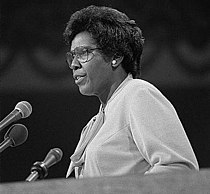
1976: Barbara Jordan & Community

ESSENTIAL QUESTION

How did Barbara Jordan call for a national community?

CONTEXT

In 1966 Barbara Charline Jordan (1936-1996) became the first African American elected to the Texas Senate since 1883, and six years later she was the first African American woman elected to the US House of Representatives. A lawyer, educator, politician, and gifted orator, she gave remarks during the impeachment hearings of President Richard Nixon (1974). She was the first woman and the first African American to give a keynote address to the Democratic National Convention, and it is from that address that this text is drawn. She retired from politics in 1979 and taught at the University of Texas at Austin. She received many awards, including election into the National Women’s Hall of Fame (1990) and the Presidential Medal of Freedom (1994). She died in 1996 from complications from pneumonia and became the first African American to be interred in the Texas State Cemetery.

In 1976 Jordan was chosen to give the Keynote Address to the National Democratic Convention in Madison Square Garden, New York. Only two years after the Watergate Scandal involving President Nixon and others, 1976 was a time of deep national divisions and distrust of government. The Convention nominated Jimmy Carter, who defeated incumbent Republican Gerald Ford in the 1976 election.

TEXT

…We are a people in a quandry about the present. We are a people in search of our future. We are a people in search of a national community…

We must restore our belief in ourselves. We are a generous people so why can’t we be generous with each other? We need to take to heart the words spoken by Thomas Jefferson: Let us restore to social intercourse that harmony and that affection without which liberty and even life are but dreary things.

A nation is formed by the willingness of each of us to share in the responsibility for upholding the common good.

A government is invigorated when each of us is willing to participate in shaping the future of this nation…

If we promise as public officials, we must deliver. If we as public officials propose, we must produce. If we say to the American people it is time for you to be sacrificial; sacrifice. If the public official says that, we (public officials) must be the first to give. We must be. And again, if we make mistakes, we must be willing to admit them. We have to do that. What we have to do is strike a balance between the idea that government should do everything and the idea, the belief, that government ought to do nothing. Strike a balance.

…But a spirit of harmony will survive in America only if each of us remembers that we share a common destiny. If each of us remembers when self-interest and bitterness seem to prevail, that we share a common destiny…

INQUIRY

  1. What is a quandry?
  2. According to the text, how is a nation formed?
  3. Why does Jordan quote Thomas Jefferson? According to Jefferson, what are the consequences of not seeking “that harmony and that affection”?
  4. What are the responsibilities of public officials?
  5. How is a government invigorated?
  6. Jordan speaks of a balance. Describe the balance and how that balance might be achieved.
  7. What is the “common destiny” that Jordan references? Why is it important to remember that “common destiny”?
  8. In what ways can we encourage harmony in our lives?

ADDITIONAL RESOURCES

https://history.house.gov/People/Detail/16031

1776: A Feminine Rebellion

ESSENTIAL QUESTION

What political advice does Abigail Adams give her husband John in 1776?

CONTEXT

Abigail Smith Adams (1744-1818) was born in Weymouth, Massachusetts, to a liberal Congregationalist minister and his wife. Although the family held up to four slaves, Abigail later developed anti-slavery views. Even though she had no formal education, she learned to read, write, and cipher and enjoyed access to her father’s large library. In 1764 she married John Adams, a young lawyer from Braintree, Massachusetts. As the political atmosphere of Boston became more unsettled in the 1770s, Abigail remained at the farm in Braintree while husband John tended to his law practice and political duties in Boston. John became the second President of the United States and Abigail’s son John Quincy became the sixth President of the United States. She died in her home in 1818 of typhoid fever.

Due to John’s active political career Abigail and John spent months apart, but wrote over 300 letters to each other. This text is taken from a letter Abigail wrote to John on March 31, 1776, just prior to the announcement of the Declaration of Independence.

TEXT* (original spellings are maintained)

Do not put such unlimited power into the hands of the Husbands. Remember all Men would be tyrants if they could. If perticuliar care and attention is not paid to the Laidies we are determined to foment a Rebelion, and will not hold ourselves bound by any Laws in which we have no voice, or Representation.

That your Sex are Naturally Tyrannical is a Truth so thoroughly established as to admit of no dispute, but such of you as wish to be happy willingly give up the harsh title of Master for the more tender and endearing one of Friend. Why then, not put it out of the power of the vicious and the Lawless to use us with cruelty and indignity with impunity. Men of Sense in all Ages abhor those customs which treat us only as the vassals of your Sex. Regard us then as Beings placed by providence under your protection and in immitation of the Supreem Being make use of that power only for our happiness.

INQUIRY (Cite from the text where you found your responses)

  1. Abigail Adams uses strong language to describe men. When she says “Remember all Men would be tyrants if they could”, what does she mean? What keeps all men from being tyrants?
  2. While John Adams did not take the advice in this letter seriously, what does the fact that his wife describes her thoughts so plainly imply about their relationship?
  3. What does she mean by “use us with cruelty and indignity with impunity”?
  4. What does Abigail says that women will do if “perticuliar care and attention is not paid to the Laidies”?
  5. According to Abigail, how can men prevent a revolution by women?
  6. How does Abigail contrast “Men of Sense” and tyrants? What is the effect of this contrast?
  7. Would Abigail’s speech be relevant in our lives today? Why or why not?

ADDITIONAL RESOURCES

*Text from “Abigail Adams to John Adams, 31 March 1776,” Founders Online, National Archives, https://founders.archives.gov/documents/Adams/04-01-02-0241. [Original source: The Adams Papers, Adams Family Correspondence, vol. 1, December 1761 – May 1776, ed. Lyman H. Butterfield. Cambridge, MA: Harvard University Press, 1963, pp. 369–371.]

https://www.womenshistory.org/education-resources/biographies/abigail-adams

https://www.masshist.org/digitaladams/archive/letter