Tag: American history

1814: Key’s “Rockets Red Glare”

ESSENTIAL QUESTION:

How does The Star Spangled Banner represent America?

CONTEXT:

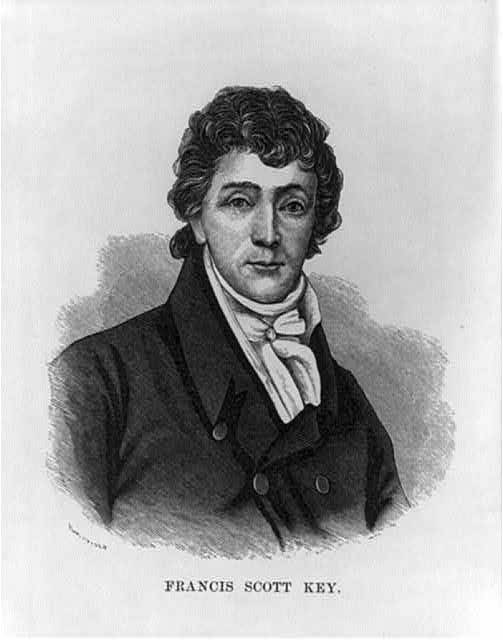
Francis Scott Key (1780-1843) was an amateur poet and well-known lawyer who argued before the US Supreme Court. From Frederick, Maryland, he wrote a poem entitled “The Defense of Fort M’Henry” which would eventually become “The Star Spangled Banner.”

In 1814 the British Army burned Washington, DC, and a friend of Key’s, William Beanes, was arrested by the British and taken to a prison ship. With the permission of US President Madison, Keys went to Baltimore, Maryland. With the help of an American agent for prisoners of war, Keys located his friend and secured his release. However, they had overheard plans for the upcoming British attack on Baltimore, and thus they could not return to shore until after the battle.

The British began to fire upon Fort McHenry in Baltimore Harbor on September 13; the attack lasted 25 hours. Key witnessed the bombardment throughout the night, not knowing how the battle was going. But in the morning on September 14 he saw the large (30 X 42 feet) American garrison flag flying over the fort (the flag is now in the Smithsonian National Museum of American History). The flag Key observed had 15 stripes and 15 stars (the current 13 stripes limit was not adopted until 1818). Key began composing his poem on the back of a letter he kept in his pocket. It was published first as a broadside that week and was soon set to song lyrics. By the Civil War it was a popular song for national unity and the US military began using it in the 1890s for flag ceremonies.

Although it is a difficult song to sing and some lyrics are considered controversial, it became increasingly popular and was the unofficial national anthem by the end of the 19th century. In April 1930 the House of Representatives passed a bill introduced by Representative John Linthicum of Maryland to make “The Star-Spangled Banner” the nation’s official anthem. Despite critics who disliked the melody or felt the law unnecessary, the Senate passed the bill the following year, and President Herbert Hoover signed it into law on March 2, 1931.

TEXT:

O say can you see, by the dawn’s early light,
What so proudly we hail’d at the twilight’s last gleaming,
Whose broad stripes and bright stars through the perilous fight
O’er the ramparts we watch’d were so gallantly streaming?
And the rocket’s red glare, the bombs bursting in air,
Gave proof through the night that our flag was still there,
O say does that star-spangled banner yet wave
O’er the land of the free and the home of the brave?

On the shore dimly seen through the mists of the deep
Where the foe’s haughty host in dread silence reposes,
What is that which the breeze, o’er the towering steep,
As it fitfully blows, half conceals, half discloses?
Now it catches the gleam of the morning’s first beam,
In full glory reflected now shines in the stream,
’Tis the star-spangled banner – O long may it wave
O’er the land of the free and the home of the brave!

And where is that band who so vauntingly swore,
That the havoc of war and the battle’s confusion
A home and a Country should leave us no more?
Their blood has wash’d out their foul footstep’s pollution.
No refuge could save the hireling and slave
From the terror of flight or the gloom of the grave,
And the star-spangled banner in triumph doth wave
O’er the land of the free and the home of the brave.

O thus be it ever when freemen shall stand
Between their lov’d home and the war’s desolation!
Blest with vict’ry and peace may the heav’n rescued land
Praise the power that hath made and preserv’d us a nation!
Then conquer we must, when our cause it is just,
And this be our motto – “In God is our trust,”
And the star-spangled banner in triumph shall wave
O’er the land of the free and the home of the brave.

INQUIRY:

  1. Key was a slave owner, although as an attorney he represented several slaves in their search for freedom. He was a leader in the American Colonization Society, although he was against the abolition movement. The third verse is often seen as controversial, with its reference to slave and hireling; but many historians see this as a reference to the British Army in the War of 1812, including the Corps of Colonial Marines, British free troops of color who had formerly been slaves. How might this be misunderstood by an audience today?
  2. Examine the last two lines of each stanza of the poem. How does the image of the star spangled banner change? What is the progression?
  3. How does the punctuation of the last line change from stanza to stanza? What does that represent?
  4. What is the effect of repeating the last line at the end of each stanza?
  5. What does the sight of the flag represent in the first stanza? Does that change over the course of the poem? Justify your response.
  6. Remembering that this was originally a poem written during a battle, what was the tone of this work? What was the mood?
  7. Why do you believe the first stanza was adopted as our national anthem? What does it say about the US?
  8. Choose a national anthem from another country (see https://nationalanthems.info/ for information). Research the anthem and the country and compare it to the American national anthem. How does that anthem represent the country from which it originates?

ADDITIONAL RESOURCES:

https://amhistory.si.edu/starspangledbanner/the-lyrics.aspx

https://guides.loc.gov/star-spangled-banner/beginning-your-research

https://www.loc.gov/collections/patriotic-melodies/articles-and-essays/star-spangled-banner/

1941: Roosevelt’s Four Freedoms

ESSENTIAL QUESTION:

How did President Franklin Roosevelt explain the purpose of World War II?

CONTEXT:

Franklin Delano Roosevelt (1882-1945) was the 32nd president of the United States (1933-1945), the only president to serve more than two terms. During his presidency America saw many years of the Great Depression as well as involvement in World War II. On January 6, 1941, he delivered his Annual Message to Congress, from which this text is drawn.

In his Message he outlined American foreign policy, focusing on three items: a commitment to national defense; supporting those foreign nations who were resisting aggression and therefore keeping war away from the American Hemisphere; and supporting any peace made on the basis of morality and the security of those nations fighting to secure democracy. It is important to note that the United States had not officially entered the War at this point but was providing assistance to Great Britain (and eventually others) through actions including the Neutrality “Cash and Carry” Act (1939), the Destroyer Deal (1940), and the Lend-Lease Act (1940).

TEXT:

In the future days, which we seek to make secure, we look forward to a world founded upon four essential human freedoms.

The first is freedom of speech and expression–everywhere in the world.

The second is freedom of every person to worship God in his own way–everywhere in the world.

The third is freedom from want–which, translated into world terms, means economic understandings which will secure to every nation a healthy peacetime life for its inhabitants–everywhere in the world.

The fourth is freedom from fear–which, translated into world terms, means a world-wide reduction of armaments to such a point and in such a thorough fashion that no nation will be in a position to commit an act of physical aggression against any neighbor–anywhere in the world...

This nation has placed its destiny in the hands and heads and hearts of its millions of free men and women; and its faither in freedom under the guidance of God. Freedom means the supremacy of human rights everywhere. Our support goes to those who struggle to gain those rights or keep them. Our strength is our unity of purpose. To that high concept there can be no end save victory.

INQUIRY:

  1. In 1943, well-known illustrator Norman Rockwell published paintings of each of the freedoms in The Saturday Evening Post in February/March, 1943 for four consecutive weeks, each illustration accompanied by an essay written by a well-known author. In response to popular demand, prints of the Four Freedoms were later sold to raise money for the war effort. Images of Rockwell’s paintings are available in the additional resources below. Investigate the images. What impact might the visual representation of the Four Freedoms have that the written word might not?
  2. Roosevelt used parallel construction and repetition when he listed the freedoms. What was the effect of these rhetorical devices?
  3. Discuss the four freedoms and list them in priority order. Justify your choices.
  4. Even though the US had not entered the war at the time of this speech, Roosevelt clearly identified each freedom for the world, not just the US. Given the world situation in early 1941, what do you believe was his purpose? How might that wording have been influenced by the aid the US was giving Great Britain in early 1941?
  5. Roosevelt closed his remarks explaining the essential democratic values which were the purpose of the War, a war which had already engulfed Great Britain and most of Europe. What was the purpose of ending the speech with these words?
  6. In the additional resources below you will find a video of Roosevelt delivering this section of his speech. View the video. What tone did Roosevelt use in this speech?
  7. Roosevelt made this address to the US Congress. Was that his only audience? What other audiences, within the US and around the world, might he have been addressing? Explain your response.
  8. In this lesson you have access to three versions of this speech–written text, audio delivery, and artistic interpretation. How do these versions support each other? Which version do you believe would have been most effective? Justify your response.

ADDITIONAL RESOURCES:

https://www.americanrhetoric.com/speeches/fdrthefourfreedoms.htm

https://www.mfah.org/blogs/inside-mfah/norman-rockwells-four-freedoms

https://www.nrm.org/2012/10/collections-four-freedoms/

1776: Washington at Year’s End

ESSENTIAL QUESTION:

How did George Washington use language to convince his Continentals to remain in arms even after the difficult year of 1776?

CONTEXT:

As the year 1776 drew to a close, the American war effort was in crisis. The British occupied New York. Congress had abandoned Philadelphia in the face of the British advance and moved to Baltimore. General George Washington (1732-1799) worried, as his army was scheduled to dissolve; many one-year enlistments would elapse at year’s end. On December 23, Thomas Paine’s published The Crisis, and Washington had the series of essays read to his troops camped up and down the Delaware River in an attempt to improve morale.

On Christmas Eve his army crossed the Delaware River and defeated the British at the Battle of Trenton the next morning in less than one hour . The Americans then crossed back into Pennsylvania; on December 28 they crossed back to Trenton, planning to launch another attack on the British. But a more immediate problem existed; in three days, the Army’s enlistments would expire.

On December 30, Washington gathered his men and addressed his troops as a comrade in arms, asking them to stay six more weeks and offering a ten-dollar bounty (on December 27 Congress had authorized Washington to offer bounties for enlistment). When volunteers were asked for, no one stepped out. One soldier spoke up and reminded the General of all they had sacrificed; exhausted and lacking proper equipment, they were looking forward to going home. Seated on his horse, Washington rode along the line of men and spoke the words below.

TEXT:

My brave fellows, you have done all I asked you to do, and more than can be reasonably expected; but your country is at stake, your wives, your houses and all that you hold dear. You have worn yourselves out with fatigues and hardships, but we know not how to spare you. If you will consent to stay one month longer, you will render that service to the cause of liberty, and to your country, which you probably can never do under any other circumstances.

INQUIRY:

  1. How did Washington acknowledge the soldiers’ sacrifices? Why was that important?
  2. After Washington’s words, soldiers grouped and discussed. One man said “I’ll go if you will.” What feeling did this comment convey? Would you have agreed to stay?
  3. Another soldier whispered, “We can’t go home under such circumstances.” What feeling did this comment convey? Would you have agreed with this soldier?
  4. The men responded in small groups at first until finally 200 of the regiment had agreed to stay. Washington then spoke to each additional regiment personally, and eventually he had 3000 soldiers remain. What was the effect of Washington addressing each regiment in person?
  5. The men who stayed in the Army were not required to reenlist on paper–Washington said he would trust each man upon his word. What did this say about Washington’s attitude toward his Continental Troops?
  6. What appeals to emotion did Washington use in this speech? Why do you believe they worked?
  7. What was the tone of Washington’s speech? Cite examples.
  8. Do you believe this speech displays leadership on Washington’s part? Why or why not?

ADDITIONAL RESOURCES:

Chernow, Ron. Washington: A Life. New York: Penguin Books, 2010.

“George Washington to Robert Morris, 31 December 1776,” Founders Online, National Archives, https://founders.archives.gov/documents/Washington/03-07-02-0389. [Original source: The Papers of George Washington, Revolutionary War Series, vol. 7, 21 October 1776–5 January 1777, ed. Philander D. Chase. Charlottesville: University Press of Virginia, 1997, p. 497.]

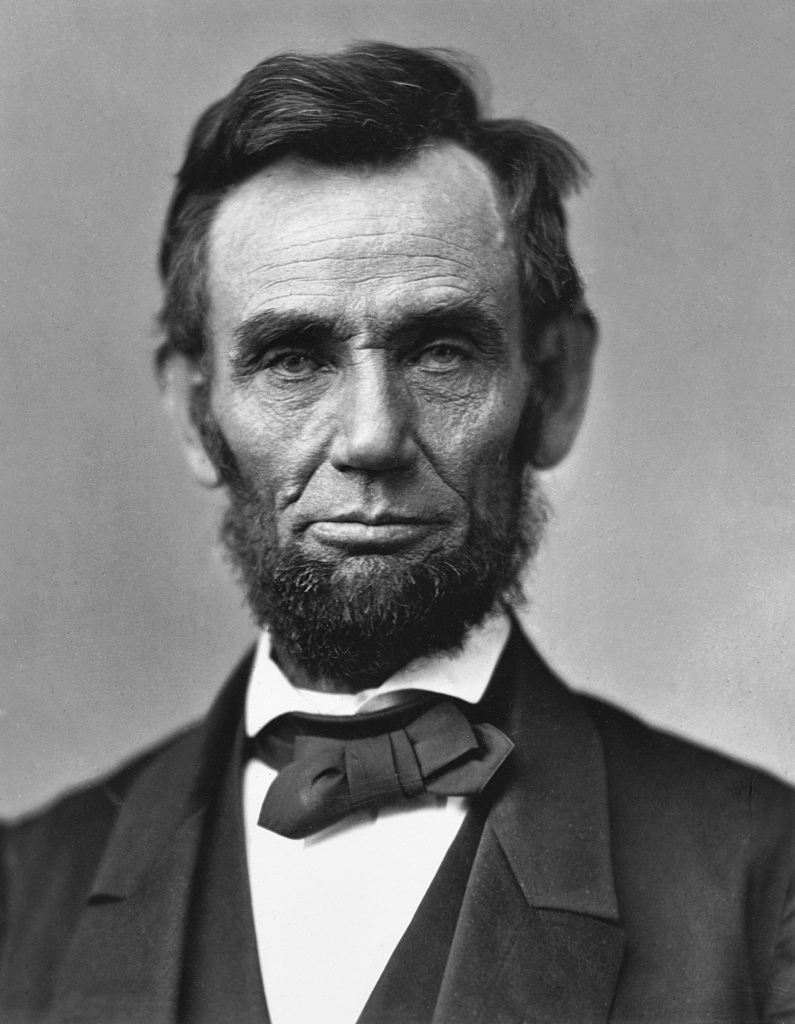
1865: Lincoln’s 2nd Inaugural

ESSENTIAL QUESTION:

How did Abraham Lincoln use language to convey his view of Reconstruction?

CONTEXT:

In 1864, the fourth year of the American Civil War, a presidential election was held in which incumbent Abraham Lincoln ran against General George McClellan, the campaign focusing on Lincoln’s war record. In late 1864 many believed Lincoln would lose this election, fearing that McClellan might negotiate with the Confederacy and end the war without emancipation. But when the electoral college votes were tallied, a series of Northern victories (including the fall of Atlanta) and the voting power of Union soldiers had given Lincoln a clear majority.

On March 4, 1865, 41 days before he would be assassinated, Abraham Lincoln delivered his second inaugural address, only 700 words and 20% the length of his first inaugural speech. He spoke from the North Portico of the Capitol Building, with its newly completed dome, and this inaugural address was the first in which African Americans were allowed to attend. Reflecting upon the four years of war, Lincoln outlined plans to heal the nation, and his words are engraved on the north interior wall of the Lincoln Memorial in Washington, DC.

TEXT:

Fellow countrymen: at this second appearing to take the oath of the presidential office there is less occasion for an extended address than there was at the first. Then a statement somewhat in detail of a course to be pursued seemed fitting and proper. Now, at the expiration of four years during which public declarations have been constantly called forth on every point and phase of the great contest which still absorbs the attention and engrosses the energies of the nation little that is new could be presented. The progress of our arms, upon which all else chiefly depends is as well known to the public as to myself and it is I trust reasonably satisfactory and encouraging to all. With high hope for the future no prediction in regard to it is ventured.

“On the occasion corresponding to this four years ago all thoughts were anxiously directed to an impending civil war. All dreaded it ~ all sought to avert it. While the inaugural address was being delivered from this place devoted altogether to saving the Union without war insurgent agents were in the city seeking to destroy it without war ~ seeking to dissolve the Union and divide effects by negotiation. Both parties deprecated war but one of them would make war rather than let the nation survive, and the other would accept war rather than let it perish. And the war came.

“One eighth of the whole population were colored slaves not distributed generally over the union but localized in the southern part of it. These slaves constituted a peculiar and powerful interest. All knew that this interest was somehow the cause of the war. To strengthen perpetuate and extend this interest was the object for which the insurgents would rend the Union even by war while the government claimed no right to do more than to restrict the territorial enlargement of it. Neither party expected for the war the magnitude or the duration which it has already attained. Neither anticipated that the cause of the conflict might cease with or even before the conflict itself should cease. Each looked for an easier triumph and a result less fundamental and astounding. Both read the same Bible and pray to the same God and each invokes His aid against the other. It may seem strange that any men should dare to ask a just God’s assistance in wringing their bread from the sweat of other men’s faces but let us judge not that we be not judged. The prayers of both could not be answered ~ that of neither has been answered fully. The Almighty has His own purposes. “Woe unto the world because of offenses for it must needs be that offenses come but woe to that man by whom the offense cometh.” If we shall suppose that American slavery is one of those offenses which in the providence of God must needs come but which having continued through His appointed time He now wills to remove and that He gives to both North and South this terrible war as the woe due to those by whom the offense came shall we discern therein any departure from those divine attributes which the believers in a living God always ascribe to Him. Fondly do we hope ~ fervently do we pray ~ that this mighty scourge of war may speedily pass away. Yet, if God wills that it continue until all the wealth piled by the bondsman’s two hundred and fifty years of unrequited toil shall be sunk and until every drop of blood drawn with the lash shall be paid by another drawn with the sword as was said three thousand years ago so still it must be said ‘the judgments of the Lord are true and righteous altogether.’

“With malice toward none with charity for all with firmness in the right as God gives us to see the right let us strive on to finish the work we are in to bind up the nation’s wounds, to care for him who shall have borne the battle and for his widow and his orphan ~ to do all which may achieve and cherish a just and lasting peace among ourselves and with all nations.”

INQUIRY:

  1. Why did Lincoln believe this inaugural address could be shorter that the one he delivered in 1861?
  2. When Lincoln said, “Both parties deprecated war but one of them would make war rather than let the nation survive, and the other would accept war rather than let it perish,” how did he contrast the political aims of the North and South in 1861–to what political aims did he allude?
  3. How did Lincoln characterize the American Civil War? What did he see as its cause?
  4. Identify biblical allusions Lincoln made in this speech. What were the effects of these allusions?
  5. Identify examples of alliteration, repetition, and parallel structure, all of which are important especially in speeches. What purpose did they accomplish in this address?
  6. What was the tone of this address? Compare the tone to Lincoln’s first inaugural address, made in 1861. What might account for the differences?
  7. How did Lincoln view America’s future? Give examples.

ADDITIONAL RESOURCES:

https://www.nps.gov/linc/learn/historyculture/lincoln-second-inaugural.htm

https://www.loc.gov/resource/ppmsc.02928/

https://guides.loc.gov/presidential-election-1864

https://www.americanrhetoric.com/speeches/abrahamlincolnsecondinauguraladdress.htm

1778: Washington at Valley Forge

ESSENTIAL QUESTION:

How did the experience of Valley Forge broaden the meaning of the American Revolution?

CONTEXT:

By the winter of 1777, the American Revolution was two years old. George Washington (1732-1799) was the new commander of the American forces as his army went into winter camp near Valley Forge, Pennsylvania, and the conditions of the army were grim. Men and officers were leaving the army and food was scarce. For months Washington had lobbied the Continental Congress, the political organization that was responsible for the War, for supplies, often to no avail.

Eventually Congress sent a committee to Valley Forge to inspect the situation, many believing that their observations could be used as an excuse to dismiss Washington as the Army’s commander. When they arrived Washington presented them with a letter from which this text is drawn. The original letter, over 16,000 words, presented Washington’s suggestions for overhauling the Army, offering ideas for officer pensions, reorganizing the chain of command, instituting a draft, offering merit promotions, overhauling the quartermaster (supply) departments, and other issues. By the time the Committee left Valley Forge, they supported Washington. Washington continued to communicate with Congress, helping them to understand the realities of sustaining an army in the field. Congress continued to debate but did pass several of his suggestions.

TEXT: (spelling has been modernized)

…In regard to clothing…the mode of providing hitherto in practice, is by no means adequate to the end; and that, unless our future efforts are more effectual, it will be next to impossible to keep an army in the field…I am in hopes that valuable consequences will accrue from a resolution of Congress…directing that the several states [the individual states]…”exert their utmost endeavors to procure, in addition to the allowances of clothing heretofore made by Congress, supplies of blankets &c. for the comfortable subsistence of the officers and soldiers of their respective battalions..”

For my own part…I have little conception, that our extensive wants can be completely satisfied, in any other way, than by national, or governmental contracts, between Congress and the Court of France… Besides placing our supplies, in so essential an article, on a sure and unfailing foundation, it would cement the connection between the two countries, and if discovered, prove a new and powerful topic of hostility, between France and Britain…

To make soldiers look well and bestow proper attention and care upon their clothes…gives a taste for decency and uniformity and makes the officers regardful of the appearance of the men, as tending to promote health, and foster a becoming pride of dress, which raises soldiers in their own esteem and makes them respectable to their enemy…

INQUIRY:

  1. How did Washington describe the process of distributing clothes to the soldiers?
  2. What might be the consequences if this problem is not resolved?
  3. What did the Continental Congress do to try and alleviate the problem?
  4. Who would receive the clothes provided by each individual state, for instance, North Carolina or Massachusetts?
  5. In addition to Congress and the individual states, what other resource did Washington suggest to help provide supplies?
  6. What two advantages of a French alliance did Washington suggest?
  7. Why did Washington believe it was important for an army to be well-clothed? List at least two reasons.
  8. Do you believe it is important to be well-clothed, clean and well-kept? Why or why not?
  9. Some historians have characterized Valley Forge as a turning point in that it shifted the American Revolution from solely a discussion of the political ideal of liberty to include the realities of sustaining an army in the field. Do you agree? Why/why not?

ADDITIONAL RESOURCES:

https://www.nps.gov/vafo/index.htm

https://www.nps.gov/vafo/learn/historyculture/valley-forge-history-and-significance.htm

https://founders.archives.gov/documents/Washington/03-13-02-0335

“George Washington to a Continental Congress Camp Committee, 29 January 1778,” Founders Online, National Archives, https://founders.archives.gov/documents/Washington/03-13-02-0335. [Original source: The Papers of George Washington, Revolutionary War Series, vol. 13, 26 December 1777 – 28 February 1778, ed. Edward G. Lengel. Charlottesville: University of Virginia Press, 2003, pp. 376–409.]

https://founders.archives.gov/documents/Washington/03-12-02-0611

“George Washington to Henry Laurens, 22 December 1777,” Founders Online, National Archives, https://founders.archives.gov/documents/Washington/03-12-02-0611. [Original source: The Papers of George Washington, Revolutionary War Series, vol. 12, 26 October 1777 – 25 December 1777, ed. Frank E. Grizzard, Jr. and David R. Hoth. Charlottesville: University Press of Virginia, 2002, pp. 667–671.]

1620: Mayflower Compact

ESSENTIAL QUESTION:

Analyze the Mayflower Compact as a cornerstone of American democracy.

CONTEXT:

In the late 1500s, a number of religious groups arose in England trying to establish different practices from the Anglican Church, the official church of England. One of these groups was called the Puritans, because they wanted to make the Anglican Church more pure and simple. Another group was called the Separatists, because they wanted to separate from the Anglican Church altogether. The Pilgrims were separatists, and they were severely persecuted for their religious beliefs. They eventually moved to Holland where religious ideas were more tolerant.

But the Pilgrims remained Englishmen at heart, and eventually they were able to convince King James I of England to allow them to emigrate to the new colonies in America. In September 1620 they set sail for America with royal permission, called a patent, to settle in the colony of Virginia (which had been settled by Englishmen years before). The colony at that time was much larger than the state of Virginia today–in those days it reached present New York.

Rough seas led the Mayflower, the Pilgrim’s ship, to land in Cape Cod, Massachusetts, well north of where they were supposed to be. Since they were outside the control of the King’s patent, they needed to decide how they would be governed. They agreed to write a document for their own self-government, called The Mayflower Compact. This text is from that agreement. The Pilgrims later obtained a patent from the Council of New England in 1621 and settled Plymouth Colony.

TEXT:

IN THE NAME OF GOD, AMEN. We, whose names are underwritten, the Loyal Subjects of our dread Sovereign Lord King James, by the Grace of God, of Great Britain, France, and Ireland, King, Defender of the Faith, &c. Having undertaken for the Glory of God, and Advancement of the Christian Faith, and the Honour of our King and Country, a Voyage to plant the first Colony in the northern Parts of Virginia; Do by these Presents, solemnly and mutually, in the Presence of God and one another, covenant and combine ourselves together into a civil Body Politick, for our better Ordering and Preservation, and Furtherance of the Ends aforesaid: And by Virtue hereof do enact, constitute, and frame, such just and equal Laws, Ordinances, Acts, Constitutions, and Officers, from time to time, as shall be thought most meet and convenient for the general Good of the Colony; unto which we promise all due Submission and Obedience.

IN WITNESS whereof we have hereunto subscribed our names at Cape-Cod the eleventh of November, in the Reign of our Sovereign Lord King James, of England, France, and Ireland, the eighteenth, and of Scotland the fifty-fourth, Anno Domini; 1620.or [signatures follow]

INQUIRY:

  1. Why did the signers begin by stating that they were loyal subjects of the King?
  2. What is a “civil body politic”?
  3. Why did the signers organize the “civil body politic”? What was its purpose?
  4. Plymouth Colony was an ocean away from the English King in London. How might this have affected the power and position of the local Puritans, ordinary men not accustomed to rank and privilege?
  5. The Pilgrims obtained a patent for the colony of Plymouth in 1621, but the Mayflower Compact was read at government meetings for many years. How might this reflect how the settlers saw their colony?
  6. Only men signed the Mayflower Compact. What does this suggest about the role of women at the time?
  7. If you elect the captain of a sports team or a group, how does this reflect the principle of the Mayflower Compact?
  8. What basic principle of US government was established by the Mayflower Compact?

ADDITIONAL RESOURCES:

https://www.mass.gov/news/the-mayflower-compact

https://www.neh.gov/humanities/2015/novemberdecember/feature/who-were-the-pilgrims-who-celebrated-the-first-thanksgiving

1783: Washington resigns

ESSENTIAL QUESTION:

Assess the short and long term significance of General George Washington’s resignation of his military commission.

CONTEXT:

George Washington (1732-1799) served as the Commander in Chief of the American Forces in the American Revolution and in 1789 became the first president of the United States. While fighting in the American Revolution ended mainly with the Battle of Yorktown (1781), the war itself only ended with the Treaty of Paris (1783). In that two year period, the American Army stayed organized, with Washington as its leader, as the threat of new fighting remained. As Commander in Chief Washington constantly petitioned Congress for pay and better conditions for the soldiers who had fought in the Revolution, but there was little money; money had to be requested by Congress of the individual states. Several mutinies occurred over unpaid wages, supplies, and expiring enlistments, including the Pennsylvania Line Mutiny (1781) and the Newburgh Conspiracy (1783). Washington was able to quell these uprisings and retain control of the Army.

Washington had been appointed Commander in Chief of the American Forces in May of 1775, and many thought he would remain in power throughout his life. But the Treaty of Paris (1783) had been signed three months earlier and Washington saw his job as a military commander completed. During the War he had been granted broad powers and many thought he would continue to use them. But he did not. Having bid farewell to his soldiers the month before, in December 1783 he bid farewell to his officers and two days before Christmas in 1783 he addressed the Continental Congress in Annapolis, Maryland, to resign his commission. He then traveled to his home at Mount Vernon, hoping to live out his days as a farmer. His quiet life did not last long; he was elected President of the United States six years later, serving from 1789 until 1797. Washington died at Mount Vernon in 1799.

TEXT:

The great events on which my resignation depended having at length taken place; I have now the honor of offering my sincere Congratulations to Congress and of presenting myself before them to surrender into their hands the trust committed to me, and to claim the indulgence of retiring from the Service of my Country...

I resign with satisfaction the Appointment I accepted with diffidence. A diffidence in my abilities to accomplish so arduous a task, which however was superseded by a confidence in the rectitude of our Cause, the support of the Supreme Power of the Union, and the patronage of Heaven…

While I repeat my obligations to the Army in general, I should do injustice to my own feelings not to acknowledge in this place the peculiar Services and distinguished merits of the Gentlemen who have been attached to my person during the War. It was impossible the choice of confidential Officers to compose my family should have been more fortunate. Permit me Sir, to recommend in particular those, who have continued in Service to the present moment, as worth of the favorable notice and patronage of Congress.

I consider it an indispensable duty to close this last solemn act of my Official life, by commending the Interests of our dearest Country to the protection of Almighty God, and those who have the superintendence of them, to his holy keeping.

Having now finished the work assigned me, I retire from the great theatre of Action; and bidding an Affectionate farewell to this August body under whose order I have so long acted, I here offer my Commission, and take my leave of all the employments of public life.

INQUIRY:

  1. Washington believed this would be his last act of public life, and he handed his commission and a copy of his remarks to Thomas Mifflin, the President of the Congress. He bowed to Congress and then left for Mount Vernon to be home for Christmas. What was the short term effect of Washington’s resignation?
  2. Many wanted Washington to remain in power as head of the Army and nation. Why would they want that?
  3. Washington said he accepted his commission with diffidence. What does that mean? What powers allowed him to overcome that diffidence? What does that say about Washington as a leader?
  4. How did Washington view his officers? What language did he use?
  5. What did Washington ask the Congress to provide for his officers?
  6. Investigate the Newburgh Conspiracy (1783). How might that have influenced Washington’s comments?
  7. Washington made several religious references. What does this say about his attitude regarding the success of the American Revolution?
  8. After Washington’s resignation the Continental Army essentially disbanded, leaving the colonies with no unified military force; eventually Congress took over the responsibilities of the Army. What dangers might the new United States have faced with no organized military force?
  9. When news of Washington voluntarily giving up political power to return to his farm spread across the nation and the world, people were astonished. How did this act represent what the American Revolution had been fought for?
  10. Today the US Constitution marks the President of the United States as the Commander in Chief of the Military. What fundamental principle of American democracy doe the placing of military power into the hands of a civilian (president) represent? How did Washington’s resignation establish this principle?

ADDITIONAL RESOURCES:

https://www.mountvernon.org/library/digitalhistory/digital-encyclopedia/article/resignation-of-military-commission

https://www.aoc.gov/explore-capitol-campus/art/general-george-washington-resigning-his-commission

https://founders.archives.gov/documents/Jefferson/01-06-02-0319-0004

Washington: A Life by Ron Chernow (Penguin Books, 2011)

1987: Reagan at the Gate

ESSENTIAL QUESTION:

How did the Berlin Wall represent the Cold War?

CONTEXT:

Ronald Reagan (1911-2004), president of the United States from 1981 until 1989, delivered one of his best known speeches at the Brandenburg Gate, a major historical landmark in Berlin, Germany, on June 12, 1987.

After World War II, Germany was divided into four sectors, each controlled by one of the Allied Forces. Berlin, Germany’s capitol, was also divided. The Soviet Union controlled East Germany and East Berlin, and the Western Allies (US, Great Britain, and France) controlled West Germany and West Berlin. Many East Germans fled to West Berlin to find better economic and political opportunities, and this became a major embarrassment for the East Germans. In 1961 they began building a wall using concrete blocks and wire to prevent this exodus. The 155 kilometer wall surrounded West Berlin, separating families and friends. But escapes to the West continued, and East Berlin strengthened the Wall; escapees could face death if caught. The Wall became a major symbol of the Cold War and the division between Western culture and the Soviets.

Although by the 1980s the Soviet economy was weakening and nationalist movements were arising within the Soviet Union, it would be 1991 before the Soviet Union dissolved. In 1987 President Reagan traveled to Berlin to give this speech, emphasizing the US support for West Berlin and West Germany and pressuring the Soviets to end the division of Berlin and Germany.

TEXT:

…Behind me stands a wall that encircles the free sectors of this city, part of a vast system of barriers that divides the entire continent of Europe. From the Baltic South, those barriers cut across Germany in a gash of barbed wire, concrete, dog runs, and guard towers. Farther south, there may be no visible, no obvious wall. But there remain armed guards and checkpoints all the same–still a restriction on the right to travel, still an instrument to impose upon ordinary men and women the will of a totalitarian state. Yet, it is here in Berlin where the wall emerges most clearly; here, cutting across your city, where the news photo and the television screen have imprinted this brutal division of a continent upon the mind of the world.

Standing before the Brandenburg Gate, every man is a German separated from his fellow men.
Every man is a Berliner, forced to look upon a scar…

…But in the West today, we see a free world that has achieved a level of prosperity and well-being unprecedented in all human history. In the Communist world, we see failure, technological backwardness, declining standards of health, even want of the most basic kind–too little food.
Even today, the Soviet Union still cannot feed itself. After these four decades, then, there stands before the entire world one great and inescapable conclusion: Freedom leads to prosperity. Freedom replaces the ancient hatreds among the nations with comity and peace. Freedom is
the victor.


And now—now the Soviets themselves may, in a limited way, be coming to understand the importance of freedom. We hear much from Moscow about a new policy of reform and openness. Some political prisoners have been released. Certain foreign news broadcasts are no longer being jammed. Some economic enterprises have been permitted to operate with greater freedom from state control.


Are these the beginnings of profound changes in the Soviet state? Or are they token gestures intended to raise false hopes in the West, or to strengthen the Soviet system without changing it? We welcome change and openness; for we believe that freedom and security go together, that the advance of human liberty—the advance of human liberty can only strengthen the cause of world peace.


There is one sign the Soviets can make that would be unmistakable, that would advance dramatically the cause of freedom and peace.
General Secretary Gorbachev, if you seek peace, if you seek prosperity for the Soviet Union and Eastern Europe, if you seek liberalization: Come here to this gate.
Mr. Gorbachev, open this gate.
Mr. Gorbachev—Mr. Gorbachev, tear down this wall!…

INQUIRY:

  1. The Brandenburg Gate in Berlin is located in what was the restricted zone when Berlin was divided. Why do you think Reagan chose the Gate as the site of this speech?
  2. How did Reagan describe the Wall? What tone did those terms convey?
  3. When Reagan used the term “will of a totalitarian state”, to which country was he referring? What is a totalitarian state?
  4. What was the effect of Reagan declaring “…every man is a German, separated from his fellow men. Every man is a Berliner, forced to look upon a scar…”? How did this define Reagan’s audience for the speech?
  5. How did Reagan compare the Communist world and the Free World?
  6. What did Reagan list as the results of freedom?
  7. Did Reagan believer that the Soviets were in the process of making changes? How do you know?
  8. What did Reagan state would be the main sign of changes and the desire for freedom in the Soviet Union?
  9. In what ways did the Berlin Wall represent the Cold War?
  10. The most well known line from this speech is the last one in this excerpt. Why do you think that line would be best remembered?

ADDITIONAL RESOURCES:

https://www.stiftung-berliner-mauer.de/en/topics/berlin-wall

https://www.archives.gov/publications/prologue/2007/summer/berlin.html

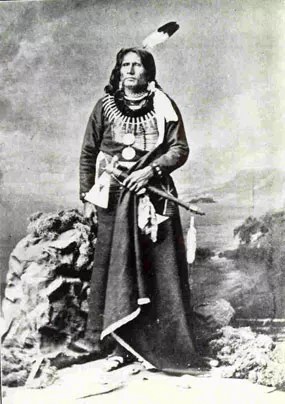
1881: Jackson’s “Century of Dishonor”

ESSENTIAL QUESTION:

Investigate America’s “Century of Dishonor.”

CONTEXT:

Helen Hunt Jackson (1830-1885), born in Massachusetts, was a poet, author, and Native American rights activist. She later moved to Colorado on the advice of her physicians to improve her poor health. In 1879 she was inspired by Chief Standing Bear (c. 1829-1908, a Ponca chief and Native American activist who argued successfully in 1879 for judicial rights in federal court), and she later wrote A Century of Dishonor, an expose of the crimes against Native Americans. It led to the founding of the Indian Rights Association (1930-1994). She died of stomach cancer in 1885.

This excerpt is from A Century of Dishonor.

TEXT: (NOTE: “Indian” is used as it was in the original text)

…There is not among these three hundred bands of Indians [in the United States] one which has not suffered cruelly at the hands either of the Government or of white settlers. The poorer, the more insignificant, the more helpless the band, the more certain the cruelty and outrage to which they have been subjected. This is especially true of the bands on the Pacific slopes.

These Indians found themselves of a sudden surrounded by and caught up in the
great influx of gold-seeking settlers, as helpless creatures on a shore are caught
up in a tidal wave. There was not time for the Government to make treaties;
not even time for communities to make laws. The tale of the wrongs, the
oppressions, the murders of the Pacific-slope Indians in the last thirty years
would be a volume by itself, and is too monstrous to be believed.
It makes little difference, however, where one opens the record of the
history of the Indians; every page and every year has its dark stain. The story of
one tribe is the story of all, varied only by differences of time and place; but
neither time nor place makes any difference in the main facts. Colorado is as
greedy and unjust in 1880 as was Georgia in 1830, and Ohio in 1795; and the
United States Government breaks promises now as deftly as then, and with added ingenuity long practice….

The history of the Government connections with the Indians is a
shameful record of broken treaties and unfulfilled promises. The history of the
border, white man’s connection with the Indians is a sickening record of
murder, outrage, robbery, and wrongs committed by the former, as the rule,
and occasional savage outbreaks and unspeakably barbarous deeds of
retaliation by the latter, as the exception….

INQUIRY: (NOTE: the term “Indian” is used in the questions as it was in Jackson’s text)

  1. What two sources did Jackson list as the source of Indian mistreatment?
  2. What role did the Gold Rush play in the mistreatment of the Indians?
  3. According to Jackson, were any tribes exempt from mistreatment? How do you know?
  4. How did Jackson characterize “the history of the Government connections” with the Indians?
  5. How did she characterize “the border, white man’s connection” with the Indians?
  6. Investigate Red Cloud, leader of the Oglala Sioux from 1865 until 1900. Evaluate his relationship with the US Government. Or choose another Native American leader to investigate, such as Sitting Bull, Geronimo, Tecumseh, Black Hawk, or Crazy Horse. Compare their relationships with the US Government during their times.
  7. The Battle of Wounded Knee in South Dakota occurred in 1890. Investigate this battle and assess how it characterized the attitude of the US Army at the time.
  8. The term “Indian” is now usually considered derogatory and offensive. “First Nations”, “Native Americans”, or other terms such as individual tribal names are considered more appropriate. Why does it matter? What value does a name have?

ADDITIONAL RESOURCES:

https://www.nps.gov/articles/000/a-century-of-dishonor-by-helen-hunt-jackson.htm

https://archive.org/details/centuryofdishono00jackrich/page/n7/mode/2up

https://www.gutenberg.org/files/50560/50560-h/50560-h.htm

https://aktalakota.stjo.org/american-indian-leaders/red-cloud/

1974: Nixon Resigns

ESSENTIAL QUESTION:

How can the powers of the US President be limited?

CONTEXT:

Richard Milhous Nixon (1913-1994) was the 37th president of the US, serving from 1969 until 1974. Prior to his presidency he served in several political offices, including as vice president under President Dwight D. Eisenhower. Elected President in 1968, he resigned in 1974 in the wake of the Watergate Scandal, a break-in at the Democratic Party Headquarters in Washington, DC, and the Nixon administration’s cover-up of that criminal act. Nixon was the only US president to resign from office. This text is from his last public speech as president and was broadcast live on radio and TV on August 8, 1974. Nixon died in New York in 1994.

TEXT:

This is the 37th time I have spoken to you from this office, where so many decisions have been made that shaped the history of this Nation. Each time I have done so to discuss with you some matter that I believe affected the national interest.

In all the decisions I have made in my public life, I have always tried to do what was best for the Nation. Throughout the long and difficult period of Watergate, I have felt it was my duty to persevere, to make every possible effort to complete the term of office to which you elected me. In the past few days, however, it has become evident to me that I no longer have a strong enough political base in the Congress to justify continuing that effort. As long as there was such a base, I felt strongly that it was necessary to see the constitutional process through to its conclusion, that to do otherwise would be unfaithful to the spirit of that deliberately difficult process and a dangerously destabilizing precedent for the future. But with the disappearance of that base, I now believe that the constitutional purpose has been served, and there is no longer a need for the process to be prolonged.

I would have preferred to carry through to the finish whatever the personal agony it would have involved, and my family unanimously urged me to do so. But the interest of the Nation must always come before any personal considerations. From the discussions I have had with Congressional and other leaders, I have concluded that because of the Watergate matter I might not have the support of the Congress that I would consider necessary to back the very difficult decisions and carry out the duties of this office in the way the interests of the Nation would require.

I have never been a quitter. To leave office before my term is completed is abhorrent to every instinct in my body. But as President, I must put the interest of America first. America needs a full-time President and a full-time Congress, particularly at this time with problems we face at home and abroad. To continue to fight through the months ahead for my personal vindication would almost totally absorb the time and attention of both the President and the Congress in a period when our entire focus should be on the great issues of peace abroad and prosperity without inflation at home.

Therefore, I shall resign the Presidency effective at noon tomorrow. Vice President Ford will be sworn in as President at that hour in this office….

By taking this action, I hope that I will have hastened the start of that process of healing which is so desperately needed in America.

I regret deeply any injuries that may have been done in the course of the events that led to this decision. I would say only that if some of my Judgments were wrong, and some were wrong, they were made in what I believed at the time to be the best interest of the Nation.

So, let us all now join together in affirming that common commitment and in helping our new President succeed for the benefit of all Americans….

INQUIRY:

  1. Nixon’s successor as president, Gerald Ford, had not been elected; he was appointed to the office of vice president after Nixon’s elected vice president, Spiro Agnew, resigned in 1973 (from charges of tax evasion). Gerald Ford, as president after Nixon’s resignation, then nominated Nelson Rockefeller as vice president. Thus from 1974 until 1977 neither the president nor the vice president were elected by the people. What part of the US Constitution provides for succession to the presidency? Why would it have been necessary to nominate a vice president if there was not one currently in office? Who had to approve Rockefeller’s appointment as vice president?
  2. What did Nixon give as the reasons that he chose to resign?
  3. Investigate the Watergate Scandal and how and why it destroyed confidence in the Nixon presidency.
  4. What is impeachment? Where and in what ways does the US Constitution discuss impeachment?
  5. Congress had already begun the impeachment process against Nixon, but he resigned before the articles of impeachment could be passed. Would it have been better for the country if he had gone through with the impeachment process? Why or why not?
  6. How important is it for a president to have a “political base” in Congress? Why?
  7. In what ways did Nixon deflect blame from himself for the necessity to resign? In what ways did he accept blame?
  8. How did Nixon change the tone of this speech in the next to last sentence? In the last sentence?

ADDITIONAL RESOURCES:

https://www.pbs.org/newshour/spc/character/links/nixon_speech.html

https://www.nixonlibrary.gov/president-nixon

https://www.whitehousehistory.org/bios/richard-nixon