
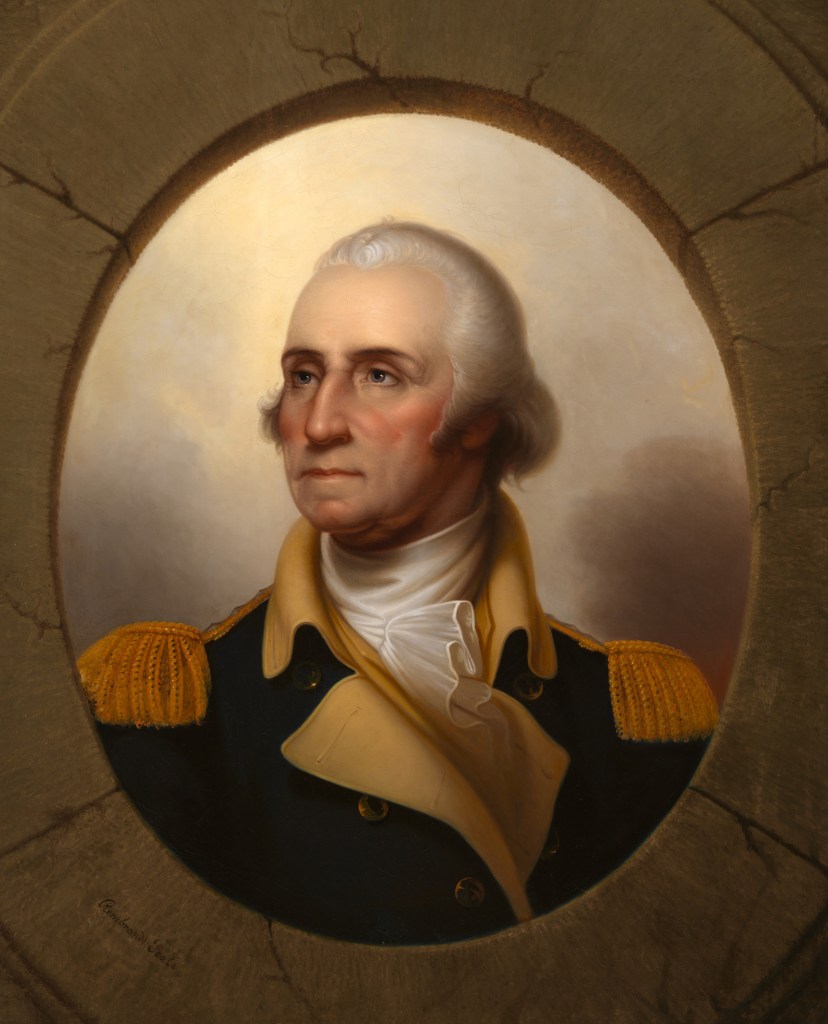
Tag: George Washington

1796: Washington and Parties

ESSENTIAL QUESTION:

Analyze the dangers of parties that George Washington foresaw for the young American Republic as he left public life.

CONTEXT:

George Washington (1732-1799) was born in Virginia to a prosperous planter family. He learned the culture of a colonial gentleman, and early on had two special interests: the military and westward expansion. At age 16 he helped survey the Shenandoah Valley; in 1754 he was commissioned a lieutenant colonel in the British Army and he served during the French and Indian War. He later managed his lands around Mount Vernon, Virginia, (his home), served in the Virginia House of Burgesses, and married Martha Custis, a wealthy widow. In 1775 the Second Continental Congress appointed him Commander in Chief of the Continental Army.

After the American Revolution Washington wished to retire to Mount Vernon, but realizing that the new nation needed stronger form of government, he encouraged a Constitutional Convention in Philadelphia in 1787. After the new Constitution was adopted, Washington was unanimously elected by the electoral college to be the first president of the United States. He set many precedents. By the end of his second term political parties had developed and there was much contention even within his cabinet; Washington was pressured to continue as president but he refused, setting another precedent of a maximum of two presidential terms which would last until Franklin Roosevelt began his third term in 1941. Another precedent he established was delivering a farewell address, from which this text is taken. He wrote it with the help of Alexander Hamilton and James Madison. Washington did not deliver his address in person to the Congress but instead published it in a Philadelphia newspaper, the American Daily Advertiser, on September 19, 1796. After leaving office Washington returned to Mount Vernon to continue farming. He died there in 1799 from quinsy, a serious throat infection.

TEXT:

…I have already intimated to you the danger of parties in the State, with particular reference to the founding of them on geographical discriminations. Let me now take a more comprehensive view, and warn you in the most solemn manner against the baneful effects of the spirit of party generally.

This spirit, unfortunately, is inseparable from our nature, having its root in the strongest passions of the human mind. It exists under different shapes in all governments, more or less stifled, controlled, or repressed; but, in those of the popular form, it is seen in its greatest rankness, and is truly their worst enemy….

Without looking forward to an extremity of this kind (which nevertheless ought not to be entirely out of sight), the common and continual mischiefs of the spirit of party are sufficient to make it the interest and duty of a wise people to discourage and restrain it.

It serves always to distract the public councils and enfeeble the public administration. It agitates the community with ill-founded jealousies and false alarms, kindles the animosity of one part against another, foments occasionally riot and insurrection. It opens the door to foreign influence and corruption, which finds a facilitated access to the government itself through the channels of party passions. Thus the policy and the will of one country are subjected to the policy and will of another.

There is an opinion that parties in free countries are useful checks upon the administration of the government and serve to keep alive the spirit of liberty. This within certain limits is probably true; and in governments of a monarchical cast, patriotism may look with indulgence, if not with favor, upon the spirit of party. But in those of the popular character, in governments purely elective, it is a spirit not to be encouraged. From their natural tendency, it is certain there will always be enough of that spirit for every salutary purpose. And there being constant danger of excess, the effort ought to be by force of public opinion, to mitigate and assuage it. A fire not to be quenched, it demands a uniform vigilance to prevent its bursting into a flame, lest, instead of warming, it should consume.

INQUIRY:

  1. Did Washington encourage or discourage the development of political parties? Quote from the text to support your response.
  2. List five dangers from the development of parties.
  3. How might parties affect US foreign policy?
  4. Why did Washington discourage parties in governments “purely elective”?
  5. What force should “mitigate and assuage” the dangers of parties?
  6. In Washington’s time many Americans chiefly identified with their state. Rather than saying “I am an American” they might say “I am a Virginian” and then say “I am an American.” Washington warned against this earlier in his speech. What dangers might exist with this frame of mind?
  7. During Washington’s administration the first political parties developed–the Federalists, chiefly from New England, and the Democratic-Republicans, chiefly from the South. People were encouraged to vote based on party loyalty rather than choosing the best qualified candidate. Investigate the toxic relationship between Alexander Hamilton (leader of the Federalists) and Thomas Jefferson (leader of the Democratic-Republicans) that developed while the two men served in Washington’s Cabinet.
  8. In 1796 when this address was delivered the US Constitution was only eight years old. How might that fact have influenced Washington’s words?
  9. To commemorate Washington’s birthday his Farewell Address is still read aloud in the US Senate. How well do you believe we are listening to his advice? Give evidence to support your answer.

ADDITIONAL RESOURCES:

https://millercenter.org/president/washington/life-in-brief

https://www.senate.gov/artandhistory/history/resources/pdf/Washingtons_Farewell_Address.pdf?utm_source=substack&utm_medium=email

Chernow, Ron. Washington: A Life. Penguin Press, 2010.

1776: Washington at Year’s End

ESSENTIAL QUESTION:

How did George Washington use language to convince his Continentals to remain in arms even after the difficult year of 1776?

CONTEXT:

As the year 1776 drew to a close, the American war effort was in crisis. The British occupied New York. Congress had abandoned Philadelphia in the face of the British advance and moved to Baltimore. General George Washington (1732-1799) worried, as his army was scheduled to dissolve; many one-year enlistments would elapse at year’s end. On December 23, Thomas Paine’s published The Crisis, and Washington had the series of essays read to his troops camped up and down the Delaware River in an attempt to improve morale.

On Christmas Eve his army crossed the Delaware River and defeated the British at the Battle of Trenton the next morning in less than one hour . The Americans then crossed back into Pennsylvania; on December 28 they crossed back to Trenton, planning to launch another attack on the British. But a more immediate problem existed; in three days, the Army’s enlistments would expire.

On December 30, Washington gathered his men and addressed his troops as a comrade in arms, asking them to stay six more weeks and offering a ten-dollar bounty (on December 27 Congress had authorized Washington to offer bounties for enlistment). When volunteers were asked for, no one stepped out. One soldier spoke up and reminded the General of all they had sacrificed; exhausted and lacking proper equipment, they were looking forward to going home. Seated on his horse, Washington rode along the line of men and spoke the words below.

TEXT:

My brave fellows, you have done all I asked you to do, and more than can be reasonably expected; but your country is at stake, your wives, your houses and all that you hold dear. You have worn yourselves out with fatigues and hardships, but we know not how to spare you. If you will consent to stay one month longer, you will render that service to the cause of liberty, and to your country, which you probably can never do under any other circumstances.

INQUIRY:

  1. How did Washington acknowledge the soldiers’ sacrifices? Why was that important?
  2. After Washington’s words, soldiers grouped and discussed. One man said “I’ll go if you will.” What feeling did this comment convey? Would you have agreed to stay?
  3. Another soldier whispered, “We can’t go home under such circumstances.” What feeling did this comment convey? Would you have agreed with this soldier?
  4. The men responded in small groups at first until finally 200 of the regiment had agreed to stay. Washington then spoke to each additional regiment personally, and eventually he had 3000 soldiers remain. What was the effect of Washington addressing each regiment in person?
  5. The men who stayed in the Army were not required to reenlist on paper–Washington said he would trust each man upon his word. What did this say about Washington’s attitude toward his Continental Troops?
  6. What appeals to emotion did Washington use in this speech? Why do you believe they worked?
  7. What was the tone of Washington’s speech? Cite examples.
  8. Do you believe this speech displays leadership on Washington’s part? Why or why not?

ADDITIONAL RESOURCES:

Chernow, Ron. Washington: A Life. New York: Penguin Books, 2010.

“George Washington to Robert Morris, 31 December 1776,” Founders Online, National Archives, https://founders.archives.gov/documents/Washington/03-07-02-0389. [Original source: The Papers of George Washington, Revolutionary War Series, vol. 7, 21 October 1776–5 January 1777, ed. Philander D. Chase. Charlottesville: University Press of Virginia, 1997, p. 497.]

1778: Washington at Valley Forge

ESSENTIAL QUESTION:

How did the experience of Valley Forge broaden the meaning of the American Revolution?

CONTEXT:

By the winter of 1777, the American Revolution was two years old. George Washington (1732-1799) was the new commander of the American forces as his army went into winter camp near Valley Forge, Pennsylvania, and the conditions of the army were grim. Men and officers were leaving the army and food was scarce. For months Washington had lobbied the Continental Congress, the political organization that was responsible for the War, for supplies, often to no avail.

Eventually Congress sent a committee to Valley Forge to inspect the situation, many believing that their observations could be used as an excuse to dismiss Washington as the Army’s commander. When they arrived Washington presented them with a letter from which this text is drawn. The original letter, over 16,000 words, presented Washington’s suggestions for overhauling the Army, offering ideas for officer pensions, reorganizing the chain of command, instituting a draft, offering merit promotions, overhauling the quartermaster (supply) departments, and other issues. By the time the Committee left Valley Forge, they supported Washington. Washington continued to communicate with Congress, helping them to understand the realities of sustaining an army in the field. Congress continued to debate but did pass several of his suggestions.

TEXT: (spelling has been modernized)

…In regard to clothing…the mode of providing hitherto in practice, is by no means adequate to the end; and that, unless our future efforts are more effectual, it will be next to impossible to keep an army in the field…I am in hopes that valuable consequences will accrue from a resolution of Congress…directing that the several states [the individual states]…”exert their utmost endeavors to procure, in addition to the allowances of clothing heretofore made by Congress, supplies of blankets &c. for the comfortable subsistence of the officers and soldiers of their respective battalions..”

For my own part…I have little conception, that our extensive wants can be completely satisfied, in any other way, than by national, or governmental contracts, between Congress and the Court of France… Besides placing our supplies, in so essential an article, on a sure and unfailing foundation, it would cement the connection between the two countries, and if discovered, prove a new and powerful topic of hostility, between France and Britain…

To make soldiers look well and bestow proper attention and care upon their clothes…gives a taste for decency and uniformity and makes the officers regardful of the appearance of the men, as tending to promote health, and foster a becoming pride of dress, which raises soldiers in their own esteem and makes them respectable to their enemy…

INQUIRY:

  1. How did Washington describe the process of distributing clothes to the soldiers?
  2. What might be the consequences if this problem is not resolved?
  3. What did the Continental Congress do to try and alleviate the problem?
  4. Who would receive the clothes provided by each individual state, for instance, North Carolina or Massachusetts?
  5. In addition to Congress and the individual states, what other resource did Washington suggest to help provide supplies?
  6. What two advantages of a French alliance did Washington suggest?
  7. Why did Washington believe it was important for an army to be well-clothed? List at least two reasons.
  8. Do you believe it is important to be well-clothed, clean and well-kept? Why or why not?
  9. Some historians have characterized Valley Forge as a turning point in that it shifted the American Revolution from solely a discussion of the political ideal of liberty to include the realities of sustaining an army in the field. Do you agree? Why/why not?

ADDITIONAL RESOURCES:

https://www.nps.gov/vafo/index.htm

https://www.nps.gov/vafo/learn/historyculture/valley-forge-history-and-significance.htm

https://founders.archives.gov/documents/Washington/03-13-02-0335

“George Washington to a Continental Congress Camp Committee, 29 January 1778,” Founders Online, National Archives, https://founders.archives.gov/documents/Washington/03-13-02-0335. [Original source: The Papers of George Washington, Revolutionary War Series, vol. 13, 26 December 1777 – 28 February 1778, ed. Edward G. Lengel. Charlottesville: University of Virginia Press, 2003, pp. 376–409.]

https://founders.archives.gov/documents/Washington/03-12-02-0611

“George Washington to Henry Laurens, 22 December 1777,” Founders Online, National Archives, https://founders.archives.gov/documents/Washington/03-12-02-0611. [Original source: The Papers of George Washington, Revolutionary War Series, vol. 12, 26 October 1777 – 25 December 1777, ed. Frank E. Grizzard, Jr. and David R. Hoth. Charlottesville: University Press of Virginia, 2002, pp. 667–671.]

1783: Washington resigns

ESSENTIAL QUESTION:

Assess the short and long term significance of General George Washington’s resignation of his military commission.

CONTEXT:

George Washington (1732-1799) served as the Commander in Chief of the American Forces in the American Revolution and in 1789 became the first president of the United States. While fighting in the American Revolution ended mainly with the Battle of Yorktown (1781), the war itself only ended with the Treaty of Paris (1783). In that two year period, the American Army stayed organized, with Washington as its leader, as the threat of new fighting remained. As Commander in Chief Washington constantly petitioned Congress for pay and better conditions for the soldiers who had fought in the Revolution, but there was little money; money had to be requested by Congress of the individual states. Several mutinies occurred over unpaid wages, supplies, and expiring enlistments, including the Pennsylvania Line Mutiny (1781) and the Newburgh Conspiracy (1783). Washington was able to quell these uprisings and retain control of the Army.

Washington had been appointed Commander in Chief of the American Forces in May of 1775, and many thought he would remain in power throughout his life. But the Treaty of Paris (1783) had been signed three months earlier and Washington saw his job as a military commander completed. During the War he had been granted broad powers and many thought he would continue to use them. But he did not. Having bid farewell to his soldiers the month before, in December 1783 he bid farewell to his officers and two days before Christmas in 1783 he addressed the Continental Congress in Annapolis, Maryland, to resign his commission. He then traveled to his home at Mount Vernon, hoping to live out his days as a farmer. His quiet life did not last long; he was elected President of the United States six years later, serving from 1789 until 1797. Washington died at Mount Vernon in 1799.

TEXT:

The great events on which my resignation depended having at length taken place; I have now the honor of offering my sincere Congratulations to Congress and of presenting myself before them to surrender into their hands the trust committed to me, and to claim the indulgence of retiring from the Service of my Country...

I resign with satisfaction the Appointment I accepted with diffidence. A diffidence in my abilities to accomplish so arduous a task, which however was superseded by a confidence in the rectitude of our Cause, the support of the Supreme Power of the Union, and the patronage of Heaven…

While I repeat my obligations to the Army in general, I should do injustice to my own feelings not to acknowledge in this place the peculiar Services and distinguished merits of the Gentlemen who have been attached to my person during the War. It was impossible the choice of confidential Officers to compose my family should have been more fortunate. Permit me Sir, to recommend in particular those, who have continued in Service to the present moment, as worth of the favorable notice and patronage of Congress.

I consider it an indispensable duty to close this last solemn act of my Official life, by commending the Interests of our dearest Country to the protection of Almighty God, and those who have the superintendence of them, to his holy keeping.

Having now finished the work assigned me, I retire from the great theatre of Action; and bidding an Affectionate farewell to this August body under whose order I have so long acted, I here offer my Commission, and take my leave of all the employments of public life.

INQUIRY:

  1. Washington believed this would be his last act of public life, and he handed his commission and a copy of his remarks to Thomas Mifflin, the President of the Congress. He bowed to Congress and then left for Mount Vernon to be home for Christmas. What was the short term effect of Washington’s resignation?
  2. Many wanted Washington to remain in power as head of the Army and nation. Why would they want that?
  3. Washington said he accepted his commission with diffidence. What does that mean? What powers allowed him to overcome that diffidence? What does that say about Washington as a leader?
  4. How did Washington view his officers? What language did he use?
  5. What did Washington ask the Congress to provide for his officers?
  6. Investigate the Newburgh Conspiracy (1783). How might that have influenced Washington’s comments?
  7. Washington made several religious references. What does this say about his attitude regarding the success of the American Revolution?
  8. After Washington’s resignation the Continental Army essentially disbanded, leaving the colonies with no unified military force; eventually Congress took over the responsibilities of the Army. What dangers might the new United States have faced with no organized military force?
  9. When news of Washington voluntarily giving up political power to return to his farm spread across the nation and the world, people were astonished. How did this act represent what the American Revolution had been fought for?
  10. Today the US Constitution marks the President of the United States as the Commander in Chief of the Military. What fundamental principle of American democracy doe the placing of military power into the hands of a civilian (president) represent? How did Washington’s resignation establish this principle?

ADDITIONAL RESOURCES:

https://www.mountvernon.org/library/digitalhistory/digital-encyclopedia/article/resignation-of-military-commission

https://www.aoc.gov/explore-capitol-campus/art/general-george-washington-resigning-his-commission

https://founders.archives.gov/documents/Jefferson/01-06-02-0319-0004

Washington: A Life by Ron Chernow (Penguin Books, 2011)